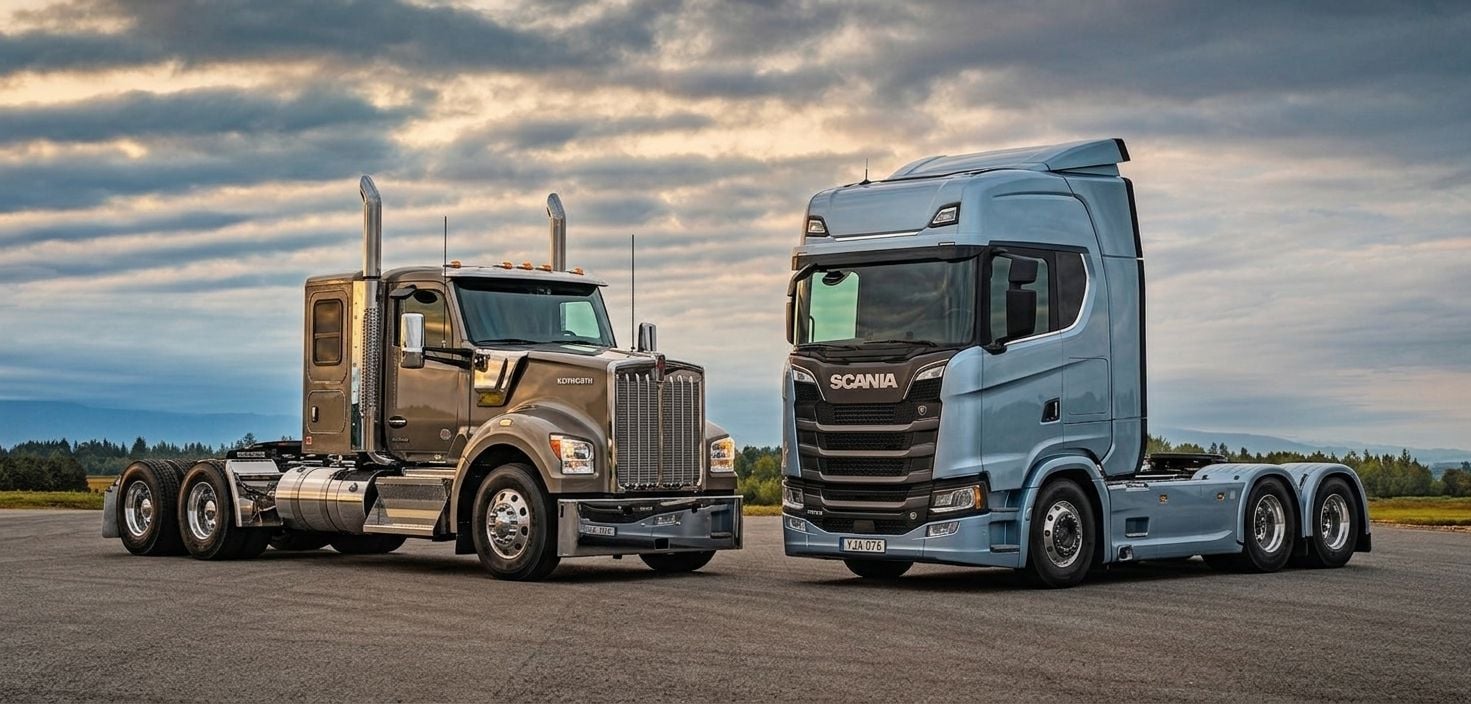
If we take the list of truck brands that operate today in the country with local factories, we notice the clear European dominance. Even the case of Volkswagen Caminhões e Ônibus — which has its own national trajectory — follows the European pattern. But how and when did this scenario consolidate?
When looking at the past, the American Ford, Chevrolet and International operated in Brazil. Even the Ford TT was the first truck to circulate in Brazil, in 1925. These three automakers were of great contribution to the socioeconomic development and implementation of trucks in Brazil.
Interestingly, in 1929, our automobile industry began to take its first steps. Engineer José Augusto Prestes designed and built a truck in Rio de Janeiro with a 100% national engine. The vehicle was the Bandeirante, considered the first Brazilian automobile — or, as it was called at the time, a self-truck.
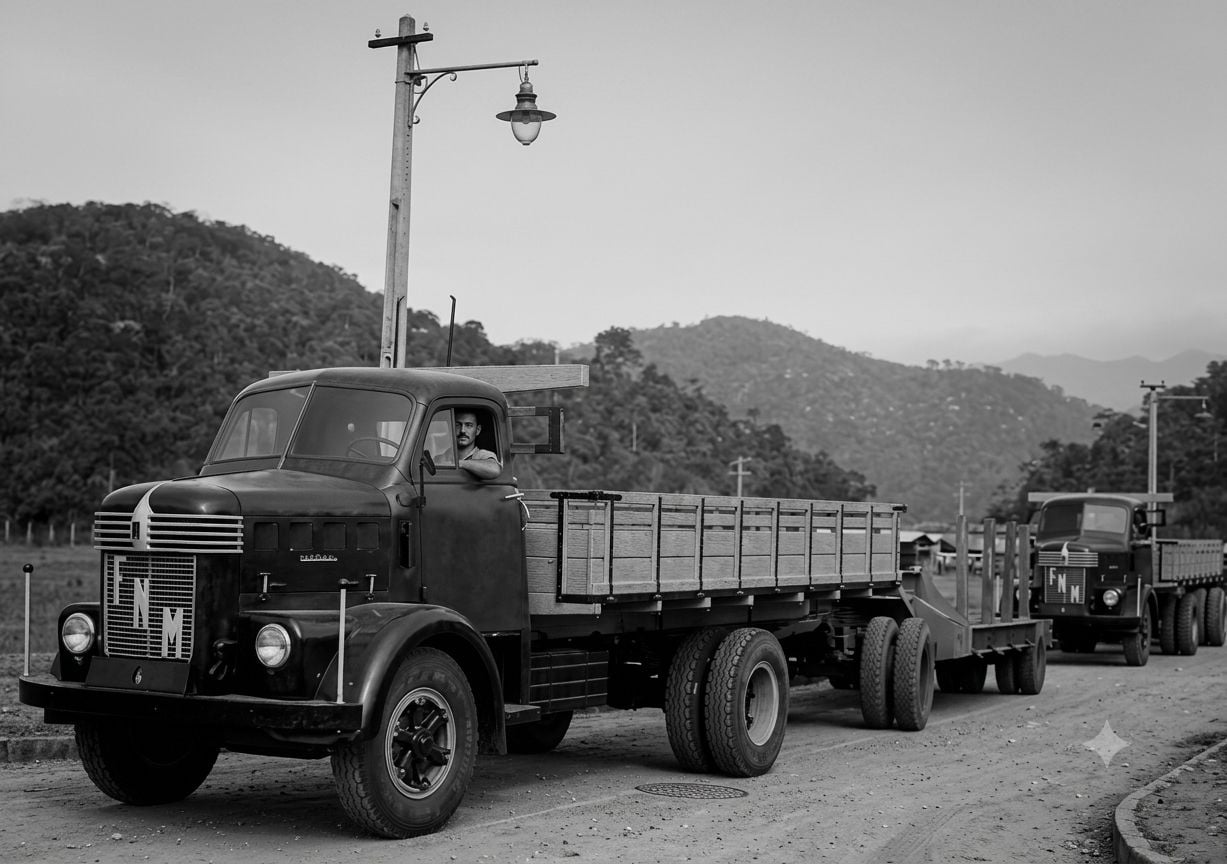
During the 1930s and 1940s, the Brazilian truck industry still did not have major prominence. This would change in the late 1940s, when the National Motor Factory (FNM) entered into a partnership with the Italian Isotta Fraschini. In this partnership, the FNM D-7300 was born, considered the first national truck.
The FNM D-7300 is considered the first national truck (Photo: FNM | Dissemination)
The great turning
point During the government of President Juscelino Kubitschek, the Plan of Goals was instituted. On July 16, 1956, Decree No. 39,412 was published, which established the guidelines for the creation of the Brazilian automobile industry and created the Executive Group of the Automobile Industry (GEIA).
In short, Kubitschek was leading Brazil towards a development model based on road transport. For this, it would be necessary to attract new automakers to the country.
In addition to the aforementioned decree, another important document was published in July 1956: Decree No. 39,568, which specifically created the National Plan for the Automobile Industry aimed at trucks.
This decree provided that manufacturers should nationalize the production of components by up to 60%. With this, the government hoped to attract more automakers not only through the CKD regime – in which vehicles are assembled in the country from imported components – but also to establish local production, create jobs and move the economy.
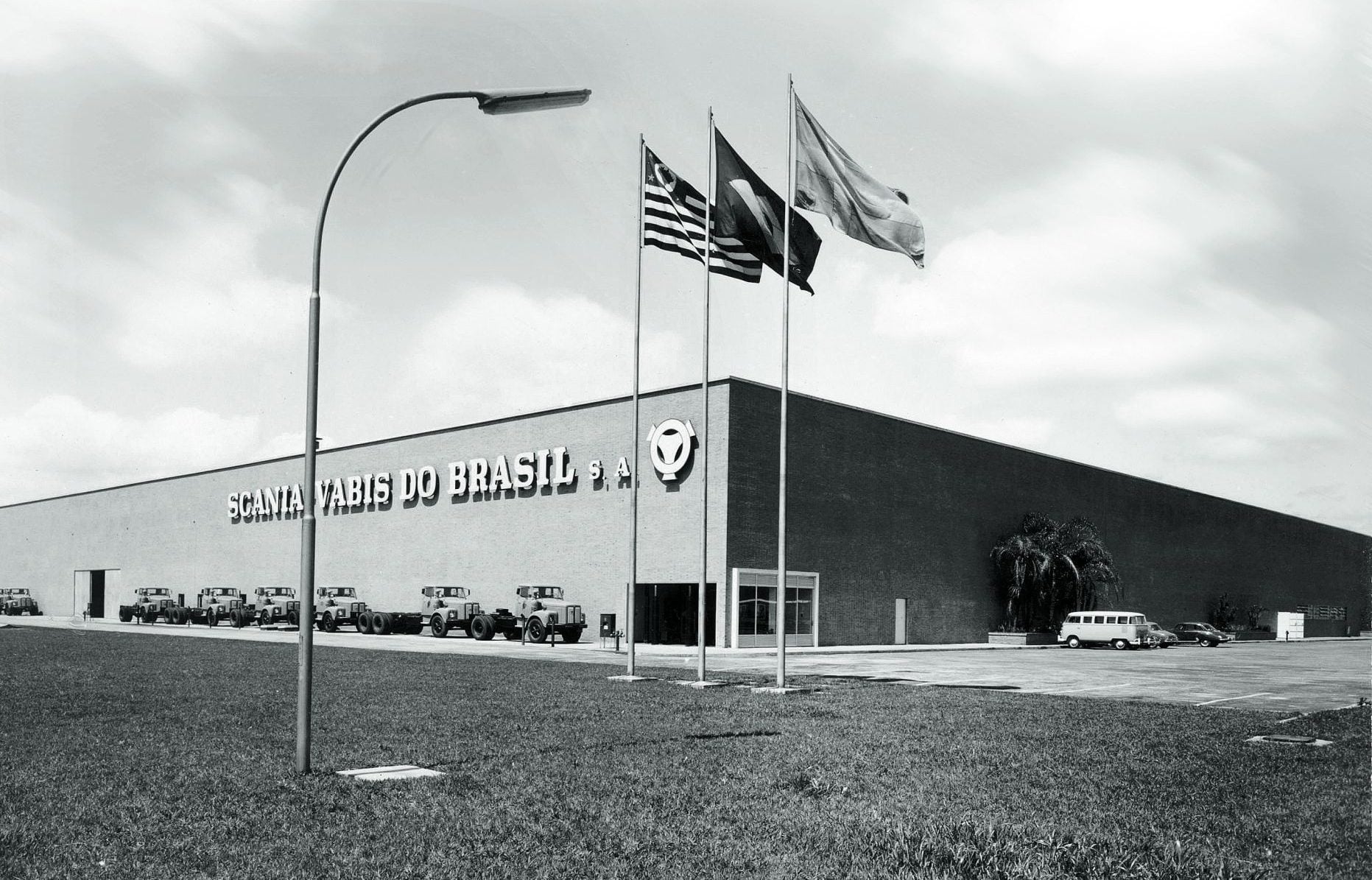
In 1962, Scania inaugurates its plant in São Bernardo do Campo in São Paulo (Photo: Scania | Disclosure)
The plan worked. Even before it, Mercedes-Benz and Scania — then called Scania-Vabis — were already starting their operations in Brazil. From that moment on, however, the scenario became even more favorable to the installation of factories and the national production of trucks.
Why were European automakers attracted?
To understand this preference for European trucks, we also need to look at the technological context available in each region.
In the United States, truck manufacturers still offered many models equipped with gasoline engines, although diesel options already existed. The first truck to leave the factory with a diesel engine was a Kenworth equipped with a Cummins engine, in 1933.
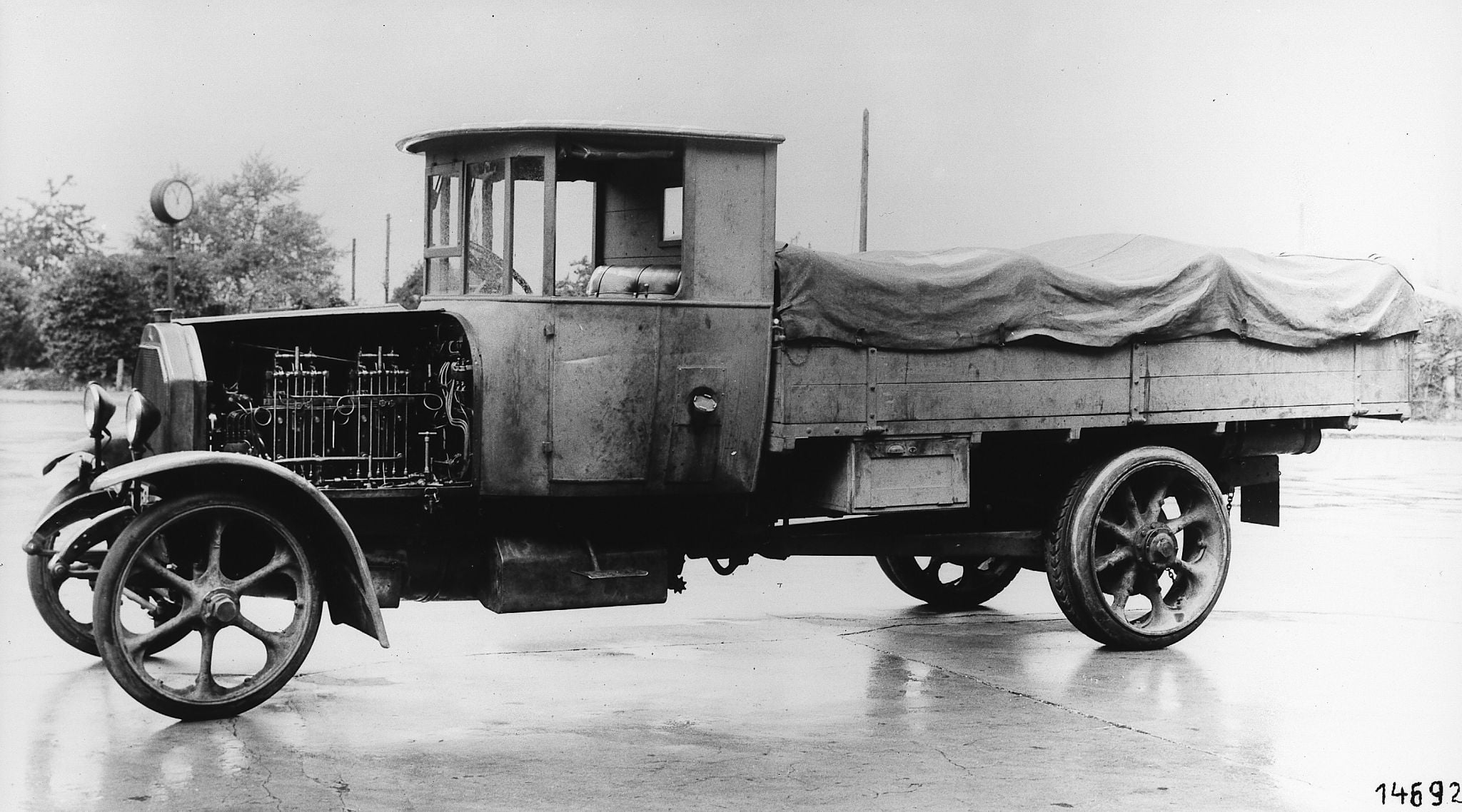
The world’s first diesel truck in production, a Benz Type 5k3 (Photo: Daimler | Disclosure)
In Europe, however, this technology had arrived earlier. In 1923, ten years earlier, Benz and Daimler presented the world’s first diesel truck.
The geography and road network of each region also shaped the vehicles. The well-planned American highways, with long straights, favored longer trucks with lower axle load density. In Europe, narrow roads and jagged relief required more compact trucks (advanced cab/”flat-faced”), with large concentrated load capacity — an architecture that fit perfectly into the Brazilian road infrastructure under construction.
With the decrees of the Kubitschek government, European automakers felt more comfortable to bet on a new expanding market, such as Brazil. Building a factory was never a simple or cheap decision, but nationalization policies and incentives for the automobile industry helped reduce the risks of this investment.
The Americans, in turn, kept the focus on their strong domestic market and on the light and medium segment, and looking at history, the American automakers were making investments in the Australian market, which has closer characteristics, although there, the weight combinations are much greater.
So, due to a series of factors, mainly political, socioeconomic and bet on European technology, as FNM did with the Italian Isotta Fraschini, Brazil became a home of European automakers and in a way, over the years, slowly, it was excluding the Americans, the last to come out being the American Ford, which left the market in February 2019, although its Cargo line was a European product that gained a survival with the joint venture between Ford and Iveco.
Comments are the sole responsibility of their authors and do not represent the opinion of this site. Comments containing profanity or offensive language will not be published. If you identify anything that violates the terms of use, please report it.