


Interlagos Festival got the dynamic format right
Interlagos Festival continued to grow, attracting record manufacturers and audiences, thanks to the formula that added experiences
By
Fernando Calmon
Published on 2026-09-05 at 05:00 PM
Published on 2026-09-05 at 05:00 PM
Be the first to comment.
Summarize with:
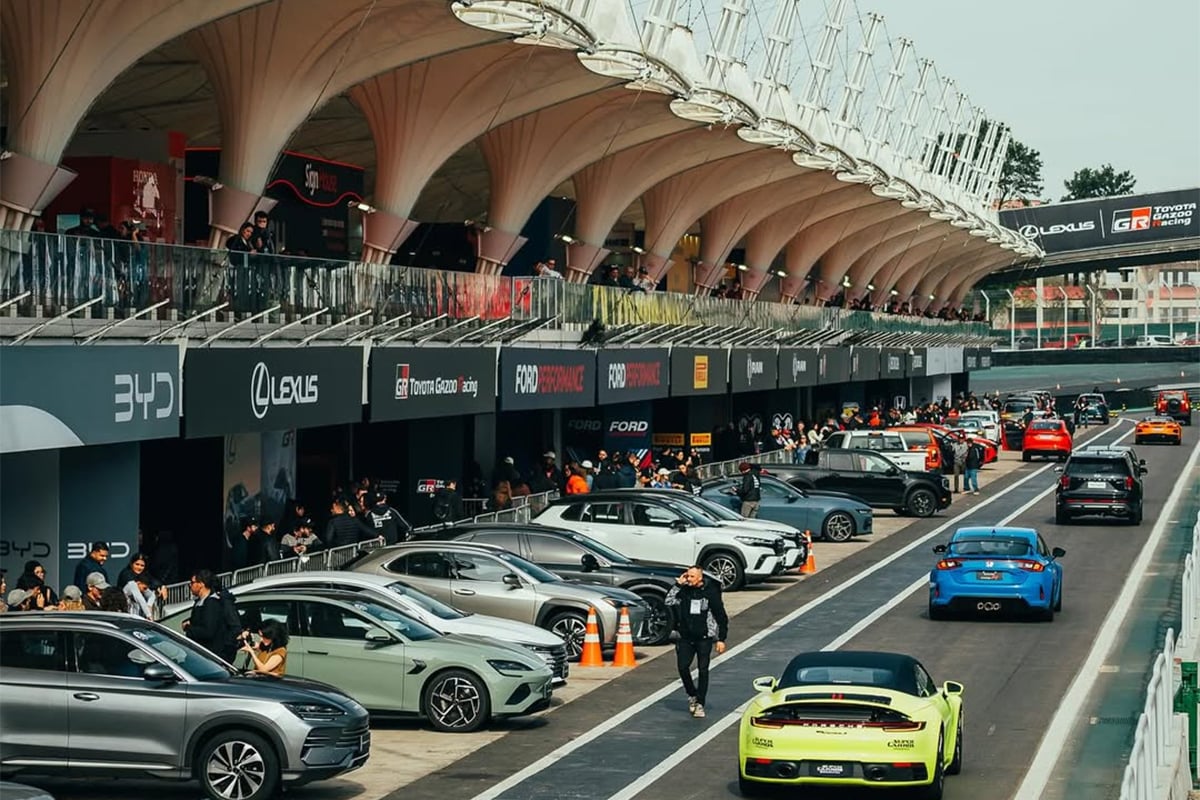
The final balance confirms the success of the initiative, which its organization classifies as the largest in the world dedicated to experimentation on racetracks. The infrastructure, in addition to the traditional VIP areas, this year included a convention center and a new 15,000 m² pavilion. 32 brands participated (including 14 Chinese) and were left out, among others, Audi, Caoa Chery, Chevrolet, Citroën, Nissan and Mercedes-Benz. VW set up a partnership with Mercado Libre in a separate booth, while Chery attended with other brands of the group (iCaur, Jetour and Omoda & Jaecoo).
SEE ALSO:
- China sells fewer vehicles domestically and accelerates exports
- Government measures have benefited few consumers, points out Fenabrave
- Bugatti is once again excited with the Destrier, a single example of 1,600 hp
Seguradora Suhai is the sponsor of the event. This year it attracted 215 thousand visitors in three days and 15.2 thousand tests (two to three laps on the track with an instructor). In total, 36 launches and presentations, including new models, versions, pre-launches and products shown for the first time to the Brazilian consumer. BMW showed the iX3, a compact SUV with two electric motors, 469 hp and 65.8 kgf·m combined, which arrives at dealerships on the 24th. Ford confirmed the F150 Raptor large pickup with 450 hp and 70 kgf·m in the first quarter of 2027. Among the newcomers from China was Dongfeng, but it will act here as DFM, intends to launch 10 models by 2028 and there is a local production plan.
GAC highlighted the GS9, a large SUV, plug-in hybrid, 500 hp and 62,5 kgf·m for R$ 399.990. IM Motors is MG’s luxury brand with the IM6, large coupe SUV, electric, 767 hp, 81,7 kgf·m (accelerates from 0 to 100 km/h in 3.5 s). Another large SUV, seven-seat, plug-in hybrid Jaecco 8 delivers combined power of 605 hp, 66 kgf·m and an estimated price in the range of R$ 300.000. Baic has the Arcfox T1 electric on pre-sale for next month for an estimated R$ 150.000 and the T5 for 2027. Another Chinese electric, Omoda E5, will have an entry-level version priced around R$ 150 thousand. BYD
Geely with national production of the EX5 EM-i, now in September at Renault’s Paraná plant, exhibited customized EX2 Street and Track units. Kwid 2027 was presented with a redesigned grille and bumper, in addition to promotional prices. Abarth, from the Stellantis Group, showed the Pulse Scorpioníssima, still as a market study. BYD showed the Mako, a prototype of the intermediate pickup with an urban proposal and flex plug-in hybrid engine, to be produced in Camaçari (BA), in the price range of Toro, Rampage, Maverick and future Niagara and Tukan.
AI is very good, but few agree to pay
The interest of the Brazilian consumer in artificial intelligence (AI) when choosing a car is already a reality. But trust in technology is very narrow, in the case of total control of the vehicle. This is what the Webmotors Autoinsights survey reveals, carried out with 1.6 thousand users of the platform. According to the survey, 51% of respondents show interest in vehicles with AI features (22%, very interested and 29%, interested). If asked about driving 100% autonomously – without any human intervention – acceptance plummets: 12% say they fully trust.
The data confirms that AI is seen fundamentally as a driving assistant, and not a substitute for the driver. While 60% would accept the help of technology in navigation tasks and internal adjustments, 37% approve of acting in active safety systems (autonomous emergency braking and collision alerts), full automatic driving falls into the background.
In the list of most desired features, the priority was as follows: collision/safety alerts, 45%; preventive mechanical diagnosis, 44%; intelligent routes, 34%; fully autonomous driving, only 10%. On the other hand, the assimilation of the concept is already advanced: 54% say they understand well or already use AI tools, 30% know the subject and only 8% say they ignore the term.
Despite high theoretical acceptance, the willingness to pay for it is still an obstacle. No less than 57% of respondents say they would not pay any additional amount to have AI in the car. Among those willing to pay, 20% would accept a ceiling of up to 5% on the price of the vehicle.
For Eduardo Jurcevic, CEO of Webmotors, AI is no longer a futuristic resource to become an expectation of a standard item. “The consumer values this technology in terms of safety, practicality and mechanical predictability, but perceives it as an attribute inherent to the evolution of the automobile – and not as an optional charged separately”, he concluded.

SEE MORE ABOUT

0 Comments
Comments are the sole responsibility of their authors and do not represent the opinion of this site. Comments containing profanity or offensive language will not be published. If you identify anything that violates the terms of use, please report it.