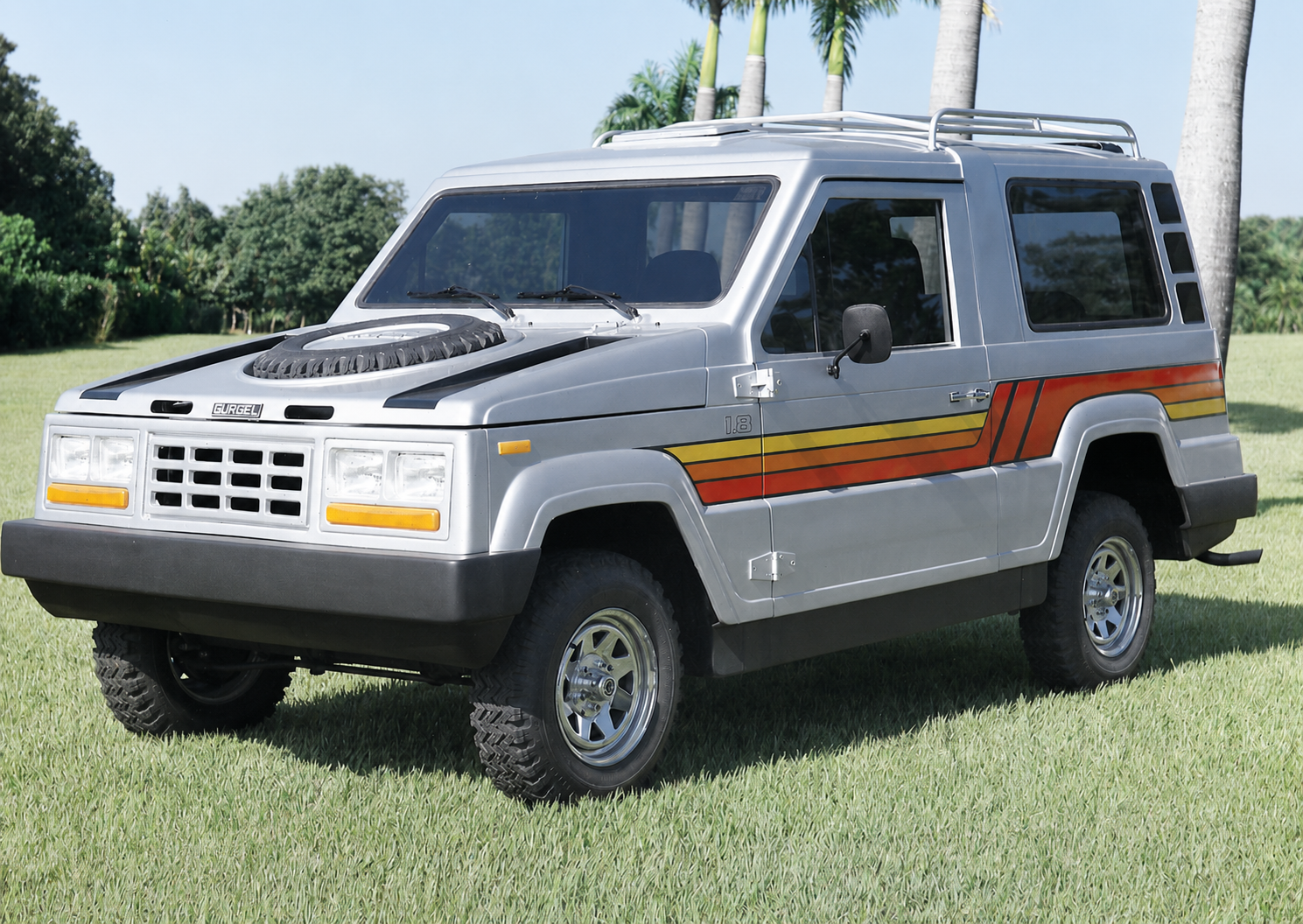
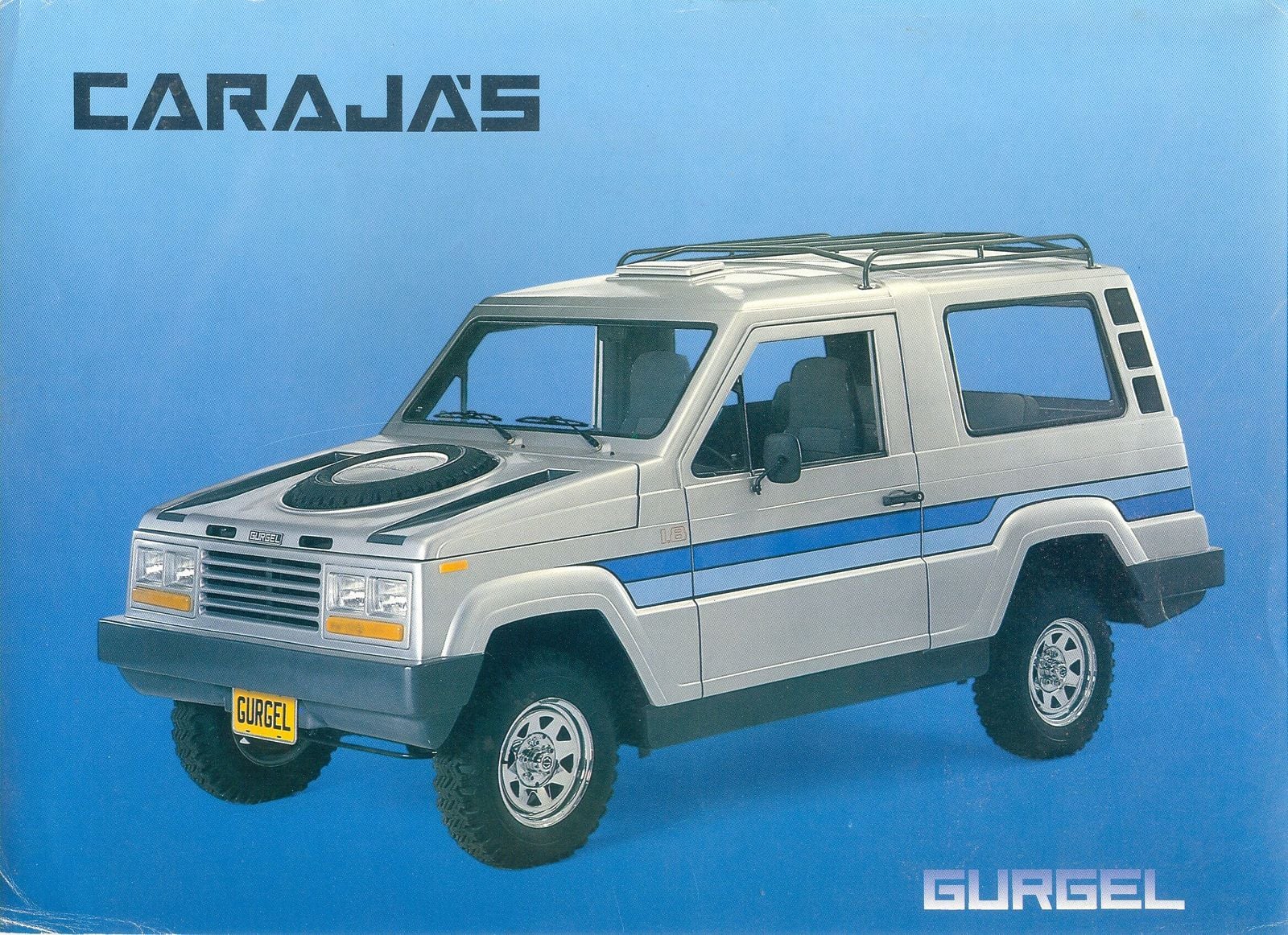
When the Gurgel Carajás was launched in 1984, the Brazilian manufacturer had in mind a vehicle capable of meeting the needs of those who needed a robust and reliable car to face dirt roads, farms, farms and regions far from large urban centers. The idea was to offer something more suitable for this scenario than models like Monza and Santana, which dominated the national market at the time.
The Carajás was a kind of “jeep”, with a fiberglass body reinforced at strategic points by an internal steel structure. At least in theory, this set should work as a reinforced chassis, reducing the risk of cracks in the body and increasing the vehicle’s resistance. In practice, however, things did not work so well.
Despite the proposal of robustness, the metal structure that served as the basis of the vehicle was excessively simple. As a result, the body had a torsion far above the ideal for a car intended to constantly travel over uneven terrain. In this respect, the Carajás proved to be quite rudimentary for a vehicle that intended to convey resistance and durability.
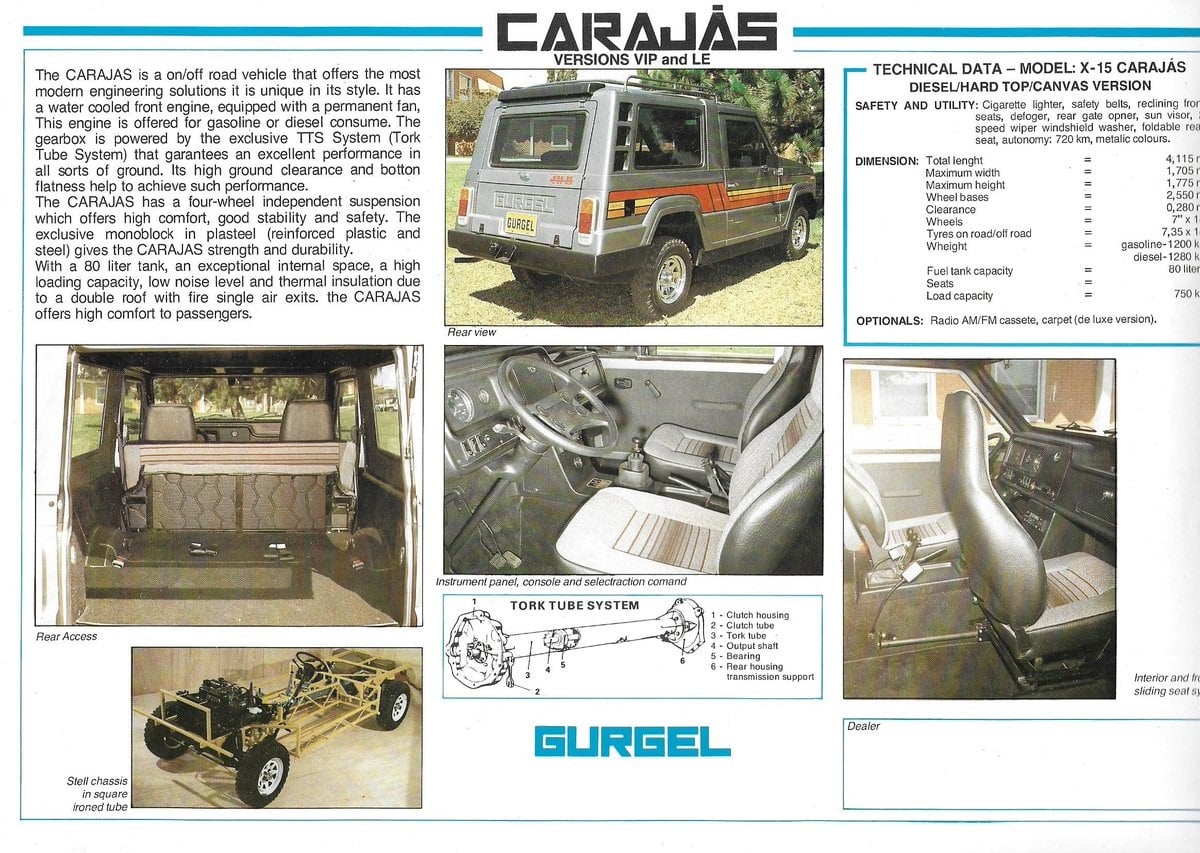
The brochure in English pointed out the “innovations” of the carajás, such as the rudimentary transmission shaft that doubled as a cardan
But the problems were not limited to the structure. The mechanical design also brought very questionable solutions. The model used engines from the Volkswagen AP family, with the 1.8 intended for the entry-level versions and the 2.0 reserved for the most sophisticated configurations. Both still equipped with a carburetor, something common in the 1980s.
Possibile with a fancy name
The problem arose when Gurgel’s engineers decided that the Carajás should have rear-wheel drive. As AP engines were used in front-wheel drive vehicles, such as Santana and Quantum, the solution found was to adapt a very unusual set.
The engine remained at the front, while the Kombi gearbox was installed at the rear. To unite the two sets, Gurgel created a long transmission shaft responsible for taking the torque from the engine to the gearbox.
At first glance, the idea seemed interesting. From an engineering point of view, however, it was far from an ideal solution.
As the structure of the vehicle had little torsional rigidity, the long axle suffered constant misalignments caused by the deformations of the body itself. The result was the appearance of vibrations, noise, and premature wear of bushings, bearings, and support components. And the problems did not end there.
Named by the manufacturer “Torque Tube”, this shaft rotated practically at the same speed as the engine, since it was connected directly to the clutch assembly. This created a huge moving mass. With each gear change, it was up to the gearbox synchronizer rings to absorb and reduce all this inertia. In practice, this severely overloaded the synchronization system.
The fiber body twisted too much on uneven terrain, forcing the engine-transmission assembly
Owners who knew this limitation adopted a very specific driving, performing slow gear changes and waiting for the natural drop in engine speed before completing the engagement. In this way, they reduced the effort imposed on the exchange rate.
The problem is that the vast majority of drivers drove the Carajás in the same way as any other car, making quick changes right after activating the clutch. The result was accelerated wear of the synchronizers and a significant reduction in transmission life. It was a design deficiency that accompanied the model throughout its trajectory.
Gurgel Carajás was not cheap
Produced between 1984 and 1991, the Carajás cost between US$ 15 thousand and US$ 20 thousand, depending on the version and engine. During its seven years of manufacture, approximately 3 thousand units were sold, a very modest volume.
Between 1988 and 1991, Gurgel also started to offer a version equipped with the 1.6 diesel engine of the Kombi. If the intention was to expand the appeal of the model, the result was just the opposite.
With only 50 hp of power, the small engine had enormous difficulty moving the approximately 1,300 kilos of the empty vehicle. When loaded, the total weight was close to two tons. Under these conditions, performance became extremely limited.
On flat stretches, the diesel Carajás was already showing difficulty in gaining speed. On climbs, the situation became even more complicated.
As a whole, the Gurgel Carajás ended up being a vehicle marked by questionable technical choices, from the structural design to the solutions adopted for transmission. Perhaps that’s why the market never embraced the project in the way the manufacturer expected.
In 1991, just when the model stopped being produced, Brazil began to open up to car imports. Suddenly, consumers had access to a huge variety of foreign vehicles, many of them more modern, refined and reliable. Faced with this new scenario, the space for such a controversial product has become even smaller.
The Carajás did not achieve the desired success, but it remains one of the most curious stories in the Brazilian automobile industry, an example of how good intentions do not always result in good cars.
Comments are the sole responsibility of their authors and do not represent the opinion of this site. Comments containing profanity or offensive language will not be published. If you identify anything that violates the terms of use, please report it.