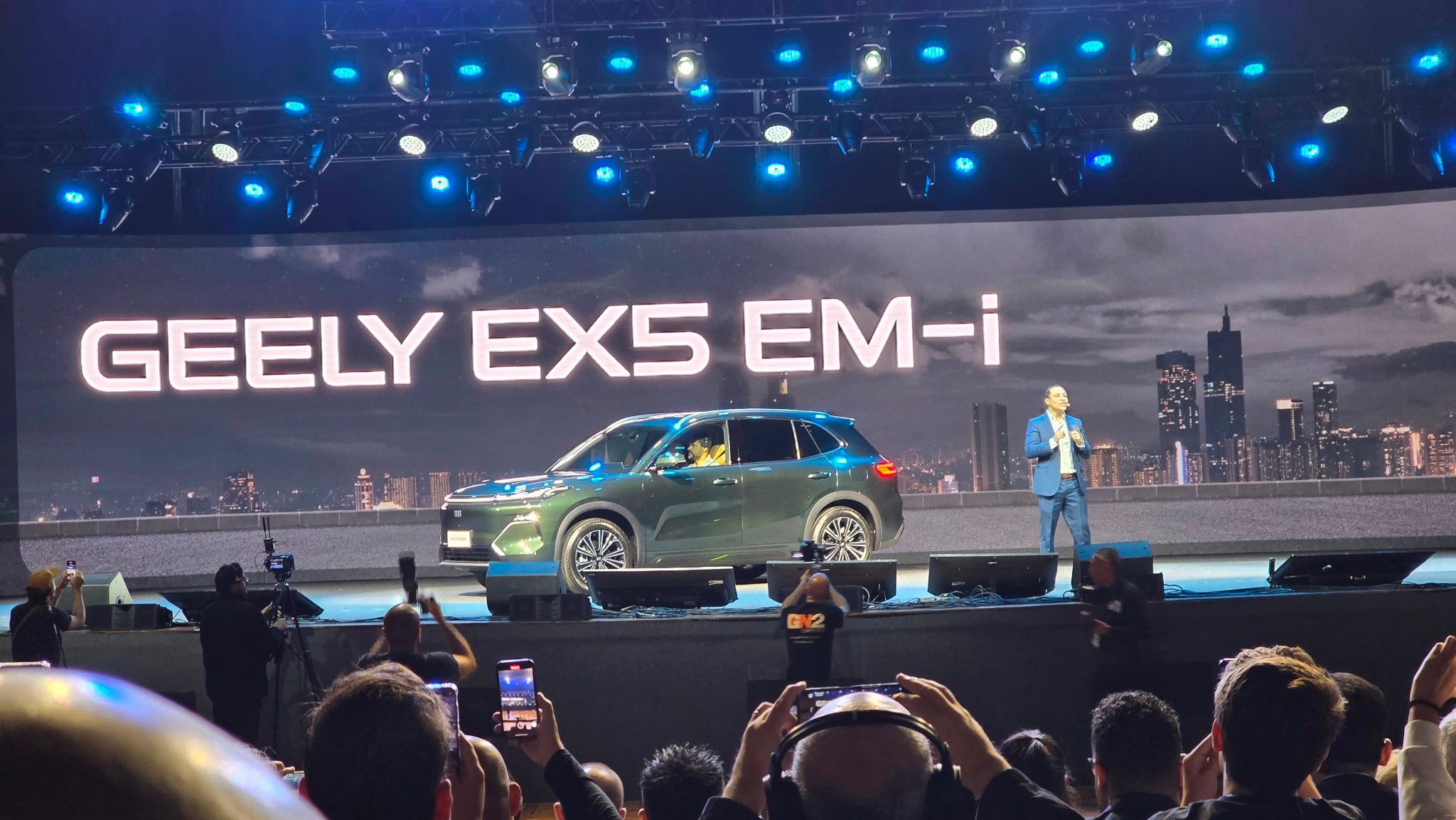
Less than a year after Renault Geely do Brasil (RGdB) announced the change of corporate name and the additional investment of R$ 2 billion by the Chinese brand at the plant in São José dos Pinhais (PR), the first product — Geely EX5 EM-i plug-in hybrid — has just rolled off the assembly line. The Franco-Chinese partnership is moving forward as quickly as the total of R$ 5.8 billion will allow by 2027. Commercialization of the plug-in hybrid will begin in November. Start of national production of the EX2 electric will be next December and sales up to two months later.
Both models, during the current import period, exceeded forecasts. Francois Provost, global president of the Renault Group, came to Brazil and affirmed his confidence in the executive team that met all the planned objectives. Fabrice Cambolive, former president of the Brazilian subsidiary from 2015 to 2017 and now global vice president of Sales and Operations of the Renault brand, confirmed four models, two from the French brand and two from the Chinese brand, produced here by the end of 2027.
Geely has maintained a 26.4% equity stake in RGbD, an operation led by Argentine Ariel Montenegro since 2025. The E-Tech 4×4 hybrid technology will be flex and will be on Boreal and Niagara also in 2027. Montenegro added that pure electric vehicles will take a larger share in the main world markets.
However, there are still setbacks, as is now happening in the sale of electric vehicles in the US, Canada and, discreetly, even in China with the cut in incentives. I asked him if, when the war in the Middle East ends and in the event that oil falls substantially in price with the normalization of production and as electric vehicles advance, he could not postpone the future pace of electrification. Montenegro replied that this is unlikely to happen.
In an interview with the Autoesporte website, Combolive predicted that 50% of Renault’s cars will be hybrid or electric in Brazil by 2030.
Stellantis’ numbers in vehicle
disassembly This is a unique initiative that should encourage other manufacturers in the same direction. In Brazil, writing off documentation for an end-of-life vehicle is extremely bureaucratic and vehicles end up abandoned or sold as raw scrap.
The French-Italian-American conglomerate completed one year of operation of its Vehicle Disassembly Center (CDV) in Osasco (SP). It consists of a pioneering structure of a manufacturer in South America, aimed at legal and traceable disassembly. The initiative validates in practice the business model based on the concepts of circular economy for end-of-life vehicles.
In the first year, the CDV dismantled 1,150 automobiles from insurance companies or auctions and allowed the recovery of more than 20 thousand components. Of these, 11 thousand have already been sold in the aftermarket. It shows a growing demand for reused parts of audited origin. There was an environmentally appropriate destination of 862 tons of materials and almost 14 thousand liters of fluids.
The reuse of components can reduce the consumption of raw materials by up to 80% and CO₂ emissions by up to 50% compared to the equivalent production of new parts. Stellantis’ strategy operates under the pillars of Remanufacturing, Repair, Reuse and Recycling. There is also the Vehicle Reconditioning Center (CRV) in Betim (MG) that recovered more than 500 vehicles in three years.
With an installed capacity of up to 8 thousand disassemblies/year, the Osasco CDV has now reached the scale phase. The next steps focus on expanding the portfolio of certified components, expanding after-sales distribution channels and consolidating reverse logistics in the region.
The company has two more CDVs abroad: Italy and Morocco. The fourth will be in France.
Niagara: Renault advance in the pickup segment
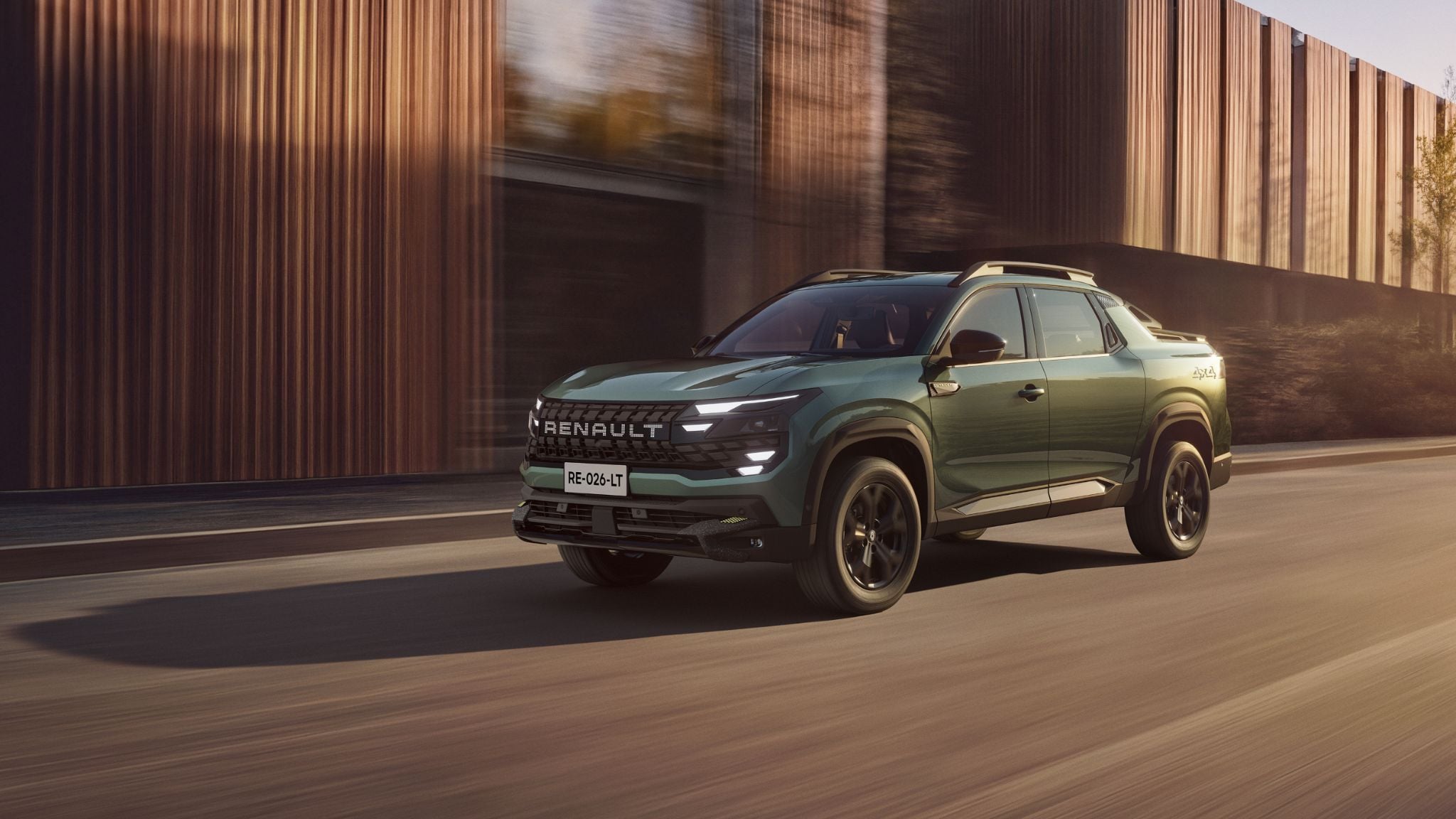
Renault Niagara arrives to compete in the segment dominated by Toro and the future BYD Mako (Photo: Renault | Disclosure)
Scheduled to debut next November, the Niagara intermediate double-cab pickup was presented last week in Córdoba, Argentina, from where it will come to Brazil. The successor to the Oroch is mainly aimed at Toro (but also Maverick, Rampage and now Mako). It uses the same structure as the Boreal medium SUV, with the same hood and front bumper, manufactured in São José dos Pinhais (PR). The front draws attention to the vertical grille and Renault inscription in small chrome pixels. High waistline, full-bodied wheel arches and door handles on the rear column follow the standards of the most current pickup trucks derived from SUVs. It will have 4×2 and 4×4 versions.
Internally, there is 200 mm of knee room in the rear seat (reference in the category) which has a 25° reclining backrest and a hidden 36-liter compartment behind it. The dashboard integrates a 10.2-inch digital instrument panel, a 10.1-inch multimedia center. with Google Built-In and a 360° camera system. New is the Google Gemini generative and multimodal AI assistant. There are 26 advanced driver assistance systems (Adas).
The Niagara measures 4.94 m in length (4.91 m in the 4×2 versions), 2.96 m in wheelbase, 1.72 m in height and 1.83 m in width. 17 or 18 in. 938-liter bucket has a rigid retractable cover, 12 V outlet and electrically opening tailgate. Payload of 654 kg (including five occupants) and towing capacity 710 kg (the largest among the intermediate versions). Clearance of 223 mm (233 mm in the 4×4 versions), entry angle, 22.1° and exit angle, 22.3°. Multi-link independent rear suspension received specific adjustment for the conditions of use in South America. Ventilated disc brakes on all four wheels.
1.3 Turbo TCe flex engine delivers 156 hp (gasoline) or 160 hp (ethanol) and torque of 27.5 kgf·m. Six-speed manual or automated dual-clutch transmission in an oil bath and electronic selector. On-demand all-wheel drive system offers six driving modes via selector on the console.
Renault is not expected to make all four versions of the Niagara available in November, but over the following months. The hybrid with an electric motor on the rear axle will arrive only in the second half of 2027.
Comments are the sole responsibility of their authors and do not represent the opinion of this site. Comments containing profanity or offensive language will not be published. If you identify anything that violates the terms of use, please report it.