Although last August presented good results – daily average sales of 13.1 thousand units was the second best of the year, behind only May, with 13.7 thousand/day – Igor Calvet, president of Anfavea, highlighted the advance of imported vehicles and the loss of share of domestic vehicles.
He pointed out that in the first eight months of this year sales showed a good growth of 18.4%, but production grew only 8.5%. “We are not capturing all the growth of the market,” he added.
From January to August this year, the sale of imported models of automobiles and light commercial vehicles advanced 30.3%, while those of domestic production only 17.2%. Calvet informed that of the 148 thousand additional vehicles, only 47 thousand were actually produced in Brazil.
of 93 Of the remaining 101 thousand, the vast majority from China ready, partially (SKD) or fully disassembled (CKD) and therefore did not add important local content.
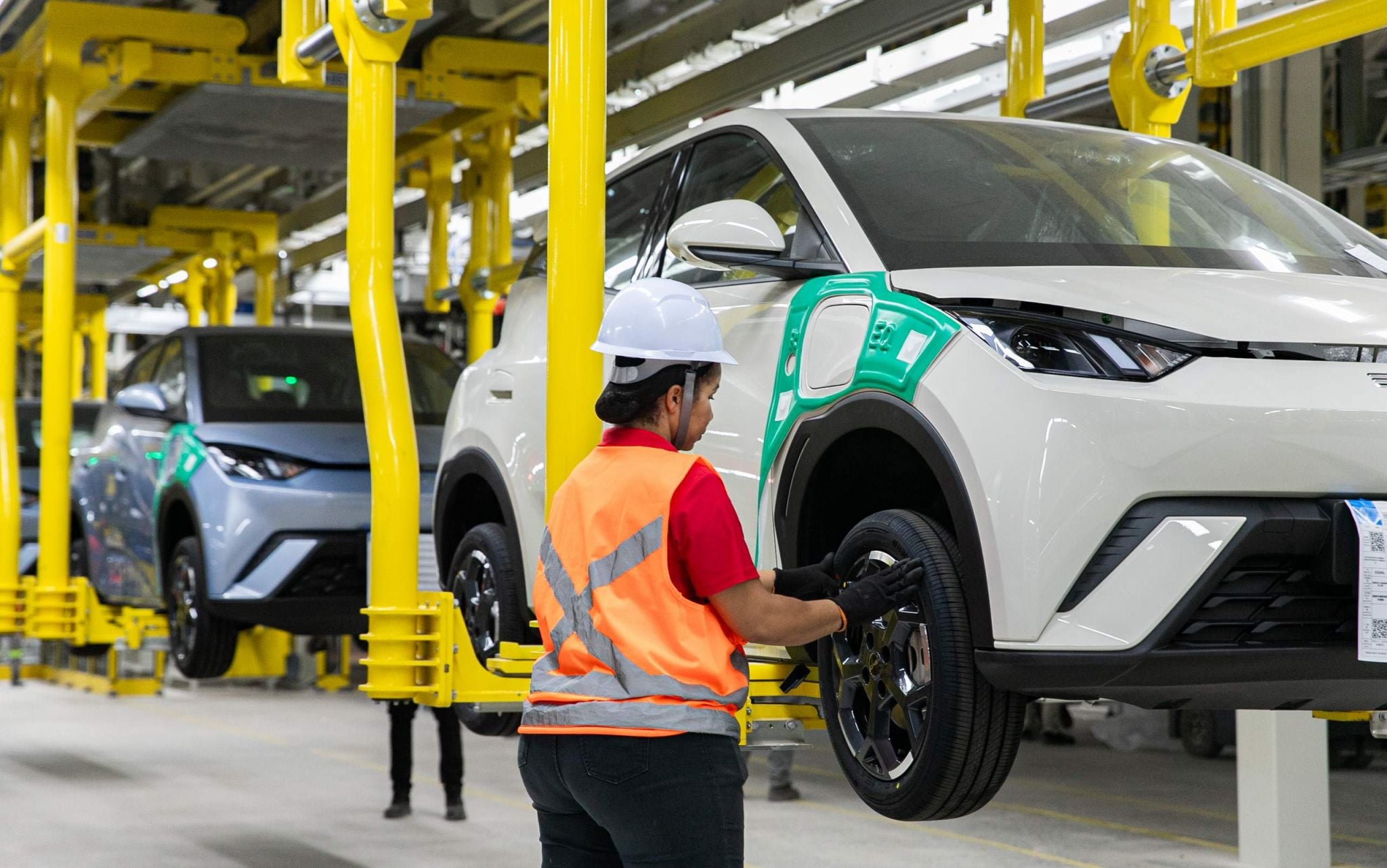
BYD assembly line in Camaçari (BA): cars arrive semi-ready in SKD kits (Photo: BYD | Disclosure)
Among the 10 best-selling models last month, three were already Chinese, one imported and the other two with symbolic indexes of Brazilian parts such as tires and glass. The executive did not make projections on how far Chinese models will be able to advance.
‘Full’ tax in 2027
A relevant point is that, as of next January, all imported electric vehicles, even CKD and SKD, will be subject to the 35% import tax (I.I.) established since the 1990s. However, there is still a high stock of BYD electric models that arrived exempt from I.I.
Abroad, tax incentives have a fixed value in the local currency and much lower than in Brazil. In addition, Chinese exports to Argentina also moved Brazilian vehicles in the neighboring country.
Even with the important advance of electric and hybrid cars in the national market of automobiles and light commercial vehicles (together 94%, leaving 1% for buses and 5% for trucks), their share remains very low in sales from January to August.
Despite high growth percentages misleading by mathematical “whim” that lead to “celebrations”, check out the overview:
Comments are the sole responsibility of their authors and do not represent the opinion of this site. Comments containing profanity or offensive language will not be published. If you identify anything that violates the terms of use, please report it.