

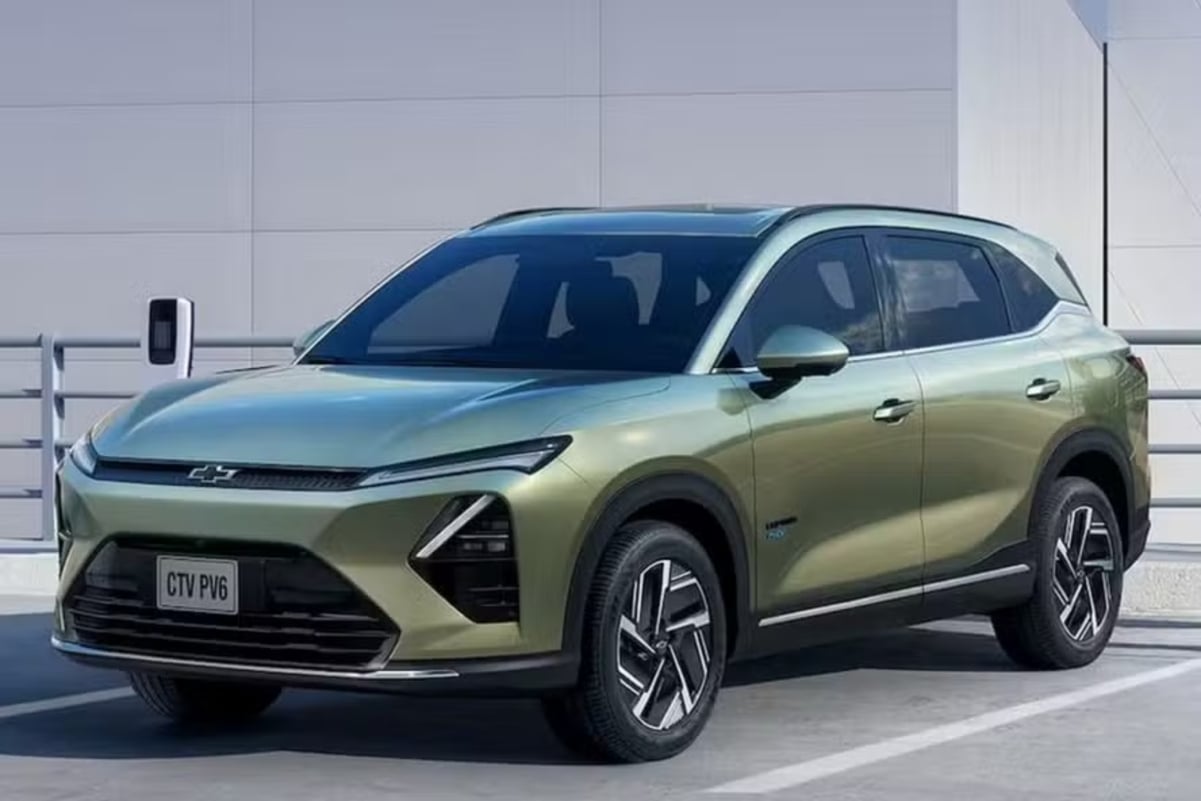
Captiva PHEV will be Chevrolet’s first plug-in hybrid produced in Brazil in 2026
Derived from the Chinese Wuling Starlight S, the electrified SUV will be assembled at the Ceará Automotive Plant (PACE), Troller's former factory, under the SKD regime
By
Julia Vargas
Published on 2026-08-26 at 10:30 AM
Published on 2026-08-26 at 10:30 AM
Be the first to comment.
Summarize with:
General Motors announced on Wednesday (26) the production of the Chevrolet Captiva PHEV, still in 2026, at the Ceará Automotive Plant (PACE). The model will be the brand’s first plug-in hybrid vehicle assembled in the national territory and aims at direct competition with GWM Haval H6 and BYD Song Plus.
The Captiva with Chevrolet’s unprecedented engine in Brazil establishes itself as the brand’s third electrified SUV to go into production at the Ceará Plant in less than a year.
SEE ALSO:
- Engine oil additive is a trap
- In addition to Captiva and Spark EUV, former Troller factory will make another Chinese
- GM invests another R$ 3.5 billion in Brazil to face the Chinese with national hybrids
car
Captiva PHEV arrives to go head-to-head with Chinese competition
With the launch of the Captiva PHEV, General Motors is preparing a direct response to the leadership of Chinese brands in the midsize SUV segment. The central objective of the plug-in hybrid variant is to lower production costs and offer a competitive final price compared to consolidated rivals such as the GWM Haval H6 and the BYD Song Plus, as well as GAC GS4 and Toyota Corolla Cross.
Spotted in tests in the interior of the state of São Paulo by the specialized portals AutoPapo and Autos Segredos, the new Chevrolet Captiva is a tropicalized version of the Wuling Starlight S. The model derives from the international joint venture between General Motors and China’s SAIC, a partnership also responsible for the production of the compact Spark EUV.
Mechanical set and electric autonomy
The Chevrolet Captiva PHEV’s powertrain was designed with a focus on balancing energy efficiency and dynamic performance. The set combines an electric powertrain and a 1.5-liter aspirated gasoline combustion engine with 106 hp of power and 13,2 kgfm of torque. The combined power is 204 hp
The SUV will be offered with two traction battery options:
- 9.5 kWh battery: Estimated range of up to 60 km in 100% electric mode.
- 20.5 kWh battery: Extended range to up to 130 km in purely electric mode.
Considering Chinese standards, the combined range is 1,100 km.
Dimensions, design and on-board
technologyAlthough the official dimensions have not yet been revealed, the Captiva PHEV should arrive with the same generous proportions as the Wuling Starlight S with 4.75 meters in length; 1.89 m in width; 1.69 m in height and 2.80 m in wheelbase, ensuring ample interior space for occupants and a trunk with a capacity of 610 liters.
Aesthetically, the cabin follows the minimalist proposal of the Chinese Starlight S, with the inclusion of the golden Chevrolet tie logo in the center of the steering wheel. The on-board technology architecture includes:
- Instrument panel: 8.8-inch tablet-style digital display.
- Multimedia Center: 15.6-inch floating screen with voice command support and Over-The-Air (OTA) remote updates.
- Safety: Complete Advanced Driver Assistance (ADAS) package.
Ceará Automotive Plant (PACE) was once a Troller factory, but today it is an SKD
Assembly HubThe assembly line responsible for the new Captiva PHEV has a unique industrial trajectory in Brazil. Operating under the SKD (Semi-Knocked Down) concept, in which vehicles are assembled from imported sets of parts, PACE is characterized by the contract manufacturing model: a factory that does not produce components locally, acting exclusively in the final assembly of automobiles.
The complex was founded in 1995 and soon became the assembly site for Troller’s jeeps. In 2007, the structure was sold to Ford, which, in order to guarantee the state tax incentives required by the government of Ceará, kept the assembly of the Troller active until 2021, the year in which it closed all its industrial operations in the country.
After three years of inactivity, the plant was acquired and modernized by the Comexport group, from Espírito Santo, being transformed into a multi-brand industrial platform under contract. With the current operation, General Motors was PACE’s first-time customer, importing components to assemble the Spark EUV, followed by the Captiva EV and Captiva PHEV. Subsequently, the Chinese MG Motors (a subsidiary of the SAIC group) also signed a contract with PACE to assemble the MG4 hatch and the S5 SUV.
SEE MORE ABOUT

0 Comments
Comments are the sole responsibility of their authors and do not represent the opinion of this site. Comments containing profanity or offensive language will not be published. If you identify anything that violates the terms of use, please report it.