Brazilian Gravel Championship marks a new phase of national cycling and the country enters the route of the sport
With the victory of Henrique Avancini and Flávia Oliveira in the Elite category, the competition held in MG makes Gravel official on the national calendar
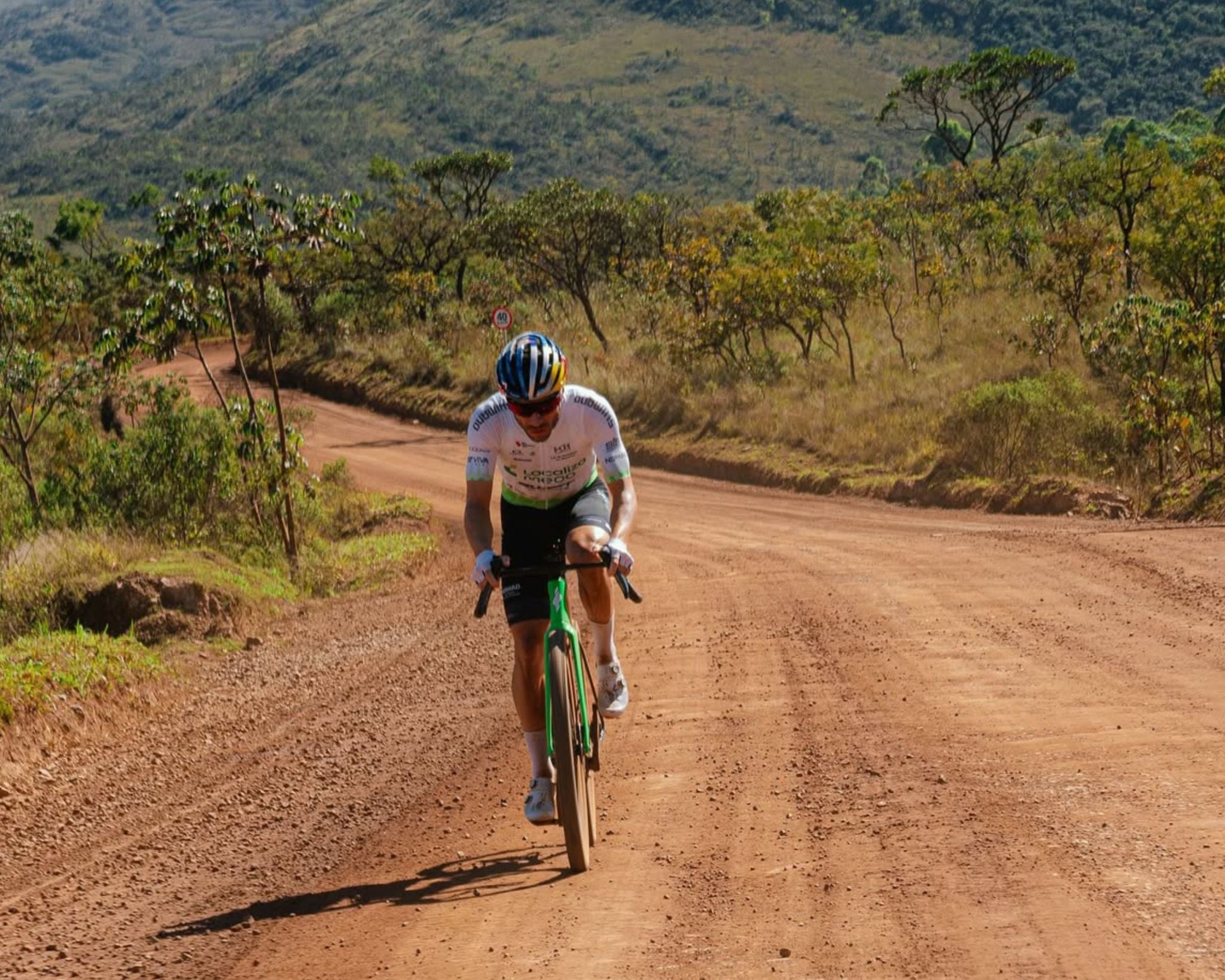
The sport is growing worldwide (Photo: Gabriel Moraes | Disclosure)
Few sports have grown as much in cycling in recent years as Gravel. Born almost spontaneously in the United States, mixing the speed of road bikes with the freedom of dirt roads, the sport quickly ceased to be a trend to become one of the great bets of the industry and international sports entities.
On the first Sunday of July (the 5th), Rio Acima (MG) hosted the first Brazilian Gravel Championship, organized by the Brazilian Cycling Confederation (CBC) in partnership with Avelar Sports. The race definitely went down in history by crowning the first national champions of the sport: Henrique Avancini, in the men’s Elite, and Flávia Oliveira, in the Women’s Elite.
More than defining winners, the event represents the consolidation of Gravel within the Brazilian sports calendar and brings the country closer to a sport that is growing rapidly in different parts of the world.
Far beyond a new category
For those who don’t know Gravel yet, the modality may seem like just a mix between mountain biking and road cycling. But it has its own characteristics.
Gravel bikes visually resemble a road bike, but have wider tires, more comfortable geometry and the ability to face different types of terrain. The races usually combine stretches of asphalt, dirt roads, gravel and rural paths, requiring resistance, technique and adaptability.
This versatility may explain its growth.
Unlike extremely specific modalities, Gravel speaks to different profiles of cyclists. It attracts those who come from mountain biking, those who practice road cycling, and also many beginners who are looking for a bike capable of traveling on different surfaces without giving up efficiency. In recent years, this growth has made the modality stop being just a market segment to gain sports recognition.
The International Cycling Union (UCI) created, in 2022, the Gravel World Championship, in addition to an international qualifying circuit, the UCI Gravel World Series, held in several countries. The Brazilian Championship held now follows exactly this international movement.
A route that represents the essence of Gravel
The city of Rio Acima, Minas Gerais, was chosen to host the first edition of the Brazilian Championship, not by chance.
Located in a region known for the rural roads and mountains of Minas Gerais, it offers the type of terrain considered ideal for the modality.
The Elite course had approximately 95 kilometers, bringing together long stretches of dirt, gravel, side roads and paved sectors, in addition to an accumulated close to 3,000 meters of altimetry, making the race very physically demanding.
This type of route synthesizes exactly the philosophy of Gravel: to travel great distances along little-explored paths, favoring natural landscapes and varied terrain.
Henrique Avancini expands a historical curriculum
Photo: @paisdociclismo | Disclosure
Among the men, Henrique Avancini confirmed the favoritism. The cyclist completed the course in 3h36min40s, winning the first Brazilian Gravel title in history. Sherman Trezza finished in second place, while André Gohr completed the podium.
The victory comes at a special moment in Avancini’s career. After building the most victorious trajectory in the history of Brazilian mountain biking, with world titles, victories in World Cup stages and leadership of the UCI international ranking, the athlete is going through a transition phase for road and gravel competitions. In recent months, its results show that this change happens quite consistently.
In addition to winning the Brazilian stage of the UCI Gravel World Series, a result that guaranteed qualification for the World Championship of the modality in Australia, Avancini recently won the Brazilian Time Trial Championship and won the traditional Tour of the Gila, in the United States.
The title won in Rio Acima further expands a curriculum that continues to grow even after his farewell to professional mountain biking.
Flávia Oliveira also goes down in history
Photo: @paisdociclismo | Disclosure
In the Women’s Elite, the first Brazilian Gravel champion is another well-known name in national cycling. Flávia Oliveira completed the course in 4h34min18s, surpassing Isabella Lacerda and Ana Laura Moraes, who took silver and bronze, respectively. Flávia has one of the most consistent careers in the history of Brazilian women’s cycling.
He represented Brazil in the Olympic Games, won the Brazilian Road Championship in 2018 and accumulated important results in international competitions, especially in the North American calendar.
Her victory also symbolizes the meeting between different cycling disciplines, as her main opponents came from mountain biking. This integration between athletes from different modalities is perhaps one of the main characteristics of Gravel today.
A sport that brings different cyclists together
When observing the podium of the competition, an important characteristic is evident. While Avancini built her career on mountain biking, Flávia became a reference in road cycling. Isabella Lacerda also has a strong trajectory in MTB, while other participating athletes came from different modalities.
This mixture would hardly happen in a traditional Brazilian road or mountain bike championship. Gravel creates precisely this hybrid environment: by using varied terrain, the modality brings together different profiles of cyclists and expands access to the sport.
This explains why so many events around the world register accelerated growth in the number of registrations.
A milestone for Brazilian cycling
For the Brazilian Cycling Confederation, the creation of the Brazilian Championship represents much more than including a new race in the calendar.
According to the secretary general of the entity, José Luiz Vasconcelos, this is an important step to accompany the international expansion of the sport and strengthen its development in the country.
“This is a historic moment for Brazilian cycling. Gravel is experiencing a great international expansion and Brazil is now part of this movement with a national championship structured and aligned with the world scenario. It is a very important kick-off, which will certainly pave the way for the growth of the sport, training of new athletes and strengthening of the national calendar“, said the leader in a statement released by the CBC.
The speech sums up the meaning of the competition well.
As happened previously with modalities such as BMX Racing and Pump Track, the officialization of a national championship tends to stimulate new events, expand the training of athletes and strengthen the cycling chain.
The future of Gravel in Brazil
It is still too early to predict how big the sport will be in the country. But some signs point to consistent growth.
The Brazilian market has started to offer more specific models of Gravel bikes in recent years. Events dedicated exclusively to the sport begin to appear in different states. And traditional mountain bike and road athletes have included this type of race in their calendars.
At the same time, Gravel dialogues with trends that we have already observed in other countries.
The growing interest in cycle tourism, bicycle travel, experiences in the middle of nature and less competitive modalities creates a favorable environment for its expansion.
In this context, the first Brazilian Gravel Championship does not represent just the end of a race.
It can be remembered, in the future, as the moment when Gravel definitively ceased to be a trend to become part of the history of Brazilian cycling.
Sources consulted
This article was prepared based on official information released by the Brazilian Cycling Confederation (CBC) about the 1st Brazilian Gravel Championship. The official results of the competition made available by the organization of the event were also used.
Comments are the sole responsibility of their authors and do not represent the opinion of this site. Comments containing profanity or offensive language will not be published. If you identify anything that violates the terms of use, please report it.