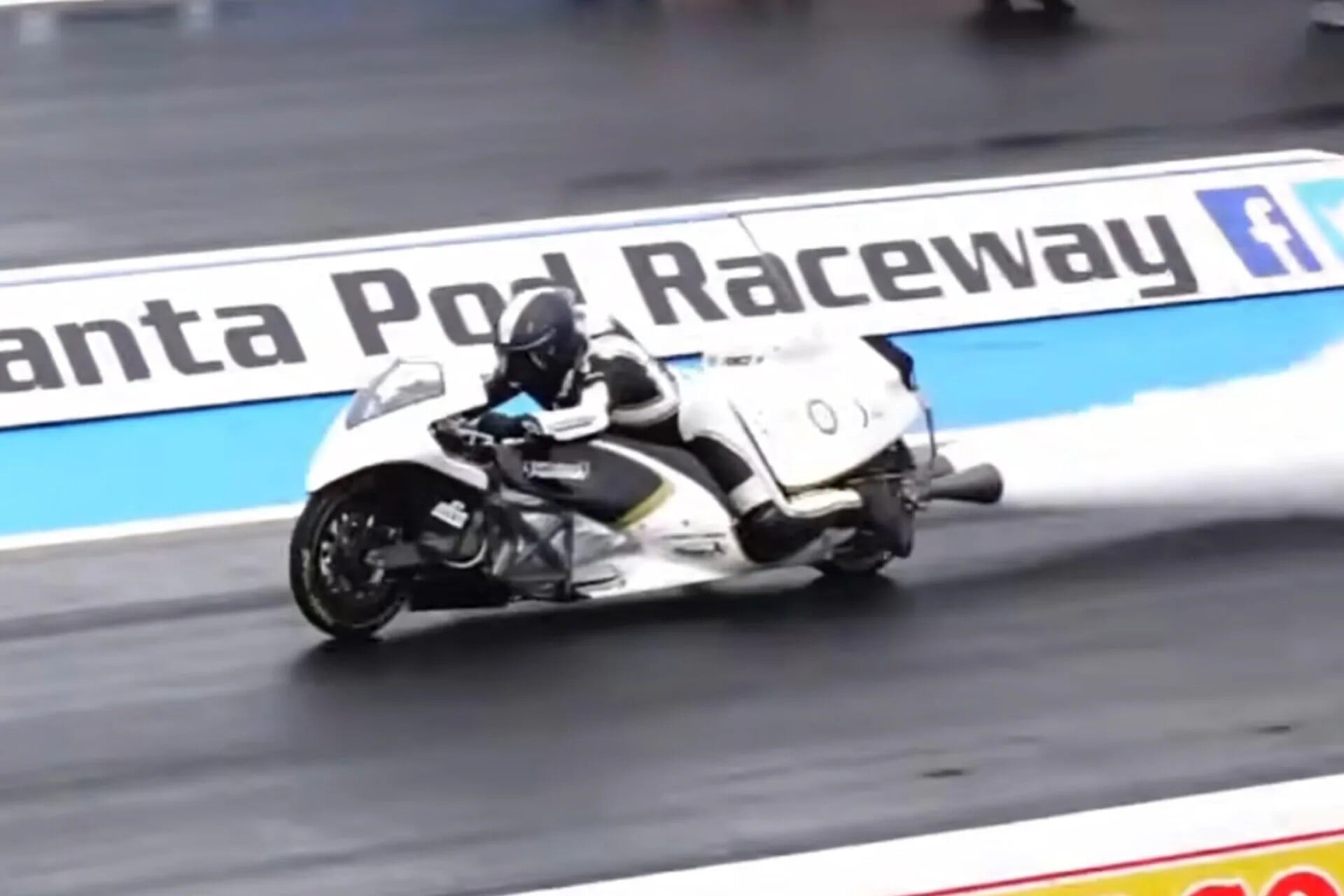
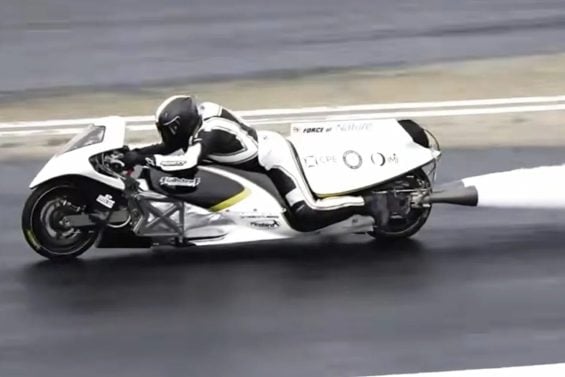
A steam-powered motorcycle has become the world’s fastest in acceleration. Named “Force of Nature” and built by British engineer Graham Sykes, the bike accelerates from 0 to 100 km/h in just 0.4 seconds and was recently presented at the Santa Pod circuit in the United Kingdom.
Sykes, a 62-year-old precision engineer from North Yorkshire, bucked the logic of the high-speed world. Instead of resorting to combustion engines, electric or rocket propulsion, it bet on a technology that many consider a thing of the past: steam. The idea arose, according to him, when he watched as a young man the attempts of the American Evel Knievel to jump the Snake River Canyon aboard a steam rocket.
The secret lies in applied physics. A small burner fueled by kerosene or vegetable oil heats the 120 liters of deionized water stored in a pressure vessel, where the temperature reaches 250 ºC and the pressure reaches 580 psi. Released by a pair of Laval nozzles at about 1.1 times the speed of sound, the superheated water turns to steam almost instantly and turns the bike into a projectile on two wheels.
The numbers are breathtaking. In addition to 0.4 seconds up to 100 km/h, the “Force of Nature” subjects the pilot to forces of up to 6.8 Gs — a rate comparable to what military fighter pilots face. At the peak of acceleration, an 85 kg driver “weighs” the equivalent of 578 kg. In a quarter-mile stretch (402 meters), the bike clocked 5.5 seconds, reaching 310 km/h.
The performance earned Sykes records as the world’s fastest motorcycle in the eighth mile. In the quarter mile, he ranks second among all motorcycles in history: the absolute time still belongs to Frenchman Eric Teboul, who in September 2022 covered the distance in 4.976 seconds aboard a motorcycle powered by a hydrogen peroxide rocket.
Now in its fifth generation, the prototype is still under development. Sykes, involved in drag racing since 1979, wants to reduce turbulence and cavitation in the water flow — today the bike expels about 40 liters per second — to extend the propulsion time, limited to approximately 2.9 seconds. The goal is bold: to cut 0.6 seconds off the time in the quarter mile and lower the mark to less than 5 seconds.
Comments are the sole responsibility of their authors and do not represent the opinion of this site. Comments containing profanity or offensive language will not be published. If you identify anything that violates the terms of use, please report it.