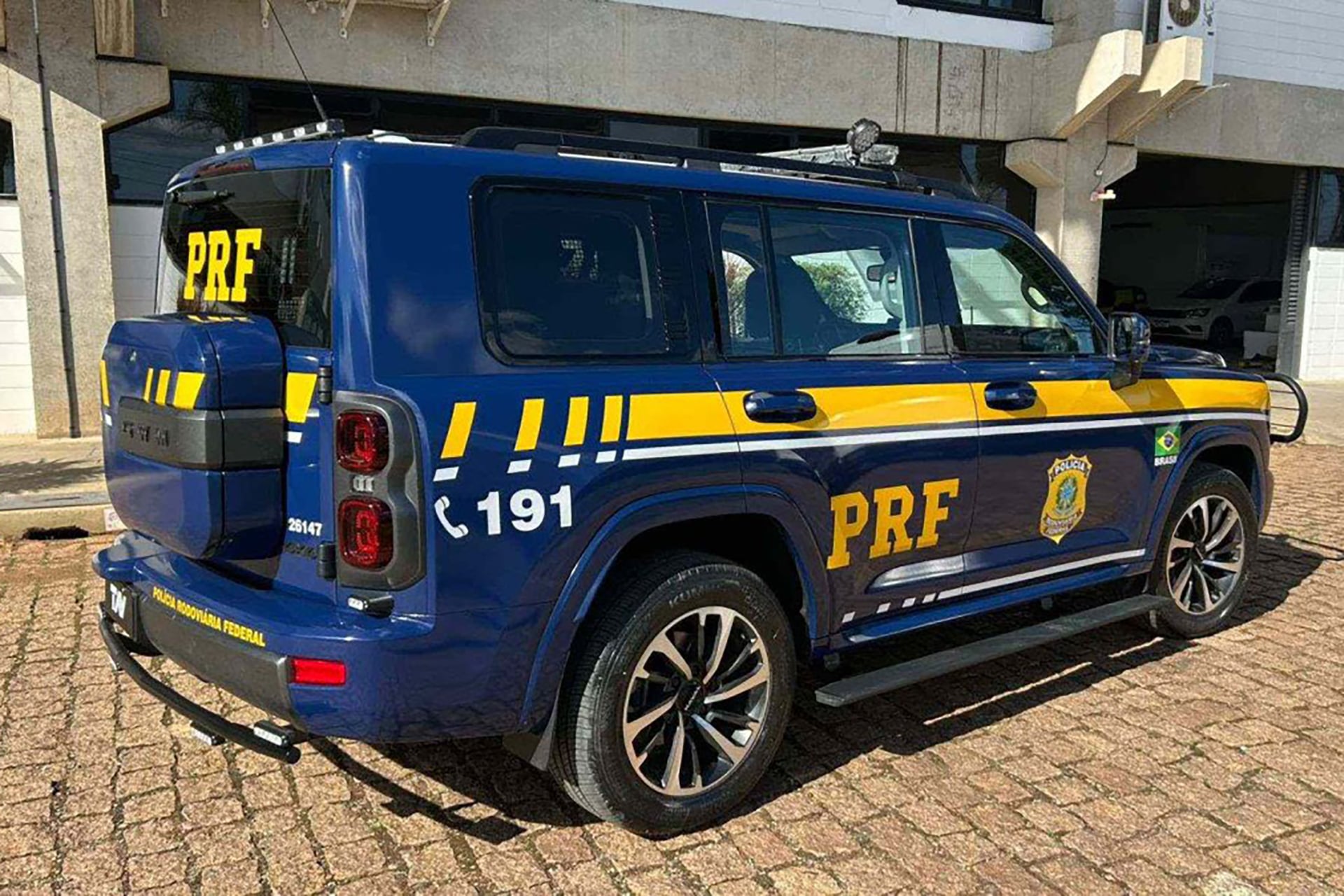
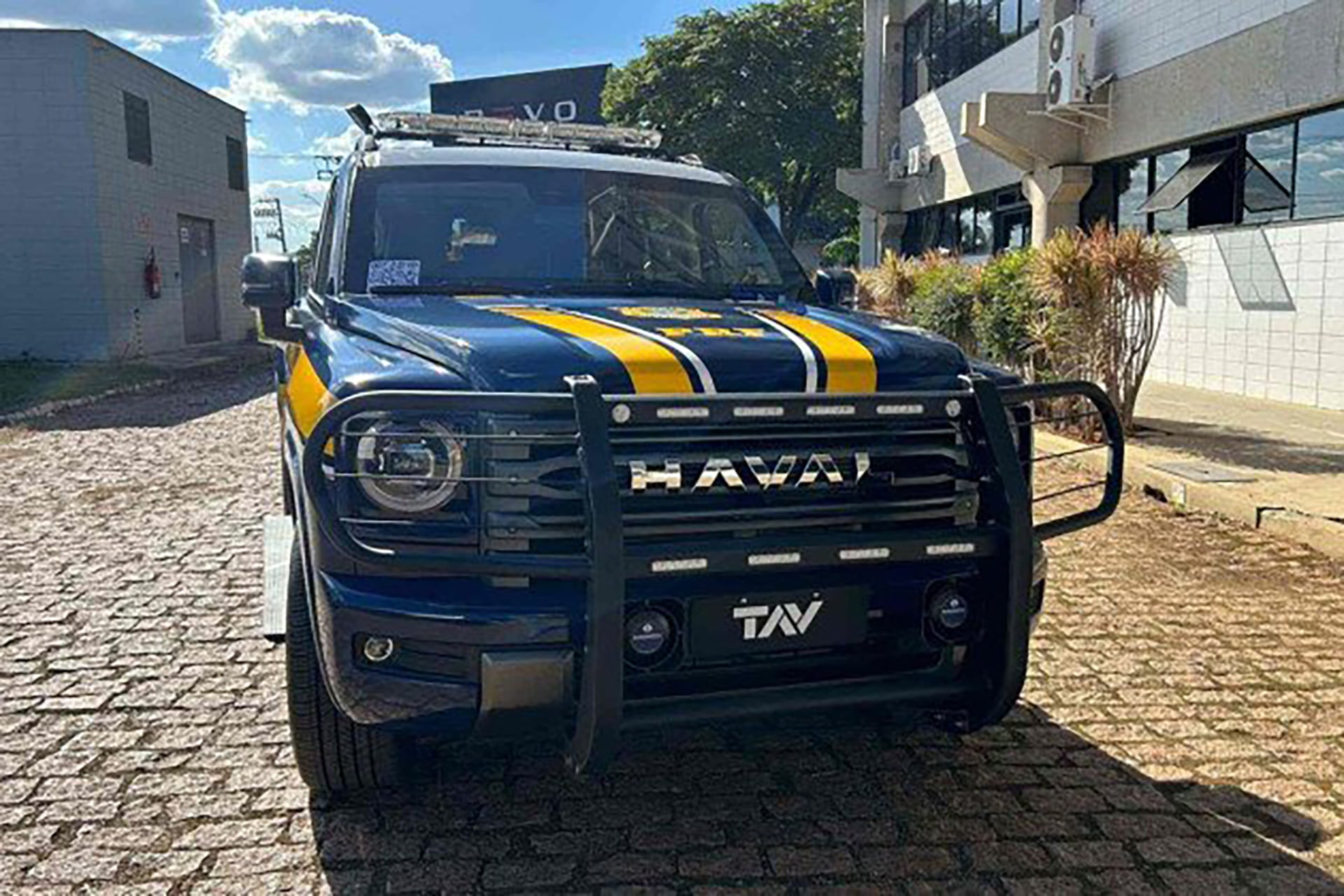
Last month, the GWM Haval H9 achieved a remarkable feat, surpassing the Toyota SW4 — its main competitor — in the sales ranking of diesel SUVs in Brazil. Now, GWM can further expand sales of the model, which is being quoted to integrate the fleet of the Federal Highway Police.
During LAAD 2026 — the main security fair in Latin America, the TAV preparer presented a portfolio of vehicles adapted for police forces, with the GWM Haval H9 adapted to the tactical requirements of patrolling and transporting detainees as its main showcase.
GWM’s SUV was configured with the visual identity standards of the Federal Highway Police (PRF), in a presentation that also included the GWM Haval H6, the JAC Hunter and the Mitsubishi Eclipse Cross.
“We are looking for partnerships so that we can test new models and types of engines, to verify whether or not they adapt to police activities,” said Rafael Aquino, director of Administration and Logistics at PRF. “We have opened a public call so that anyone interested can offer us the vehicles for testing. We seek to validate the ideas and proposals, listening to the staff, understanding what they propose and buying a vehicle that is really suitable for day-to-day life”, he added.
PRF Requirements
The PRF divides the requirements for its vehicles into different categories. In the case of the Haval H9, the rules apply to vehicles on stringer chassis, which must have permanent or partial 4×4 traction . The model still needs to have an automatic transmission, withstand severe use, transpose at least 300 mm of water depth, bring ABS/EBD, stability and traction control and front and side airbags. Minimum dimensions include a wheelbase of 2,720 mm and a ground clearance of 220 mm.
The Haval H9 meets the mechanical and dimensional requirements. Under the hood, the model has a 2.0 turbodiesel engine with 192 hp and 40,8 kgfm, combined with an eight-speed automatic transmission and 4×4 traction with reduced.
The adaptation carried out by TAV includes an isolated compartment for the transport of custodians, reinforcement of the suspension and state-of-the-art acoustic and visual signaling. According to the company, the project preserves the structural integrity of the vehicle, being approved for severe use. With manufacturing units in Tatuí and Sorocaba (SP), the company adopts a verticalized production model, which integrates everything from project engineering to its own armoring processes.
Comments are the sole responsibility of their authors and do not represent the opinion of this site. Comments containing profanity or offensive language will not be published. If you identify anything that violates the terms of use, please report it.