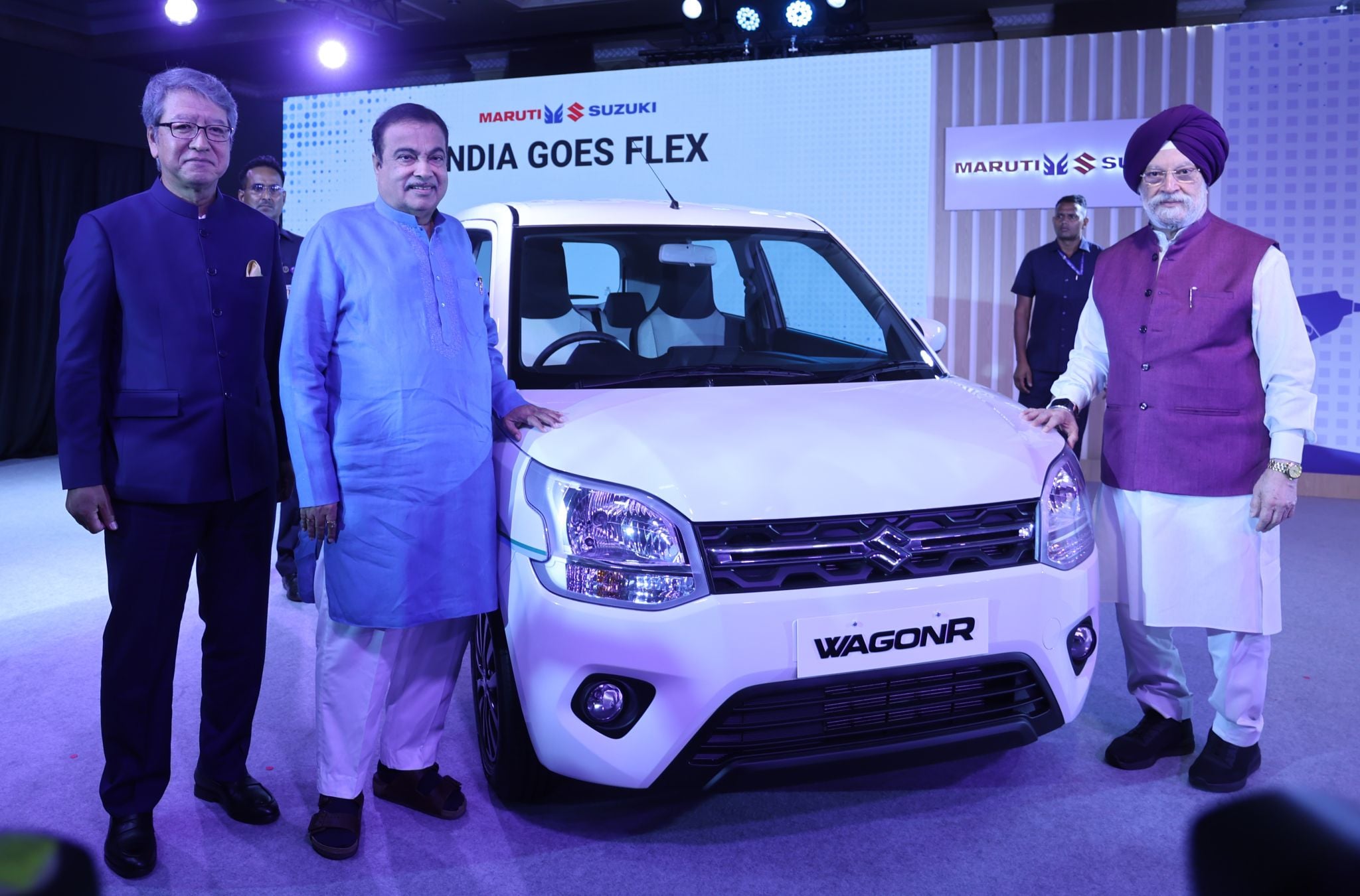
Maruti Suzuki has launched India’s first flex-fuel car, expanding the country’s commitment to renewable fuels and reducing dependence on imported oil. The technology debuts in the Wagon R, a model that had already been a pioneer in the use of CNG and LPG in the Indian market, and allows fueling with any mixture of gasoline and ethanol between 20% (E20) and 100% (E100) alcohol.
The launch took place in New Delhi, on the eve of World Environment Day, with the presence of ministers Nitin Gadkari (Road Transport and Highways) and Hardeep Singh Puri (Oil and Natural Gas). Both associated the technology with the goal of an India that is self-sufficient in energy, capable of reducing emissions and increasing the income of rural producers.
Flex-fuel vehicles can contribute to reducing oil imports and stimulate demand for locally produced ethanol. Although compatible with up to E100, the car has been homologated in India for blends up to E85, in accordance with local regulations. The government expects the expansion of the market to benefit farmers, increase the share of renewables in the energy mix and reduce emissions.
During the event, Gadkari highlighted that India still relies heavily on crude oil imports and classified ethanol as a strategic alternative to reduce this dependence. According to him, the launch may encourage other automakers to develop similar models and accelerate the expansion of the biofuel distribution infrastructure.
Petroleum Minister Hardeep Singh Puri said India’s ethanol trajectory is irreversible and has converted farmers into energy suppliers, reinforcing national energy security.
The CEO of Maruti Suzuki’s Indian operation, Hisashi Takeuchi, said that the company intends to offer different propulsion technologies, including electric, hybrid, natural gas and flex fuel. For him, still at an early stage in the country, ethanol can reduce emissions, strengthen national energy production and benefit the agricultural sector.
Comments are the sole responsibility of their authors and do not represent the opinion of this site. Comments containing profanity or offensive language will not be published. If you identify anything that violates the terms of use, please report it.