Fenabrave’s analysis of last month’s results points to growing optimism until the end of 2026. Automobiles and light commercial vehicles, which represent 94% of the market (trucks, 5%, and buses, 1%) once again presented surprising numbers. From January to May, almost 1.1 million light vehicles were sold, an increase of 18.2% over the same period in 2025.
According to the president of the entity, Arcélio dos Santos Jr., the sector reflects incentive programs such as the Sustainable Car and Move Brasil for trucks that are waiting for a second phase. For now, even more stimuli are added. “The recent launch of Move Brasil – Taxis and Apps, which will offer incentives of R$ 30 billion, with reduced interest rates and a grace period of 6 months to start paying for cars and light commercial vehicles of up to R$ 150 thousand, we expect a greater heating of the market in the coming months. This should raise sales projections for 2026,” he commented.
Another segment on the rise includes hybrids in an energy transition scenario. “These serve consumers who seek efficiency and value range, practicality and simpler adaptation to everyday use”, he evaluated. He also added that “the electric market continues to expand, and is now experiencing a consolidation phase in Brazil. The evolution depends not only on the supply of vehicles, but also on charging infrastructure, consumer information and regulatory predictability”. In the first five months of this year, 69,347 electric vehicles were sold, while hybrids totaled 121,110 units, a result 75% higher.
Chinese brands represent 90% of electric sales in Brazil, practically all imported, although at least five have announced production in Brazil. BYD built its own factory in Camaçari (BA) and before that GWM acquired the Mercedes-Benz unit that was closed, in Iracemápolis (SP). New agreements were reached with Renault, in Paraná; Caoa Chery, in Goiás; HPE Mitsubishi, also in Goiás; JLR, in the State of Rio de Janeiro. GM’s Chinese electric cars are assembled in Ceará. Toyota has just closed its unit in Indaiatuba (SP), inaugurated in 1998, to concentrate production in Sorocaba (SP). Will any other Chinese woman run for office?
The OECD (Organization for Economic Cooperation and Development) has just revealed, to no one’s surprise, that between 2005 and 2024, the Chinese government subsidized its companies three to eight times more than the average of the 39 member countries. It’s easy to see why eight million electric cars were sold in China in 2025, approximately 60% of all electric cars sold globally.
Controversies involve Luce, Ferrari’s first electric
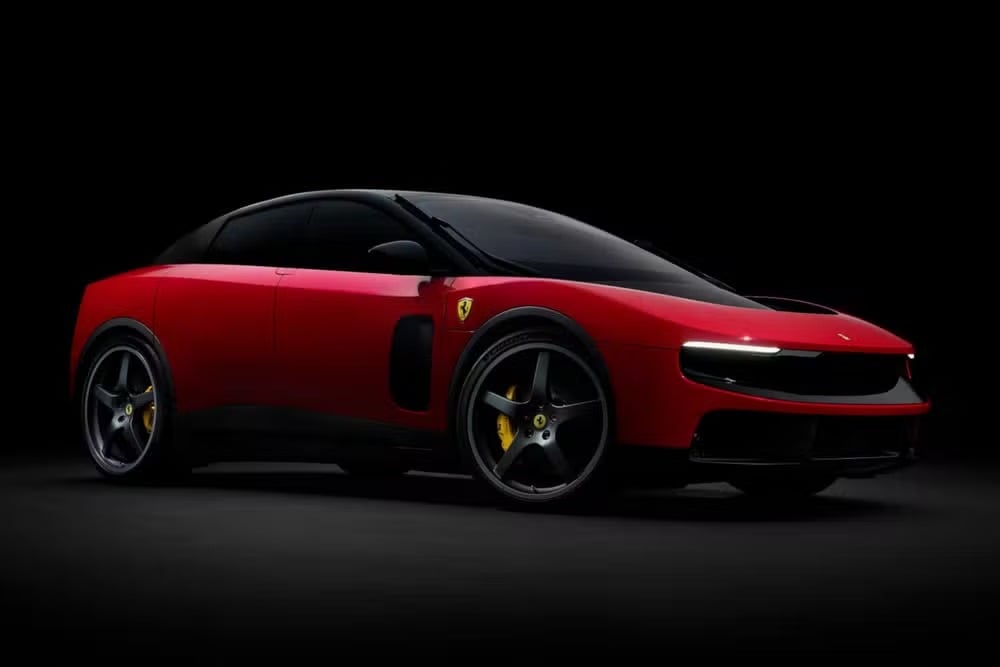
The Italian brand has never suffered so much criticism already in the presentation of its first electric model, which will only hit the world market in early 2027 for no less than 550,000 euros (R$ 3,24 million and almost double with Brazilian taxes). Designed by Jony Ive, formerly responsible for Apple’s iPhone, the Luce (light, in Italian) mixes sedan and coupe SUV lines with strange proportions, to say the least. 23-inch front wheels and 24-in. With an uninspired design, taillights of Franciscan simplicity and a front that does not attract glances form a “saltless” set, to say the least.
Luca di Montezemolo, who chaired Ferrari between 1991 and 2014, now 78, stressed that he did not want to harm the brand, “but I hoped that at least they would remove the prancing horse symbol from that car”. He was even more cruel: “Certainly, at least, the Chinese will not copy.”
Spacious interior for five occupants, however, pleases a lot. In addition to the discreet steering wheel, the square-shaped multimedia screen has an angle expressly aimed at the driver. From the back seat no one will complain, although opening the doors in the opposite direction to the traditional one is far from unconditional acceptance.
The four electric motors, one for each wheel, total 1,050 hp and 101 kgfm. Even with a running mass of an extraordinary 2,260 kg, it accelerates from 0 to 100 km/h in 2.5 s, 0 to 200 km/h in 6.8 s and a top speed of 310 km/h. Declared average range of more than 530 km.
Ferrari says that the entire production of the Luce is already sold by the end of 2027, without giving any figures. Marketing trick that sounds more like it to mitigate negative comments.
Comments are the sole responsibility of their authors and do not represent the opinion of this site. Comments containing profanity or offensive language will not be published. If you identify anything that violates the terms of use, please report it.