Honking your horn to celebrate the World Cup? Beware of the fine!
Honking when celebrating goals and victories, or for other purposes, may even be legal in the World Cup atmosphere, but it constitutes a traffic violation
Continuous horn sound should only be associated with rescue vehicles, police and ambulance (Photo: Shutterstock | AutoPapo)
The 2026 World Cup has already started and with it comes the fan and patriotic spirit, which takes over even those who are not football fans. It is in this atmosphere that Brazilians cheer in the most diverse ways and are looking forward to the long-awaited sixth championship. However, celebrations, even if well-intentioned, such as a honk to celebrate a goal or victory for Brazil, can constitute traffic violations and generate fines.
Disobeying what is provided for in the Brazilian Traffic Code (CTB) can turn the green and yellow party into a show of losses. Even though Brazilian drivers have practically developed their own ‘dialect’ for the horn, it cannot be activated by default, as this goes against what is provided for in the Brazilian Traffic Code (CTB).
Inlusive, other very common actions such as honking horns to greet someone or to vent anger in traffic are also among the conducts punished by law.
How is it allowed to use the horn
According to Resolution No. 14, of February 6, 1998, of the National Traffic Council (Contran), the horn is one of the mandatory and standardized equipment in cars, motorcycles and other vehicles in circulation in the national territory. Despite being an item required by law, its use is regulated, since the act of honking has the objective of drawing attention, of alerting those around you in traffic.
Therefore, it cannot be activated at any time, randomly or in places where it is prohibited. Using the horn also involves the form and intensity of this action, which must be done correctly by the driver. According to article 41 of the Brazilian Traffic Code (CTB):
The vehicle driver may only use a horn, as long as it is a brief sound, in the following situations:
I – to make the necessary warnings in order to avoid accidents;
II – outside urban areas, when it is convenient to warn a driver that he intends to overtake him.”
That is, the horn should only be activated to warn other road users about some safety risk or intention to overtake in rural areas.
Honking is even legal to celebrate, but it is prohibited by the CTB
Honking to celebrate goals and victories of the Brazilian National Team, or of your favorite team, despite being part of the tradition of celebrations, especially in football, is a prohibited conduct. This is because, just as when the horn is used to repress another road user or even to discount stress in traffic, the driver usually “sticks his hand” in the horn.
This action is prohibited, not only because of the inappropriate circumstance, according to the CTB, but also because of the way you honk, which can cost you R$ 88.38. Article 227 of the Traffic Code provides:
Use a horn:
I – in a situation other than a simple brief sound as a warning to pedestrians or drivers of other vehicles;
II – prolonged and successively under any pretext;
III – between twenty-two (10 p.m.) and six a.m. (6 a.m.);
IV – in places and times prohibited by the signs;
V – in disagreement with the standards and frequencies established by CONTRAN:
Infraction – light (3 points on the CNH);
Penalty – fine (R$ 88.38).
Thus, honking for a long time is not allowed, as this continuous sound must be associated only with fire and rescue rescue vehicles, police, traffic operation and inspection and ambulance. In addition, it is also forbidden to use the equipment to greet an acquaintance on the street, argue or other action that is not described in article 41 of the Brazilian Traffic Code.
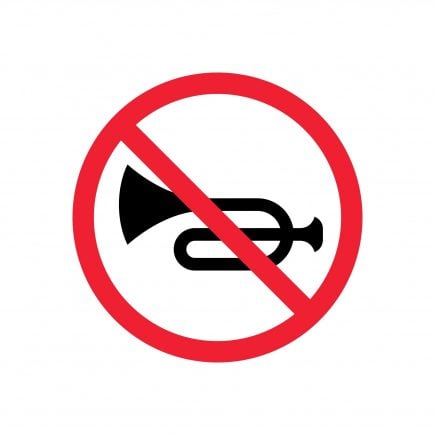
There are also places where the correct use of the horn is not allowed and must be marked by signage. These places must have the R-20 license plate that shows the driver that this action or triggering any other type of sound signal is prohibited.
R-20 regulation plate is placed in places where honking in any circumstance is prohibited.
This sign is usually found in areas near hospitals, schools, and tunnels.
Comments are the sole responsibility of their authors and do not represent the opinion of this site. Comments containing profanity or offensive language will not be published. If you identify anything that violates the terms of use, please report it.