

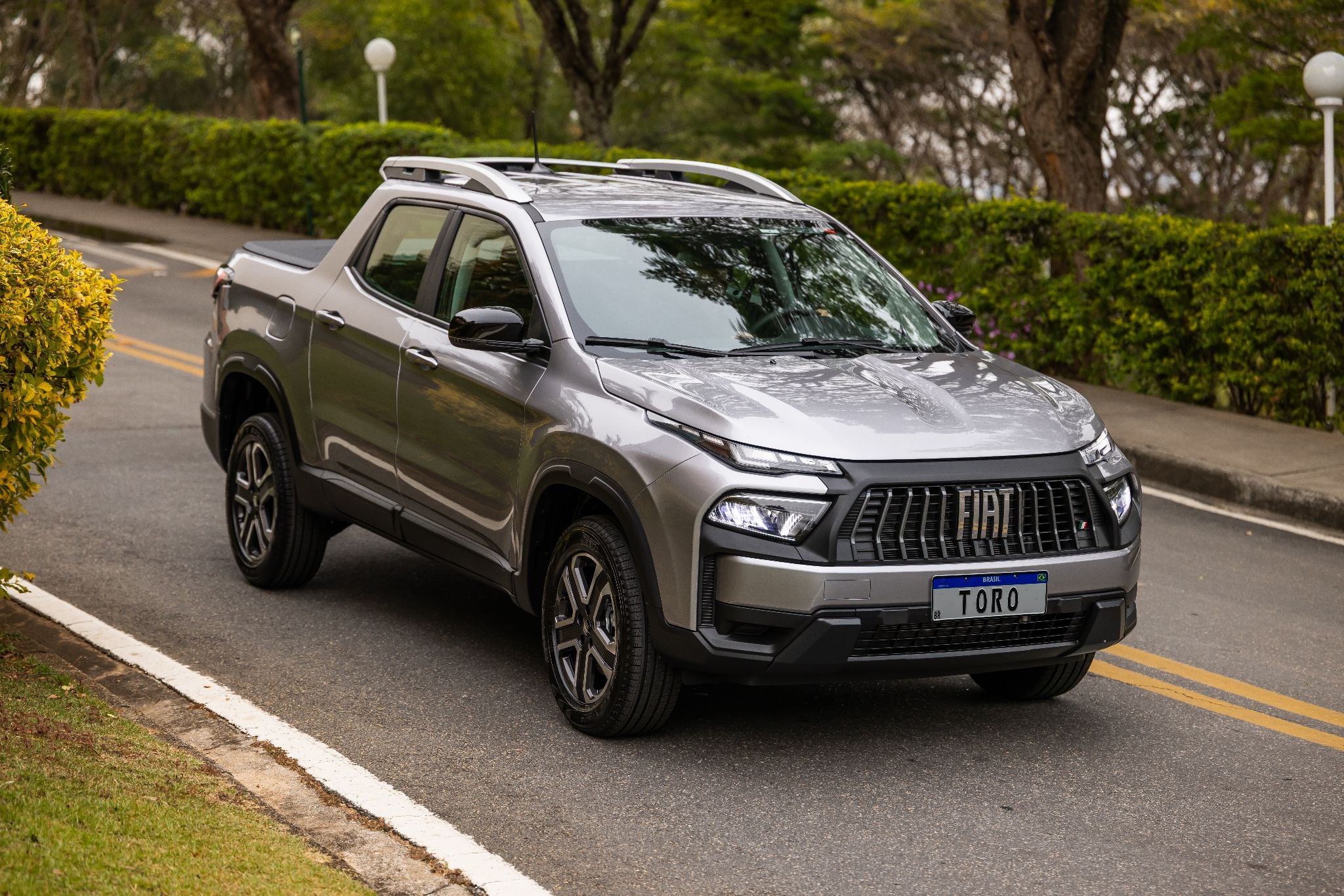
Fiat Toro Freedom pleases for its cost-benefit ratio
Fernando Calmon evaluated the intermediate version of the Italian pickup, which continues to have no direct competitors in Brazil
By
Fernando Calmon
Published on 2026-04-25 at 11:00 AM
Updated on 2026-04-25 at 11:30 AM
Published on 2026-04-25 at 11:00 AM
Updated on 2026-04-25 at 11:30 AM
Be the first to comment.
Summarize with:
Since its launch in February 2016, Toro has surprised the market by establishing itself in a segment that does not exist among small and medium pickup trucks. In fact, it has become a competitor to medium-sized trucks with a load capacity of up to one ton and for standing out for its drivability closer to a car than to a traditional pickup. One of the features that differentiate it to this day is the split horizontal opening of the bucket lid. All engines are turbo Otto (flex) and Diesel.
SEE ALSO:
- The Fiat Toro you’ve never seen: brand unveils commemorative model for Lollapalooza 2026
- Inmetro advances entry-level diesel version at Fiat Toro
- Used car: 10 facts about Fiat Toro
Fiat’s pickup has no less than six versions with 4×2 and 4×4 traction and there have been few aesthetic changes. However, in the current 2026 model year, attractive modifications have emerged in bumpers, grille, taillights and design wheels that draw attention. Another change that improved drivability and safety were the rear disc brakes. They were drum brakes, they could handle it with ease, but only if it ran without its full load capacity and/or at moderate speed.
Also noteworthy, present from now on in all versions, is the electromechanical parking brake associated with the auto-hold feature, very useful in heavy urban traffic. Both the position behind the wheel and the responses in curves are positive points and now there is also a new gear knob. Its price remains competitive.
Dimensions (m): length, 4.95; wheelbase, 2.98; width, 1.84 (2.03 with mirrors); height, 1.67. Volumes (L): trunk (bucket), 973; tank, 55. Mass: 1.670 kg. 4-cylinder turbocharged engine 1.3 L flex (hp): power 176 hp (E)/(G); torque 27.5 kgf·m (E/(G). Consumption (km/L, Inmetro): city, 6.5 and highway, 7.8 (E); city, 9.4 and highway, 10.8 (G). Range (km): city, 358 and highway, 429 (E); city, 517 and highway, 594 (G). Front-wheel drive. Epicyclic automatic transmission, 6 gears. Acceleration 0 to 100 km/h (s): 10 (E)/(G).
Price: R$ 175.490.

SEE MORE ABOUT

0 Comments
Comments are the sole responsibility of their authors and do not represent the opinion of this site. Comments containing profanity or offensive language will not be published. If you identify anything that violates the terms of use, please report it.