Japan was eliminated by the Brazilian National Team, last Monday (29), during the round of 16 stage of the 2026 World Cup. A tough victory for the Brazilian team, which already knew the difficulties of the confrontation. The triumph reached social networks and extrapolated the scope of football to memes (jokes) made with anime and other cultural punctualities between nations, which, in the universe of motorcycles, also exist.
As much as Brazil sells, in its overwhelming majority, motorcycles from manufacturers of Japanese origin, Japan also has an advantage in another aspect: in the subdivisions for authorization to drive motorcycles.
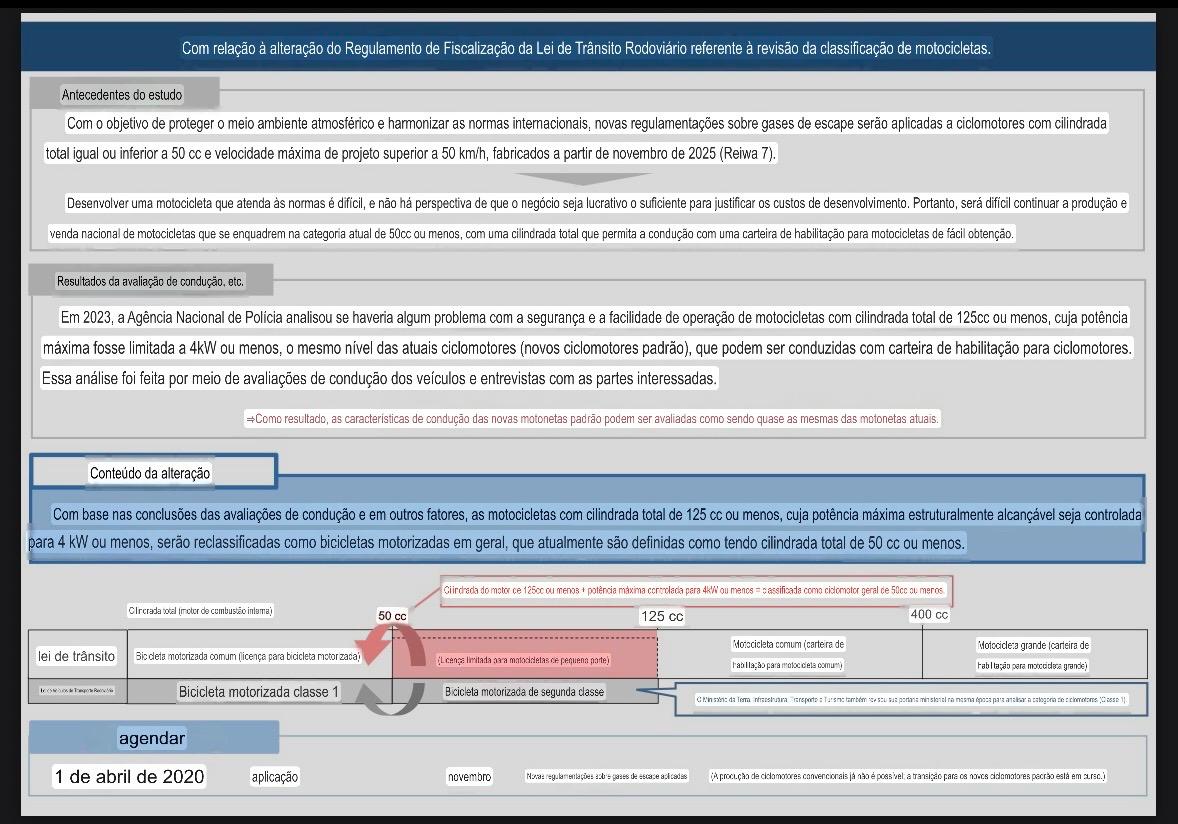
Unlike Brazil, which allows all category A drivers to ride any motorcycle, since those smaller than 50 cm³ here are called mopeds, Japan adopts a staggered license system. In practice, the motorcyclist needs to obtain a specific license for each range of motorcycles, according to the power and category of the vehicle.
In all, there are four categories of license for motorcycles:
Gentsuki (Mopeds): intended for vehicles up to 50 cm³. It allows you to drive small scooters and mopeds and is at least 16 years old to be purchased.
Kogata Nirin (Small Motorcycles): authorizes the driving of motorcycles up to 125 cm³. There is a specific license for automatic motorcycles (AT) and another for models with manual transmission (MT).
Futsū Nirin (Medium Motorcycles): valid for motorcycles up to 400 cm³, also with a distinction between automatic and manual transmission.
Ōgata Nirin (Large Motorcycles): Allows you to ride motorcycles of any size, with no power limit.
Japanese standards are up to date (Photo: Japan National Police Agency)
According to a document from the National Police Agency of Japan, one of the country’s traffic regulatory bodies, the motivation is clear and is based on safety studies. The latest update report of the rule in the country points out that:
It has been confirmed that, due to acceleration control, the new mopeds can be driven easily and safely at a level equivalent to current mopeds by people who have the skills required for the moped license,” the document states.
In view of this, Japan has a mortality rate for motorcycle accidents much lower than other countries, such as Brazil. While here about 40% of traffic deaths come from motorcycle accidents, in Japan it is half, 20%, points out the Road Safety Profiles by Country – Japan 2025,
How does the change of category work?
Contrary to what many imagine, the Japanese system does not require the motorcyclist to go through all categories before reaching the license for motorcycles with a larger displacement. As long as the candidate meets the minimum age requirement and passes the exams, he or she can directly obtain a higher license.
In practice, an 18-year-old can earn the Ōgata Nirin license, which allows you to drive motorcycles of any displacement, without the need to previously go through the categories of up to 125 cm³ or 400 cm³.
On the other hand, the legislation also does not allow for automatic progression. To change category, the motorcyclist must obtain a new specific license, taking training at an accredited driving school — or taking the exams directly at the driver’s license centers — and passing the practical evaluations corresponding to the desired category.
In this way, the evolution of the rider does not depend on a minimum amount of experience at the handlebars, but on the demonstration of technical skill required for each type of motorcycle.
Motorcycle training in Japan is more rigorous
Another differential of Japan is in the process of training motorcyclists. In addition to the division by categories, candidates undergo very careful training before receiving the license.
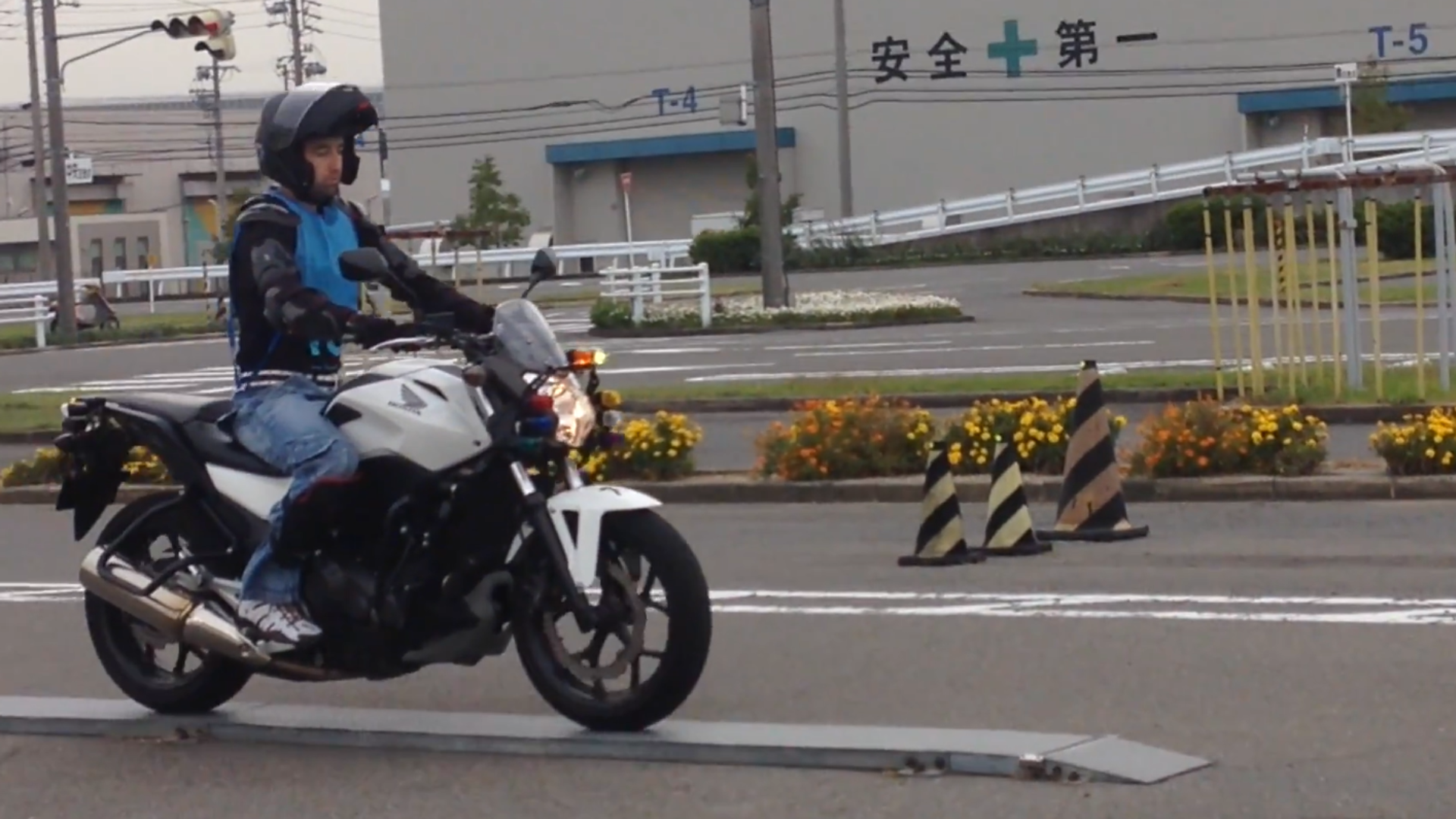
Practical classes include emergency braking exercises, controlling the motorcycle at low speed, cornering, avoiding obstacles and balancing on a narrow raised board — known as ipponbashi, considered one of the most challenging tests of the Japanese license.
Only after passing all stages does the candidate receive authorization to drive motorcycles within the category for which he was qualified.
And in Brazil?
In Brazil, the reality is quite different. Category A of the National Driver’s License allows you to drive motorcycles, scooters and motorized tricycles, all above 50 cm³. This means that a newly licensed motorcyclist can legally ride from a low-displacement motorcycle to a sports motorcycle with more than 1,000 cm³.
In addition, the recent changes arising from Contran Resolution No. 1020, of December 1, 2025, have further relaxed the way to obtain the National Driver’s License. The exams of the state Detrans that had ramps, children, slalom and sharp curves were reduced to simple movements of curves and roundabouts and mandatory stops, as is the case in São Paulo.
Another point is that, although Brazilian training also requires theoretical and practical classes and exams, there is no mandatory progression by motorcycle power or the need to conquer new categories throughout the driver’s life.
While Brazil bets on a single license for all motorcycles, Japan requires the motorcyclist to prove more effectively the specific technical capacity for each category of vehicle he intends to drive.
Comments are the sole responsibility of their authors and do not represent the opinion of this site. Comments containing profanity or offensive language will not be published. If you identify anything that violates the terms of use, please report it.