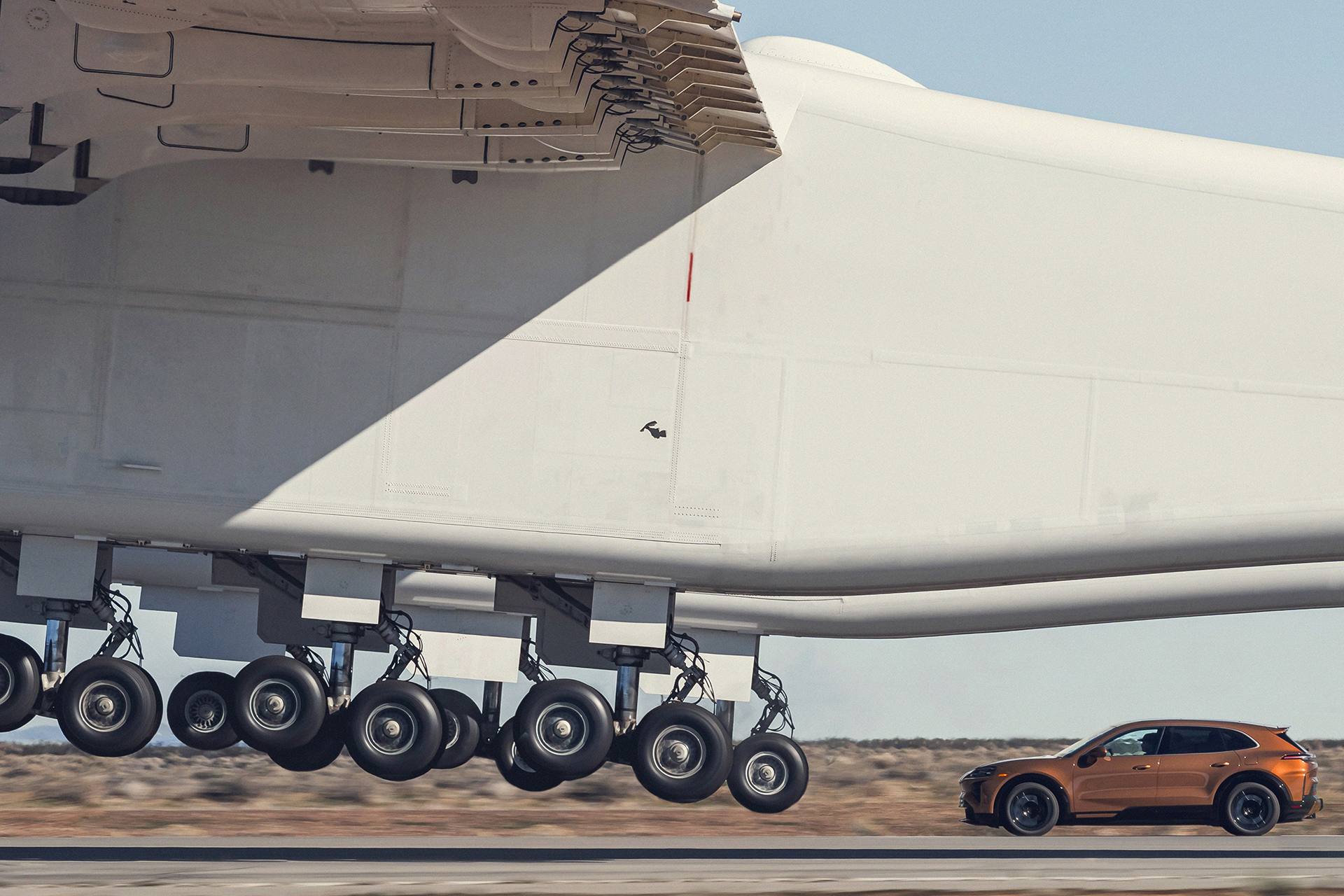
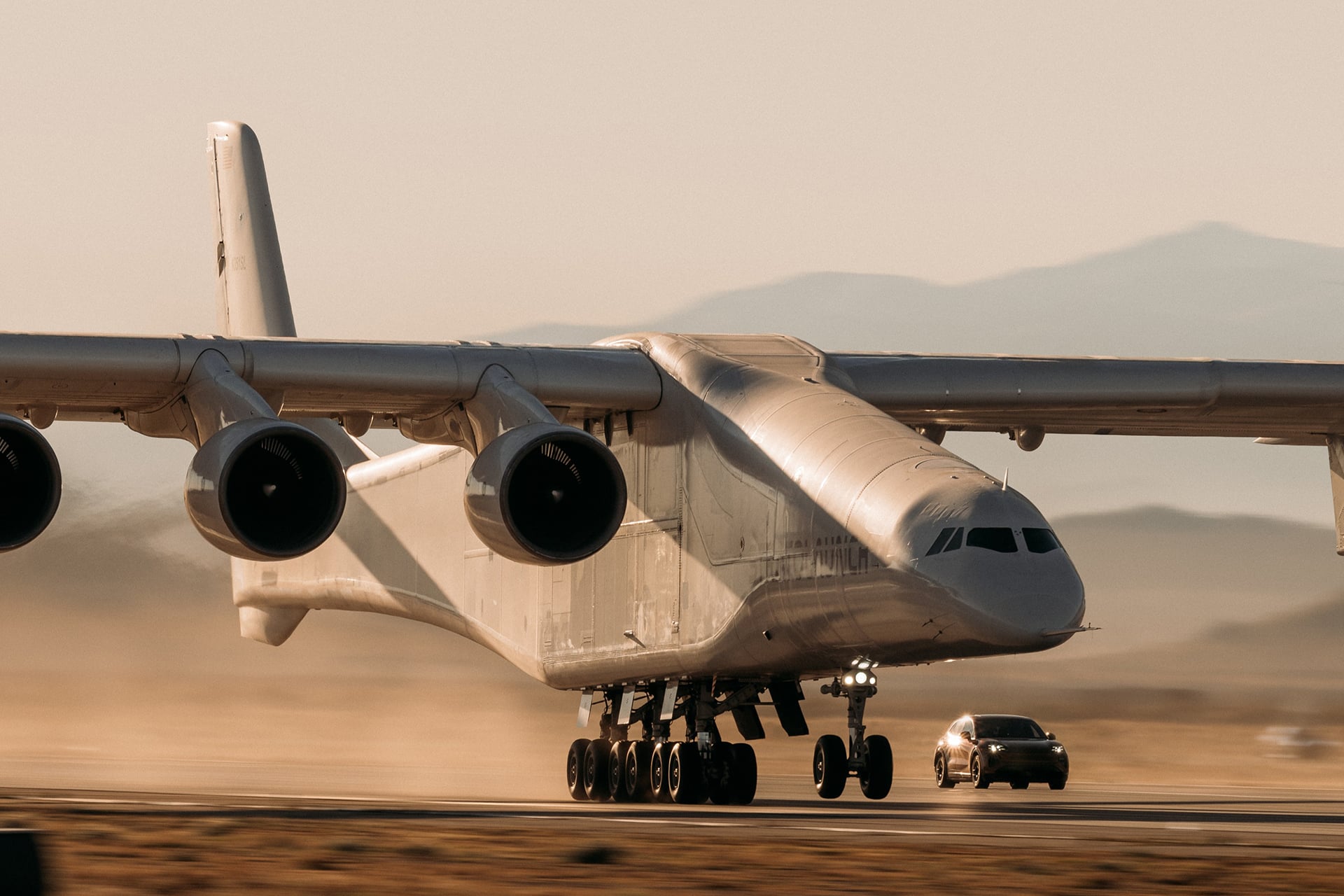
Porsche chose an unconventional way of presenting the power of the new electric Cayenne: it placed the SUV at 269 km/h under the world’s largest plane, just as it took off. And then he repeated the dose with the plane landing.
The scene was recorded at the Mojave Air and Space Port in California. The plane is Stratolaunch’s Roc: an experimental twin-fuselage aircraft used as a launch pad for space vehicles. There are 117 m of wingspan, the largest on the planet, in addition to six engines that add up to 154 tons of thrust and a maximum takeoff weight of 590 tons.
The idea did not come from Porsche, but from the engineers at Stratolaunch. By studying the Roc’s aerodynamics, they calculated that there is a point of calm in the middle of the violent displacement of air: just behind the landing gear and in front of the tail, when the jet of the engines and turbulence practically disappear.
The problem is that this bubble moves along with the plane. That is, the driver would have to enter it before the engines accelerate and stay there, millimetrically, until takeoff. Delaying would mean taking the jet in full, with the risk of the car being thrown into the air. To advance would mean to hit the landing gear.
Photo: Porsche | Disclosure
Why a 1,155 hp electric SUV
The task required power to keep up with the plane at any speed, stability and the ability to exceed 257 km/h, above the Roc’s takeoff speed. It was an ideal opportunity for the new Cayenne Turbo Electric, which delivers 1,155 hp and 153 kgfm, goes from 0 to 100 km/h in about 2.5 seconds and has active aerodynamics.
Weight, normally a defect, became an advantage: at 2,645 kg, the SUV was not shaken by turbulence as a light car probably would be. At the wheel was Patrick Long, endurance driver and former member of the Porsche factory team.
“It was probably one of the most focused and intense moments of my life,” Long said. He said that he started slowly, using the minimum of power to stay in the exact position, and that the real acceleration only came when the six engines of the plane went into regime. After 161 km/h, it activated the Boost mode and went to the end, glued to the landing gear. When he looked at the dashboard, he saw something over 273 km/h before easing off the throttle.
There were two takeoffs and two landings under the Roc. The landing maneuver repeats what the U.S. Air Force has been doing for decades with the Lockheed U-2, accompanied by a support car on the approach — only here with a plane with a wingspan three times larger. On subsequent passages, the Cayenne took rides: actor Orlando Bloom, ambassador of Porsche Design, journalist Mat Watson and two team leaders from Stratolaunch.
Comments are the sole responsibility of their authors and do not represent the opinion of this site. Comments containing profanity or offensive language will not be published. If you identify anything that violates the terms of use, please report it.