


Mechanic installs tractor turbo in 1908 Ford Model T and tests the result on the street
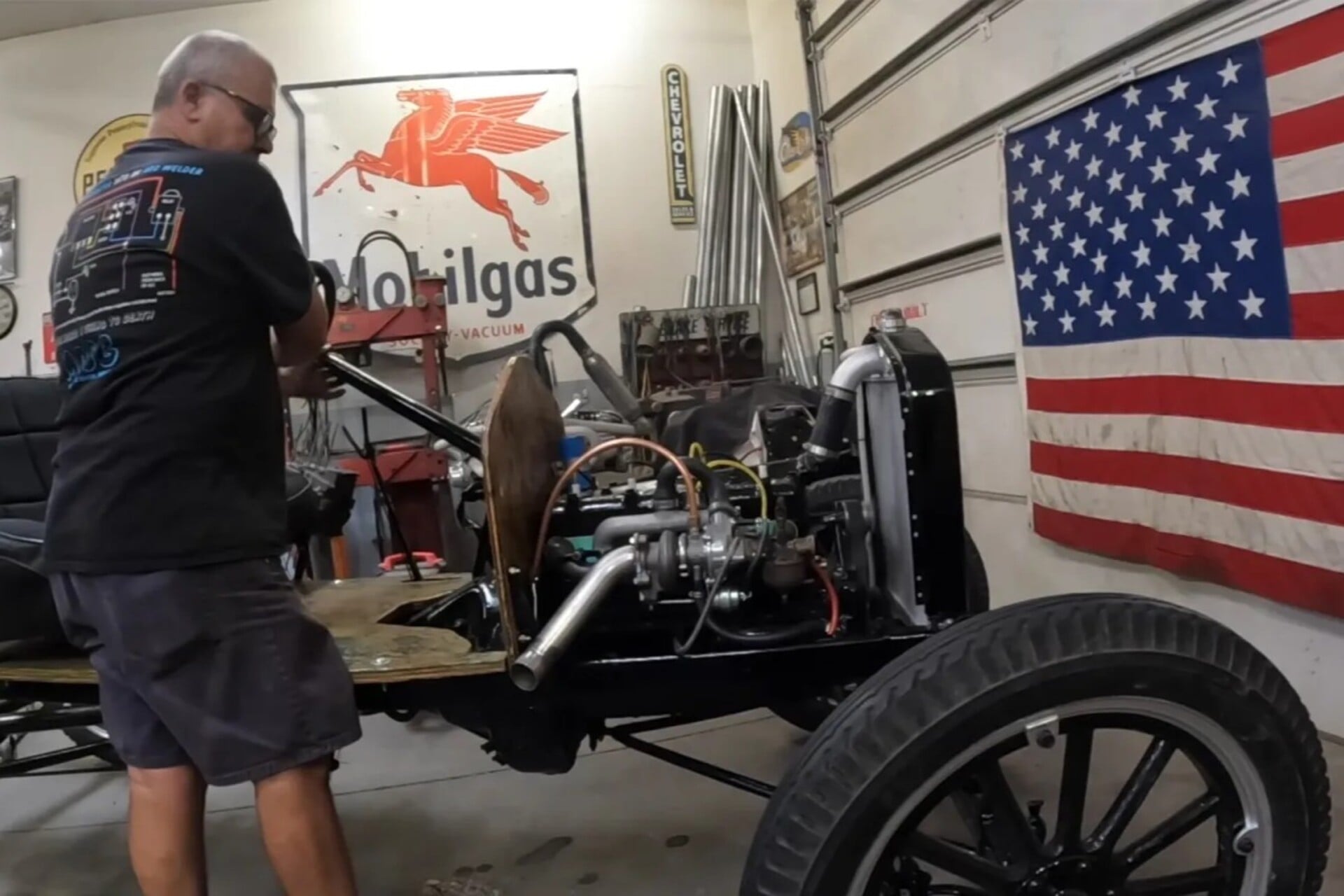
Merlin Johnson coupled a Kubota tractor turbo to the 2.9 engine of 1908; top speed rose from 37 km/h to 45 km/h
By
João Paulo Profeta
Published on 2026-09-14 at 06:00 AM
Published on 2026-09-14 at 06:00 AM
Be the first to comment.
Summarize with:
An American preparer installed a turbocharger taken from a Kubota tractor in the original engine of a Ford Model T and managed to make the assembly work. The engine, designed in 1908, started to take the car to 45 km/h, against the 37 km/h it registered before the modification.
The author of the project is Merlin Johnson, an experienced mechanic who maintains Merlin’s Old School Garage YouTube channel. The Model T’s engine is a 2.9-liter four-cylinder, side-valve engine that delivered 20.3 hp when it left the factory.
Supercharging, however, is not newer than the car: Swiss engineer Alfred Büchi patented an exhaust-gas-powered turbine design in 1905, three years before Henry Ford launched the Model T. The technology would only reach serial production in 1962, with the Oldsmobile Jetfire.
Lubrication was the biggest obstacle
The physical installation was the simple part. Johnson removed the original cast-iron exhaust manifold, drilled a hole, fabricated a flange, and screwed the turbo in there.
The problem was with the oil. Model T engines don’t have a lubrication pump: the oil travels through a pipe that runs from the front of the engine to the gearbox and is spread by splash, without pressure. Without a pressurized line, the turbine shaft would burn out in a few moments.
The solution found was to use the centrifugal force of the flywheel to push the lubricant through a copper tube to the turbo. The return was in charge of a simple siphon, which returns the oil to the engine.
Test drive yielded 8 km/h more
The first start in the workshop took place without leaks and the test drive through the neighborhood confirmed the operation of the arrangement. According to Johnson, the supercharge pressure was around 6 psi (about 0.4 bar), which indicates that the centennial engine can withstand at least this level without breaking.
The gain of 8 km/h, however, is modest by today’s standards. Even turbocharged, Johnson’s Model T would remain below the minimum speed allowed on a Brazilian highway with a limit of 110 km/h — 55 km/h, half the maximum, according to article 62 of the Brazilian Traffic Code.
The method is neither the cheapest nor the most efficient of accelerating a Model T, and it is unlikely to be copied on a scale by other owners of the model. The car, however, is among the historical foundations of hot-rod culture in the United States, which helps explain why it continues to be the target of modifications more than a century later.
SEE MORE ABOUT

0 Comments
Comments are the sole responsibility of their authors and do not represent the opinion of this site. Comments containing profanity or offensive language will not be published. If you identify anything that violates the terms of use, please report it.