


Iveco and Toyota develop hydrogen truck with more than 900 km of autonomy
Truck will have Toyota's third-generation fuel cell system, with 408 hp, and road tests in the first half of 2027
By
Júlia Haddad
Published on 2026-09-15 at 05:00 PM
Updated on 2026-09-15 at 05:25 PM
Published on 2026-09-15 at 05:00 PM
Updated on 2026-09-15 at 05:25 PM
Be the first to comment.
Summarize with:
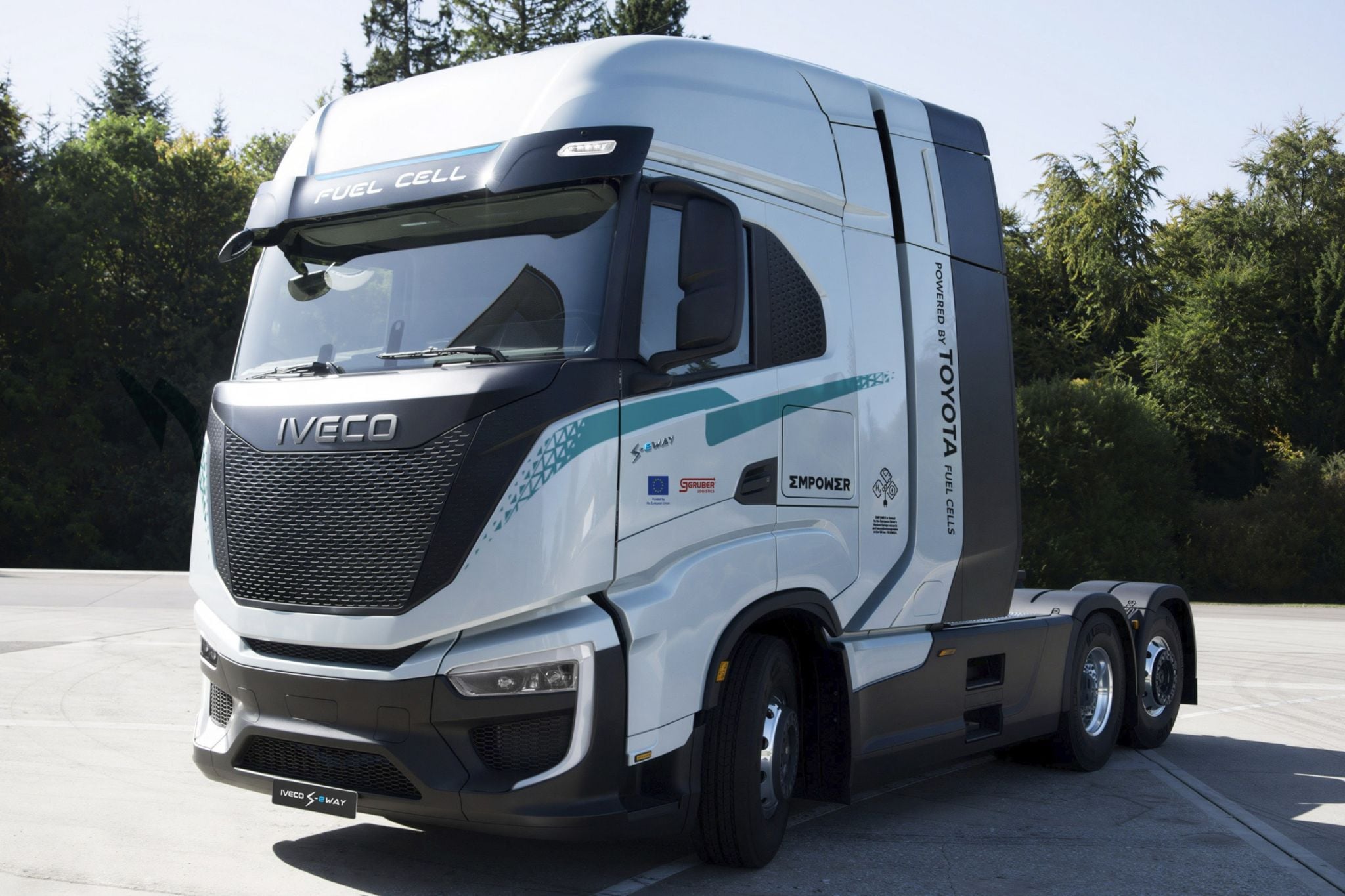
Iveco and Toyota will jointly develop a hydrogen-powered heavy-duty truck with a range of more than 900 km and which, at the same time, will use half the battery capacity of the previous generation. The IVECO S-eWay Fuel Cell is born within Empower, a project funded by the European Union’s Horizon Europe program, and is expected to run on roads in the first half of 2027.
Toyota enters with the fuel cell system — the third generation presented by the Japanese brand in February 2025, with a total power of 408 hp. Iveco is responsible for the development of the vehicle, the integration of components and the validation of the set, supported by the experience of H2Haul, a program that has already placed hydrogen trucks on European routes.
Less battery, more autonomy
The most curious advance of the project is not in the power, but in the energy bill:uA more efficient management strategy allows the truck to charge only half of the battery used in the first generation of Iveco’s FCEVs. This reduces the weight of the vehicle and simplifies the architecture, something decisive in cargo transport, in which each kilogram saved in the structure is one kilogram more available for freight.
The projected durability is more than 25 thousand hours of operation, a number that the industry is pursuing to equate the fuel cell to the diesel engine. This is precisely the promise of the third generation of Toyota’s technology, which, according to the manufacturer, brings together a useful life comparable to that of a diesel, efficiency about 20% higher than the previous generation and a more compact package.
The company also defends the pressure of 700 bar as a standard for refueling. In practice, the 900 km announced are equivalent to leaving São Paulo, arriving in Curitiba and returning without stopping to refuel.
What this has to do with Brazil
There is no forecast for the S-eWay Fuel Cell to reach the Brazilian market, but Iveco maintains in Sete Lagoas (MG), where it manufactures the S-Way, its only product development center outside Europe. The same multi-energy logic cited in the European project already appears here in the S-Way NG, powered by natural gas and biomethane, and in the electric eDaily.
Hydrogen, however, is also no longer a distant hypothesis in the country. In July, GWM supplied a fuel cell truck with green hydrogen produced at Senai Cimatec, in Camaçari (BA). The bottleneck, here as in Europe, continues to be the supply network.
Validation activities for the S-eWay Fuel Cell begin in the fourth quarter of this year, before road tests scheduled for the first half of 2027. Neither company has disclosed a price or series production schedule. In parallel, Iveco has been testing since June, with operator Gruber Logistics, a battery-electric truck derived from the S-eWay Rigid, also within Empower.
SEE MORE ABOUT

0 Comments
Comments are the sole responsibility of their authors and do not represent the opinion of this site. Comments containing profanity or offensive language will not be published. If you identify anything that violates the terms of use, please report it.