


Historic drought on the Danube River reveals Nazi army motorcycle sunk 80 years ago
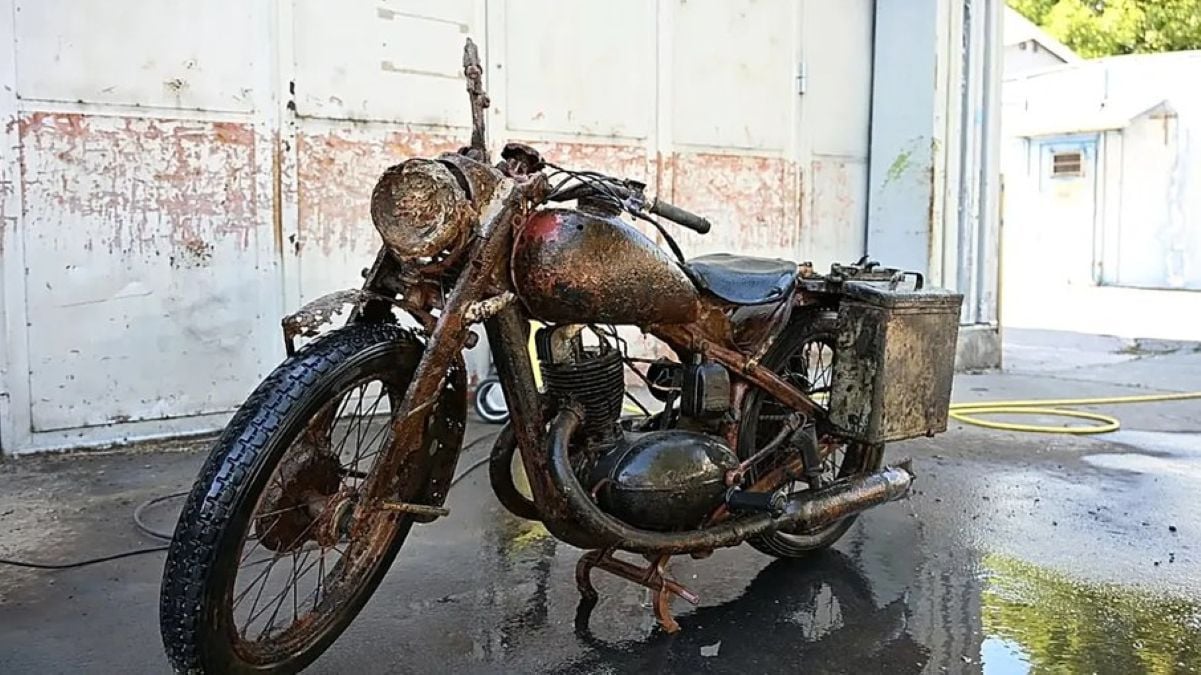
DKW NZ 350-1 was in the riverbed in front of the Hungarian Parliament in Budapest; intact signs indicate that the families were never warned
By
Júlia Haddad
Published on 2026-09-25 at 04:00 PM
Published on 2026-09-25 at 04:00 PM
Be the first to comment.
Summarize with:
The historic drought that lowered the level of the Danube River this summer brought to light in the center of Budapest (Hungary) a German military motorcycle from World War II and the remains of two Wehrmacht soldiers, more than 80 years after the end of the conflict. Next to the bodies, still unidentified, were two entire nameplates.
The discovery took place on August 2, in front of the Hungarian Parliament, in a stretch of the bed exposed by the record ebb and flow. The motorcycle was pulled from the mud by technicians from the Hungarian Institute and Museum of Military History, a partner of the German War Cemeteries Commission (Volksbund), an entity that locates and identifies German servicemen killed in combat and which announced the find.
At the site, the teams also found anti-tank mines, which required the action of bomb squads, as well as a gallon of fuel and a military decoration.
Motorcycle was used in reconnaissance
missions The model was identified as a DKW NZ 350-1, developed for the Wehrmacht and used from 1944. With a single-cylinder two-cylinder engine 346 cm³ of 11.5 hp, air-cooled, it was used for reconnaissance missions and the transport of orders and maps. About 12 thousand units were manufactured until the end of the war in 1945.
Even covered in mud and rust, DKW kept the frame, wheels, fuel tank and cargo trunks practically intact. According to the commission, the mud from the port, mixed with diesel oil, helped to preserve the motorcycle and the plates. The entity also states that the model was considered particularly robust and reliable at the time.
DKW was later incorporated into Auto Union, the origin of the current Audi. In Brazil, the brand became known for Vemag cars, such as the Belcar and the Vemaguet.
Identity of soldiers still a mystery
When a soldier died, half of the plaque remained with the body and the other was sent to Berlin so that the family could be notified. The fact that the two halves were together indicates that the deaths were never officially reported.
Speaking to Fox News, Volksbund spokeswoman Diane Tempel-Bornett said the plates were still being deciphered and that the identity of the soldiers remained unknown. According to her, the fact that they were next to the bodies does not guarantee that they belonged to them, although that is possible.
To identify the soldiers, experts analyze height, age and possible origin, as well as personal objects such as wedding rings, glasses, jewelry and documents, and cross-reference the data with military records. The cause of death is also uncertain: the spokeswoman said that it is only possible to speculate whether the soldiers tried to cross the frozen Danube, suffered a fall, were shot or drowned.
The site was the scene of the Battle of Budapest, fought between October 1944 and February 1945, in which about 30,000 German soldiers died. After the analysis, the two soldiers will be buried in the Budaörs war cemetery, on the outskirts of the Hungarian capital.
SEE MORE ABOUT

0 Comments
Comments are the sole responsibility of their authors and do not represent the opinion of this site. Comments containing profanity or offensive language will not be published. If you identify anything that violates the terms of use, please report it.