


Chinese bullet train accelerates from 0 to 800 km/h in 5.3 seconds and breaks record
1.1-ton prototype reached 800 km/h after 600 meters and stopped at 200 meters; The entire test, from start-up to immobilization, lasted eight seconds
By
Júlia Haddad
Published on 2026-08-18 at 01:30 PM
Published on 2026-08-18 at 01:30 PM
Be the first to comment.
Summarize with:
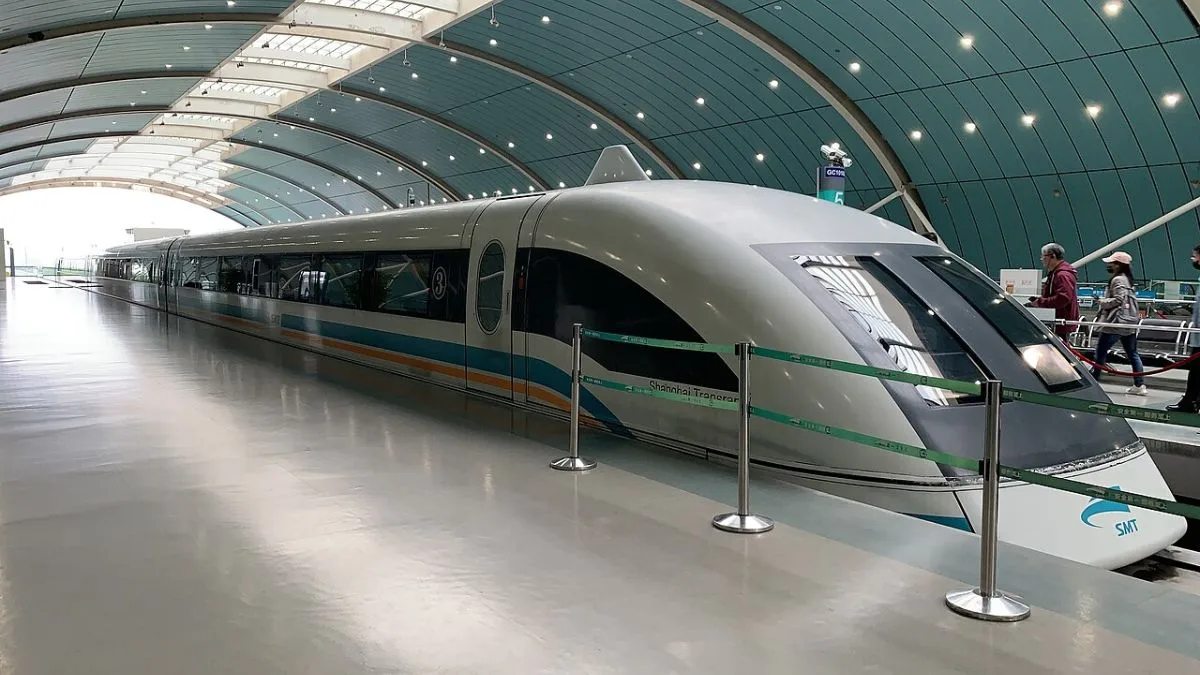
A prototype maglev train accelerated from 0 to 800 km/h in 5.3 seconds on a test track of just 1 km in Hubei province, China, the highest short-distance acceleration ever recorded for a rail vehicle.
The 1.1-ton unmanned vehicle reached maximum speed after 600 meters and was immobilized at about 200 meters by the electromagnetic braking system. From start to stop, the test lasted about eight seconds.
The test was conducted on November 24, 2025 by the Wuhan-based Donghu Laboratory and released at the end of December, after weeks of validation. The feat returned to international news this month, when China’s permanent mission to the UN republished the images of the photo shoot on social networks.
Average acceleration is about 42 m/s², or 4.3 g — more than four times what the fastest electric super sports cars extract in a sprint. In the interval in which a factory hot hatch still struggles to reach 100 km/h, the prototype was already at 800 km/h, close to the cruising speed of a commercial aircraft.
How a maglev train works
Unlike a conventional train, a maglev does not rest on wheels. Magnetic forces lift the vehicle above the track and eliminate contact with the rails — and with it, most of the friction. Coils along the route generate the fields that push it forward. It is this absence of contact that makes room for speeds unreachable by traditional railroads.
The Wuhan runway combines levitation by permanent magnets and electromagnetic propulsion. The short-distance acceleration method dispenses with the 30 km to 40 km of tracks required by conventional tests, but demands extreme precision. According to Li Weichao, director of the electromagnetic propulsion innovation center at Donghu Laboratory, the measurement of speed and positioning operates with a margin of 4 millimeters.
Three records in six months
The 800 km/h is the third record for the same project in six months. In June 2025, the vehicle reached 650 km/h in seven seconds. On July 14, it raised the mark to 700 km/h. The escalation comes as commercial maglevs in operation in China and Japan run at around 320 km/h, and Chinese high-speed trains are close to 350 km/h.
Passengers, however, are not on the immediate horizon. The acceleration of 4.3 g is incompatible with the transport of people, and the platform serves to develop electromagnetic propulsion, levitation control and operation at extreme speeds — with future uses also planned in electromagnetic launch and aerospace applications. Infrastructure cost, road alignment and safety requirements remain the biggest barriers.
In Brazil, the parameter is different. The São Paulo-Campinas Intercity Train (TIC), designed for up to 140 km/h, will be the first medium-speed service in the country. The Rio-São Paulo HST, authorized by ANTT and designed for up to 350 km/h, has not yet started its works.
SEE MORE ABOUT

0 Comments
Comments are the sole responsibility of their authors and do not represent the opinion of this site. Comments containing profanity or offensive language will not be published. If you identify anything that violates the terms of use, please report it.