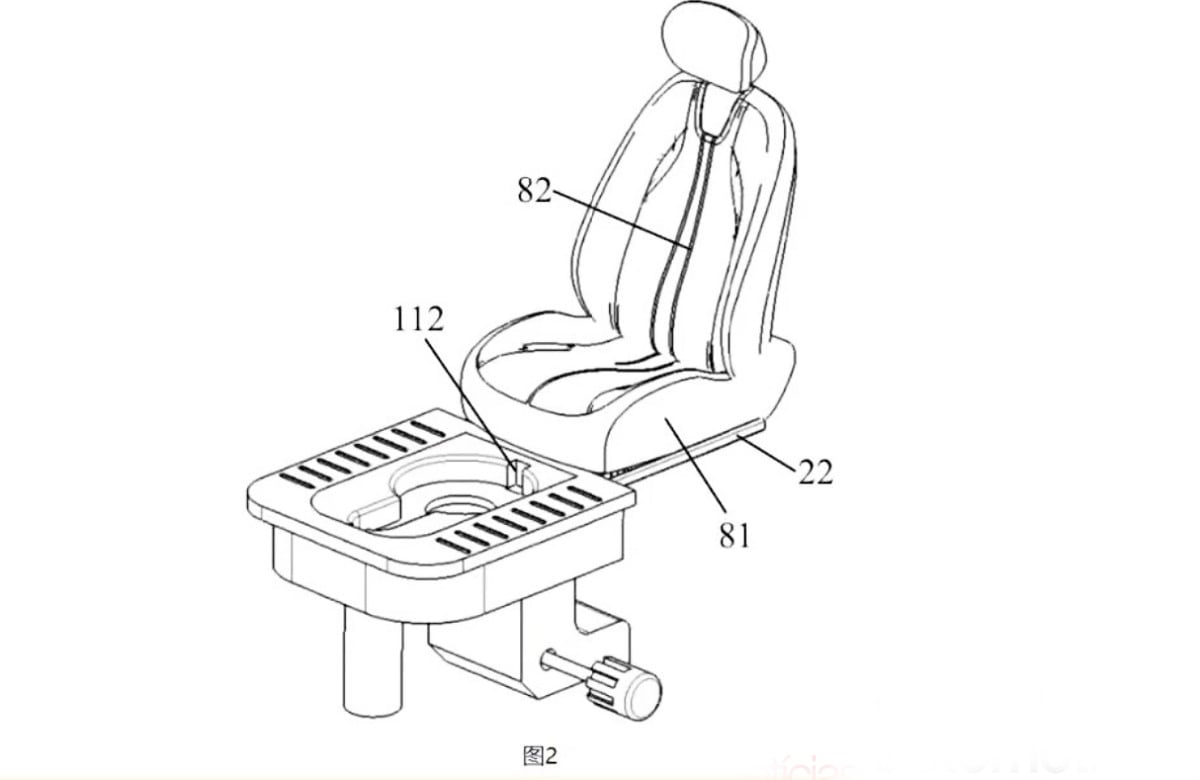
The Chinese manufacturer Seres — Huawei’s industrial arm in the production of vehicles of the Aito line — has registered an unusual patent for the automotive market: a toilet integrated into the cabin. Approved on April 10, 2026, the project describes a retractable system designed to be fully concealed under the passenger seat, transforming the space under the seat into an emergency toilet facility.
Unlike common portable toilets in motorhomes, the patent, formally classified as “arrangement of sanitary equipment in vehicles”, proposes a built-in solution. The mechanism uses slide rails connected to the seat. When activated, the structure advances to the living space, revealing the vase. After use, the set retracts under the seat, preserving aesthetics and circulation inside the vehicle.
Analysts point out that novelty may appear in the Aito M9 (Photo: Aito | Disclosure)
Despite the innovative proposal for long trips, Seres’ engineering will need to overcome complex technical obstacles before making production viable. In electric and hybrid vehicles, the floor is primarily occupied by the battery pack. This architecture makes it difficult to install drainage pipes and reservoirs for waste storage. There is also the need to ensure absolute sealing against odors in the closed environment of the cabin and to ensure the durability of the mechanical rail system.
In the Chinese market, automotive analysts point out that the patent may be part of a strategy to revitalize the Aito M9. The brand’s luxury SUV has accumulated three consecutive months of declining sales, with a 44.2% decline in recent deliveries. To regain space in the premium segment, Huawei and Seres are preparing a structural update of the utility for 2026. The inclusion of the integrated toilet could be offered as an exclusive option for VIP configurations or adaptations aimed at recreational use.
Comments are the sole responsibility of their authors and do not represent the opinion of this site. Comments containing profanity or offensive language will not be published. If you identify anything that violates the terms of use, please report it.