


China studies nuclear tank with cannon capable of hitting targets at 450 km
Peer-reviewed study predicts 10 MW reactor and 50 MJ electromagnetic cannon, with entry into service only after 2045
By
Júlia Haddad
Published on 2026-09-18 at 08:00 AM
Published on 2026-09-18 at 08:00 AM
Be the first to comment.
Summarize with:
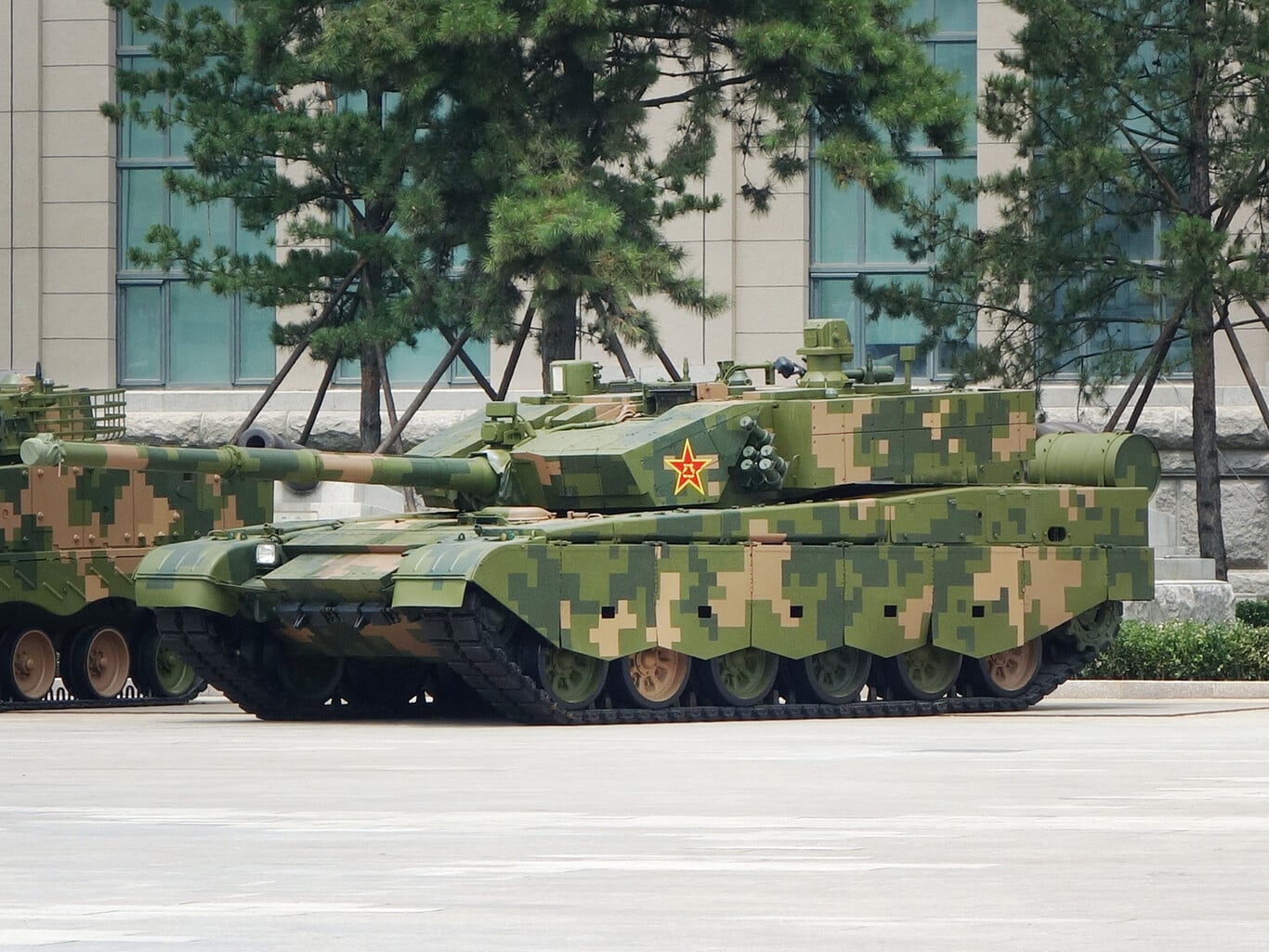
Chinese military researchers have presented the concept of a tank of about 60 tons powered by a compact nuclear reactor and armed with an electromagnetic cannon capable of hitting, in theory, targets up to 450 km.
The study, peer-reviewed, was published in June in the Chinese scientific journal Acta Armamentarii and predicts the entry into service of the nuclear version only after 2045.
The work is signed by the Inner Mongolia First Machinery Group, a historic manufacturer of Chinese armored vehicles, in partnership with the Beijing Institute of Technology. The weight places it in the category of the American Abrams and the German Leopard 2, well above the approximately 42 t of the Leopard 1A5 BR, the main combat vehicle of the Brazilian Army.
The reactor, however, is not there to provide autonomy. The objective is to power the electromagnetic cannon, or railgun, which accelerates metallic projectiles between two conductive rails by magnetic fields, without explosive propellant.
From diesel to atom, in three stages
There are three generations of the armored vehicle. The first, scheduled for until 2035, would maintain a diesel generator of about 1,500 hp combined with supercapacitors and flywheels to power a 10 megajoule (MJ) cannon, with an estimated range of 150 km. The set would also include a 2 MJ electromagnetic shield, capable of neutralizing anti-tank missiles before they pierce the hull.
In the second phase, between 2035 and 2045, the energy of the cannon would rise to 20 MJ, with a range close to 300 km, and the active armor would reach 10 MJ. Solid-state batteries, superconductors and an intelligent energy management microgrid on board would come into play.
Only in the third stage, after 2045, would diesel give way to a small 10 MW modular reactor (SMR), cooled by lead-bismuth, powering a 50 MJ cannon. The projectiles would leave at about 3.5 km/s, or 12,600 km/h, to reach the projected 450 km.
The bottleneck is electrical, not nuclear
The biggest difficulty, acknowledged by the authors themselves, is not in the atom. A 50 MJ cannon requires releasing an enormous amount of electricity in fractions of a second, something that a reactor, designed to deliver constant power, does not do alone. The charge would need to be accumulated between shots on capacitors and batteries, which makes power electronics the real obstacle of the project.
The physical requirements are equally harsh: the reactor would have to fit in 2 m³, with radiological shielding of a maximum of 3 t and recharging fuel every five years. Added to this are the heat dissipation and impacts of up to 30 g off-road.
An expert heard by the South China Morning Post newspaper classified as unrealistic to install a fission reactor in a manned armored vehicle, due to the shielding and cooling required and the risk of losing the reactor in combat. For him, the concept would make more sense on an unmanned platform.
For now, it is a conceptual study, not an ongoing program. The range of 450 km remains a project estimate, without practical demonstration.
SEE MORE ABOUT

0 Comments
Comments are the sole responsibility of their authors and do not represent the opinion of this site. Comments containing profanity or offensive language will not be published. If you identify anything that violates the terms of use, please report it.