


China hunts rocket in the air with net over ship and challenges SpaceX’s dominance
The country becomes the second in the world to recover an orbital rocket and the first to capture it in a net at sea, and not with landing legs
By
Júlia Haddad
Published on 2026-07-14 at 01:00 PM
Updated on 2026-07-14 at 03:23 PM
Published on 2026-07-14 at 01:00 PM
Updated on 2026-07-14 at 03:23 PM
Be the first to comment.
Summarize with:
China has recovered the first stage of an orbital-capable rocket for the first time, a feat achieved on the maiden flight of the Long March 10B rocket on July 10. With the operation, the country became the second nation — and the third organization, considering private companies — to bring back an orbital-class booster, behind only the American SpaceX and Blue Origin. The Chinese landing, in fact, was the first to do so by capturing the stage in a net, and not with landing legs.
The achievement represents a strategic breakthrough for China’s space program, as reusing rockets reduces costs and increases the frequency of launches. While the United States still leads the industry in number of orbital missions and lunar exploration projects, China has narrowed that gap in recent years.
A historic day in China’s space program!
China’s Long March-10B has successfully completed its maiden flight—and recovered its first stage via a sea-based net. This marks the country’s first-ever controlled rocket recovery. A major leap toward reusable launch capabilities…. pic.twitter.com/FWuQXLltaD
— Mao Ning 毛宁 (@SpoxCHN_MaoNing) July 10, 2026
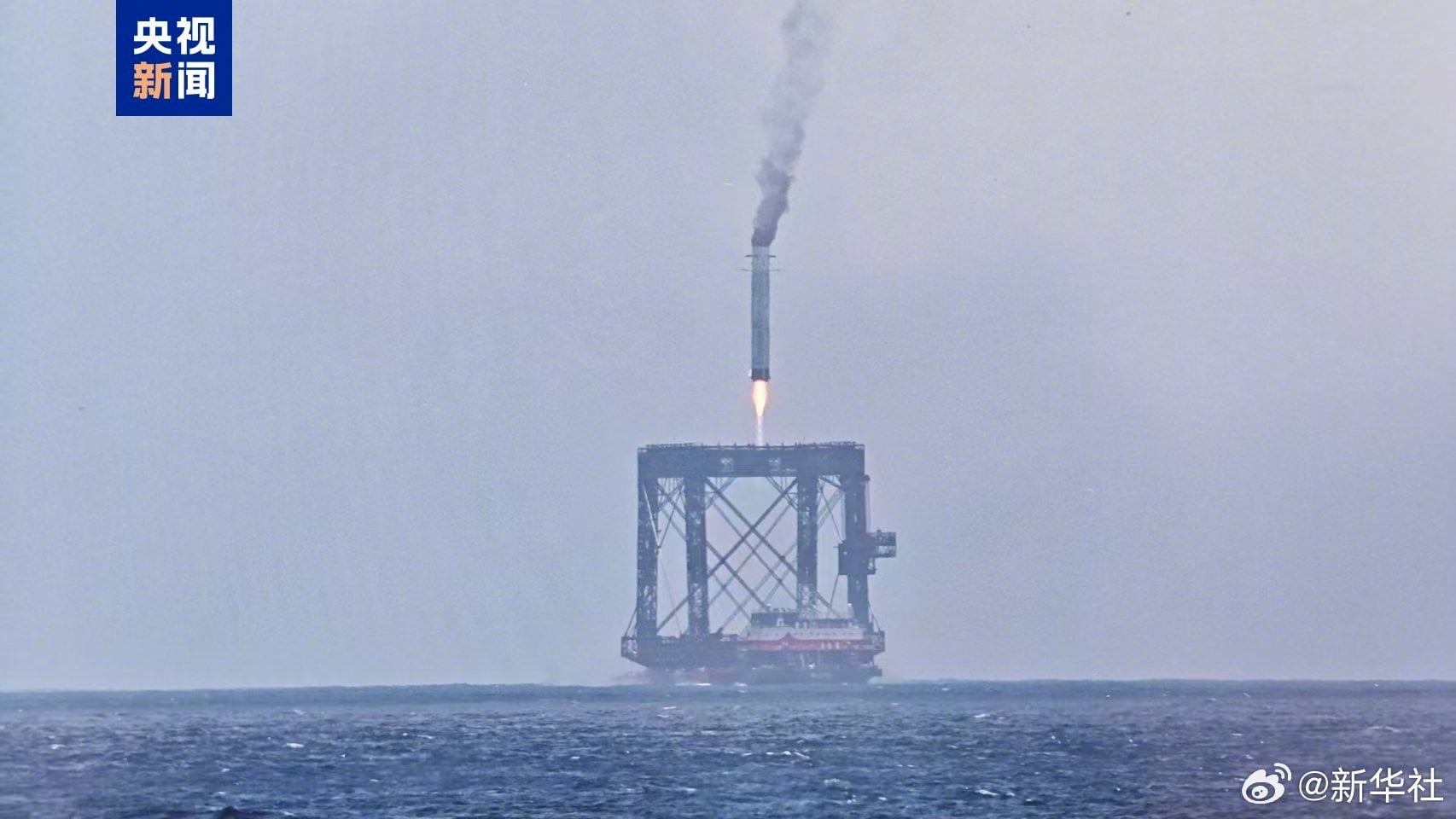
The rocket took off from the Wenchang Commercial Space Launch Center on Hainan Island in the south of the country. About six minutes after the separation between the first and second stages, the booster began a controlled and guided descent, with part of the engines restarted for the return, until it was captured by the recovery vessel Linghangzhe (“navigator”, in free translation).
Hooks installed in the fuselage attached to tensioned cables over the deck, while a damping hydraulic system absorbed the remaining energy. According to the China Aerospace Science and Technology Corporation (CASC), the state-owned company responsible for the project, it was the first recovery of a network-system transport rocket in the world.
According to the manufacturer, the method dispenses with the landing legs used by SpaceX and Blue Origin, which reduces the weight of the vehicle and increases the margin of error during capture — advantages that, according to engineers linked to the program, still need to be proven at scale, since there is only one successful recovery so far.
Developed by the China Academy of Launch Vehicle Technology (CALT), a subsidiary of CASC, the Long March 10B is 63 meters high, 5 meters in diameter and has a mass of about 760 tons at takeoff. The first stage is powered by seven YF-100K engines running on kerosene and liquid oxygen, while the second stage burns methane and liquid oxygen. In a reusable configuration, the rocket is capable of carrying up to 16 tons to low Earth orbit.
CASC said it intends to reuse the same recovered stage later this year — a decisive step to transform the demonstration into real savings, since a single recovery does not, by itself, constitute a consolidated reuse program.
China also has ambitious plans to expand its presence in space, which include the development of megaconstellations of satellites and manned missions to the moon. The Long March 10B is the cargo variant of the Long March 10 family, still under development, whose full version is expected to take taikonauts to the lunar surface by 2030. The United States, for its part, maintains a manned landing goal in 2028, within the Artemis program.
SEE MORE ABOUT

0 Comments
Comments are the sole responsibility of their authors and do not represent the opinion of this site. Comments containing profanity or offensive language will not be published. If you identify anything that violates the terms of use, please report it.