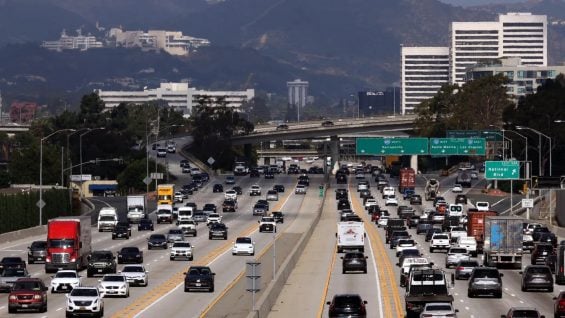
The California Department of Transportation (Caltrans) has submitted a proposal for the creation of a high-speed bus network, designed to operate in exclusive lanes and reach between 130 km/h and 225 km/h. The goal of the state project is to connect remote urban areas and tourist hubs that would be left out of a future rail route due to the high costs of implementing the tracks. To ensure road safety and fluidity, the collectives will not share traffic with passenger cars, using segregated lanes built parallel to the current highways.
The logistics concept is based on the use of vehicles with specialized engineering, improved aerodynamics and a focus on stability to maintain cruising speed during long routes. Preliminary feasibility studies indicate that, traveling at 160 km/h (100 mph), the journey between Los Angeles and San Francisco would be covered in less than four hours. The plan includes the use of the interstate highway axis such as 5 and 80, in addition to U.S. Route 101.
Although it has a lower operating speed than the future west coast bullet train, the integrated bus system requires a considerably lower financial investment. In addition, it offers greater flexibility in defining routes than fixed rails, whose infrastructure works accumulate a history of delays in the region.
Autobahn-inspired engineering challenges
The biggest obstacle to the realization of the plan lies in the limitations of the current network. The curves and resurfacing of the existing roads were designed for legal limits of up to 135 km/h. To allow a bus to travel at 225 km/h, the new lanes will require perfectly flat asphalt, rigorous maintenance, controlled inclines and wide run-off areas.
As a structural reference, the state of California sought paving guidelines on Texas toll roads and Germany’s famous Autobahn. Caltrans treats the proposal as a viable project and complementary to the billionaire local rail program, although the express bus network has not yet had an official date set to get off the ground.
Comments are the sole responsibility of their authors and do not represent the opinion of this site. Comments containing profanity or offensive language will not be published. If you identify anything that violates the terms of use, please report it.