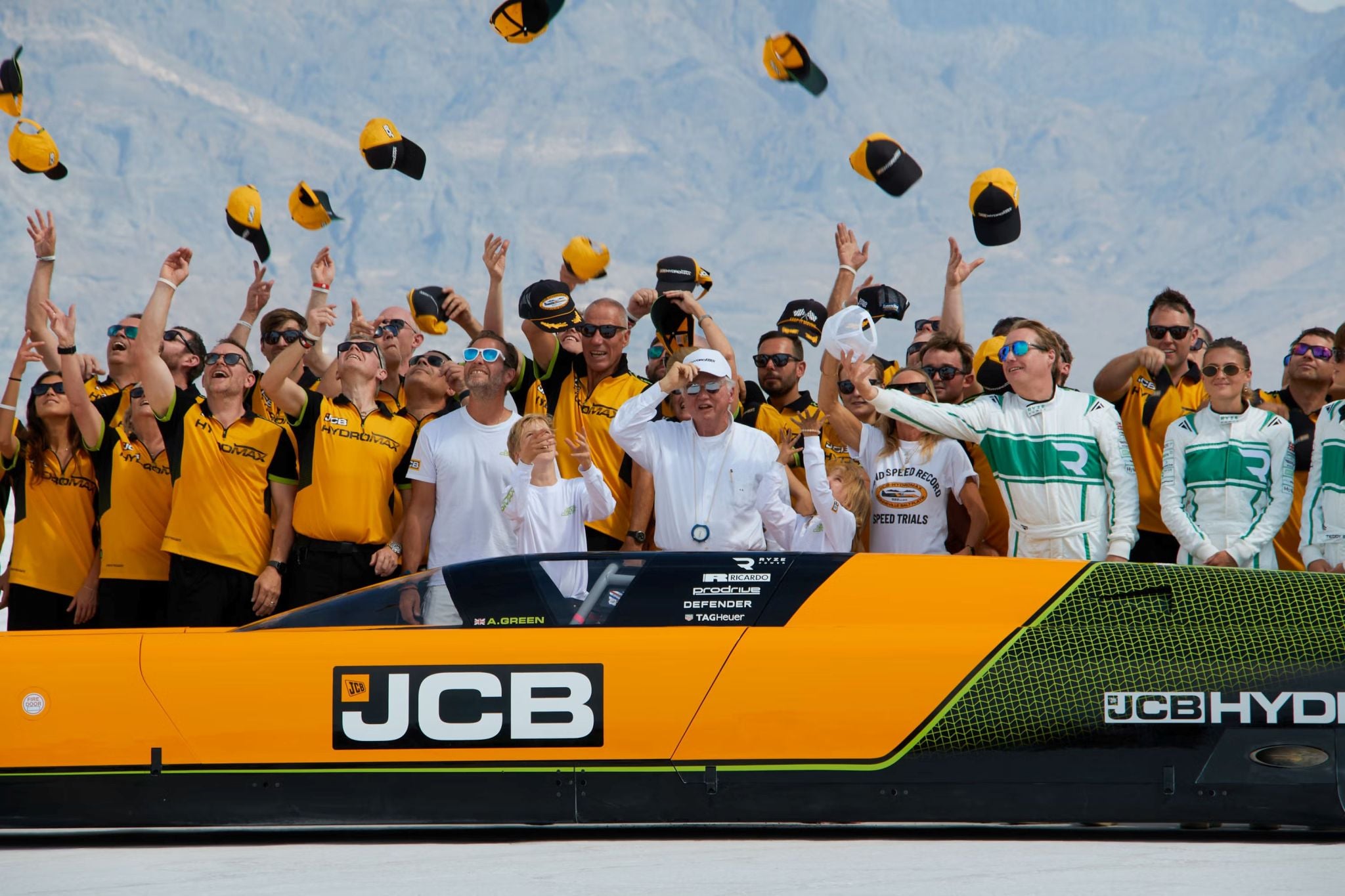
British driver Andy Green set the world speed record for hydrogen combustion engine cars. At the age of 64, the retired Royal Air Force officer averaged 653.909 km/h in the salt flats of Bonneville, Utah, on the 11th, at the wheel of the JCB Hydromax. The mark more than doubles the previous record in the category, of 298.5 km/h, set by the BMW H2R in 2004.
According to FIA rules, the average is worth two passes in opposite directions within an hour. Green did 644.7 km/h in the first and 663.3 km/h in the second, covering the timed mile in just under nine seconds. The entity made the attempt official and confirmed the result, which also surpasses the record of 487.6 km/h for hydrogen fuel cell vehicles.
Foto: Reprodução
Two excavator engines
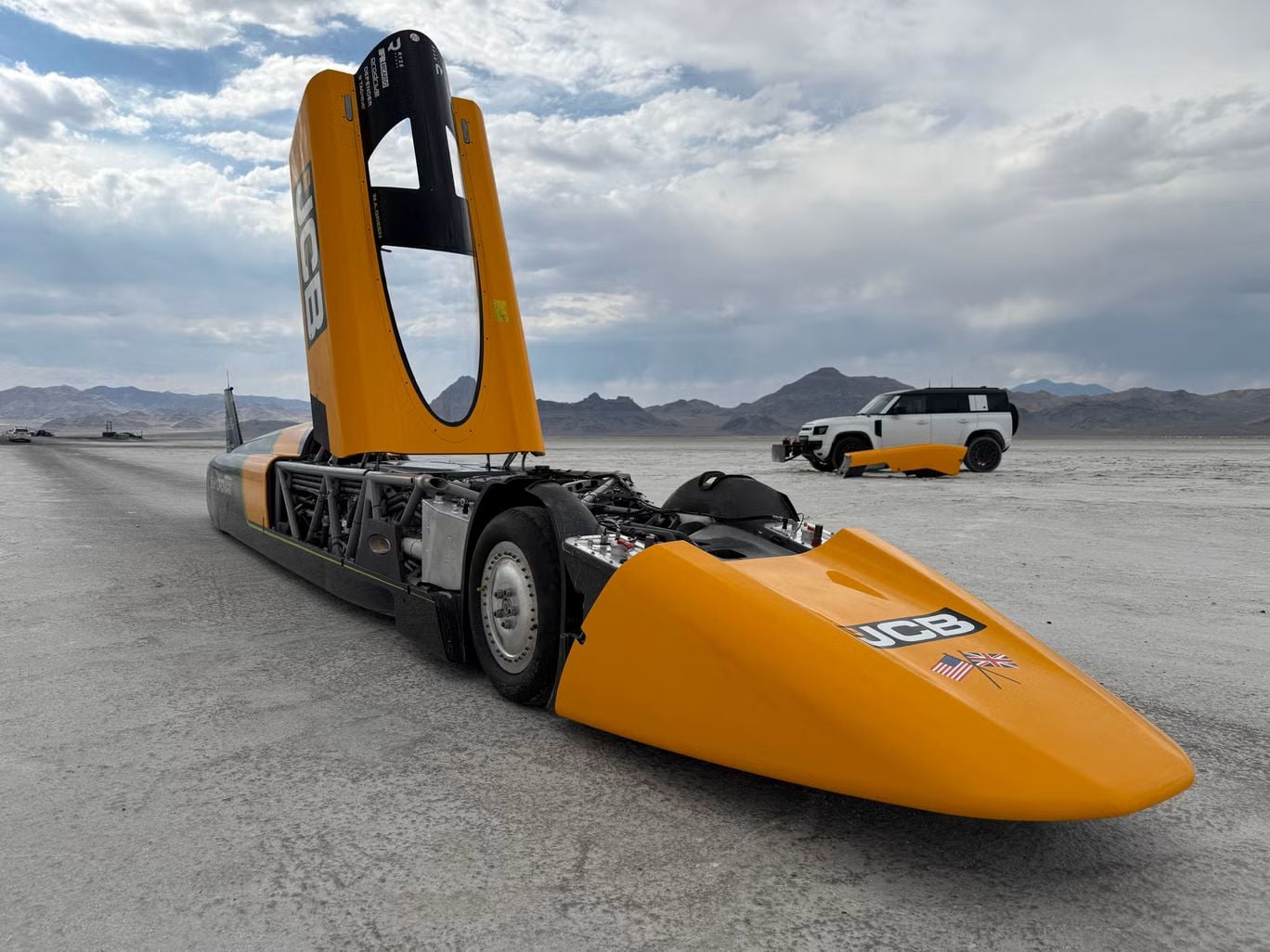
With 9.75 m in length, the Hydromax is powered by two standard derived engines, the same ones that JCB uses in its construction machinery, produced at the plant in Foston, England. Each one yields 811 hp, which gives 1,622 hp as a whole.
The architecture is unusual: one engine sits behind the rider and moves the rear wheels, while the other, in front, drives the front wheels. The car was built by Prodrive, with two gearboxes supplied by Xtrac, one for each engine. Green rides inside a composite sub-monobloc, protected by a steel cage in the style of those used in drag racing.
The project is part of a hydrogen program in which JCB claims to have invested 100 million pounds, with 150 engineers and more than 150 engines already produced. Before Bonneville, the car had reached 335 km/h in May tests at Wittering Air Force Base in the United Kingdom. On August 5, it also broke the record in the SCTA supercharged engine aerodynamic class, with an average of 592.8 km/h.
From Dieselmax to supersonic
The record marks Green’s reunion with JCB two decades after the Dieselmax, a diesel car he took to 563.4 km/h in 2006, in the same salar, a mark that still stands. He is also the first and only person to surpass the speed of sound on land: 1,227.985 km/h with the ThrustSSC, in 1997, in the Black Rock Desert in Nevada.
Photo: AP Photo (Hannah Schoenbaum)
“Twenty years ago we came to Bonneville with the JCB Dieselmax and showed what British engineering could do with diesel. Today we did it again, this time with hydrogen-powered engines,” said Anthony Bamford, chairman of the board of JCB, who conceived the attempt.
The company presents the technology as zero-emission, an argument that still meets resistance: most of the hydrogen produced in the world comes from fossil fuels. JCB signed an agreement to buy green hydrogen, obtained from renewable energy, a modality that accounts for a small share of global production.
Comments are the sole responsibility of their authors and do not represent the opinion of this site. Comments containing profanity or offensive language will not be published. If you identify anything that violates the terms of use, please report it.