


Traffic Turning Rules: See What Silly Mistakes You Make Every Day
Although they seem very basic, several drivers still make mistakes when converging that can generate fines
By
Julia Vargas
Published on 2026-07-27 at 07:00 PM
Published on 2026-07-27 at 07:00 PM
Be the first to comment.
Summarize with:
The act of turning right or left while it is something natural and routine for those who drive any type of vehicle, precisely because it is a maneuver performed dozens of times throughout the day. But, over time, this habit can become an action done in “automatic mode” and with that many people end up making mistakes in the turn, which can constitute a traffic violation and increase the risk of collisions.
Conversion is nothing more than an angled movement, to the left or right, of changing the original direction of the vehicle, whether at an intersection, junction or side access, entering another street or avenue. And when this happens, the trajectories of different road users intersect.
SEE ALSO:
- How to replace a fine with a written warning?
- Know who has the right of way at intersections without signaling
- Does pedestrian always have preference? It depends on where it’s circulating
Although it seems like a very basic driving concept, small mistakes in positioning or when following signs are very common and can be punished by law or even represent some kind of danger.
Most common mistakes when converting
Although it seems like a simple action, to be done correctly, it requires advance preparation. The driver needs to observe the local signs, position the vehicle in the appropriate lane, reduce speed, activate the direction indicator (arrow) and check if there are safe conditions before completing the movement.
Failure to comply with the rules of conversion is among the main causes of accidents at urban intersections. See the most frequent mistakes, their risks and the framework in the legislation:
| Frequent Error | Risk of Accident | Classification in the CTB |
|---|---|---|
| Steering from the wrong lane (Art. 197) | Side collision by closed in another vehicle | Medium Infraction (R$ 130.16) |
| Do not give an arrow in advance (Art. 196) | Rear-end collision due to lack of flow | Serious Infraction (R$ 195.23) |
| Invading the opposite lane during the curve | Head-on collision or blocking of oncoming | Serious Infraction (R$ 195.23) / Very Serious (R$ 293.47) |
| Not checking the side | Running over motorcyclists or cyclists in the corridor | High risk of serious accident |
| Disrespecting the pedestrian’s preference (Art. 214) | Being run over in lanes or crossings | Very serious infraction (R$ 293.47) |
| Making a turn in a prohibited place (Art. 207) | Flow Surprise Interception | Serious Infraction (R$ 195.23) |
What does the Brazilian Traffic Code (CTB) say?
Article 38 of the CTB establishes that, when leaving the road on the left or right side, the driver must give way to pedestrians and cyclists, as well as to vehicles traveling in the opposite direction in the lane from which he is going to leave.
In addition, the legislation brings central points that every driver needs to establish:
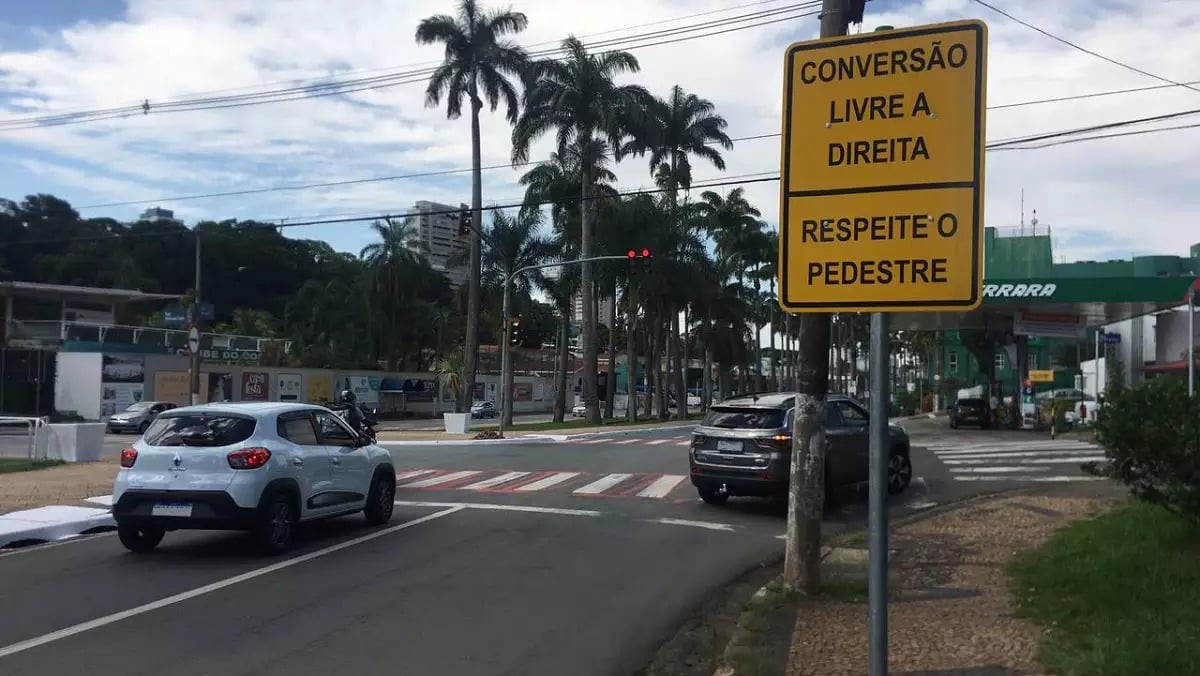
- Priority to the pedestrian: pedestrians who have already started crossing the destination road have preference to pass, even if the traffic light is open for the vehicle that makes the turn.
- Respect for exclusive lanes: if there are signs indicating specific lanes for turning, the driver must strictly respect them.
- Prohibition of signalized turn: places where there is a sign “No Left Turn” or “No Right Turn” prevent the maneuver, even if the road seems momentarily free.
How to Do a Transit Conversion Correctly
To make the turn safely and within the legal standards, the driver must adopt the following preventive route:
- Early observation of signs: check regulation signs, road markings on the asphalt and traffic lights before reaching the corner or intersection. On some roads, there are exclusive lanes to turn.
- Correct positioning in the Lane: Get as close as possible to the right or left edge of the lane, when it is one-way. To turn on a two-way street, approach the center of the lane, over the dividing line of the flow, without invading the wrong way.
- Advance signaling (use of the arrow): activate the turn signal early enough so that vehicles coming behind and on the side roads recognize your intention.
- Speed reduction and surroundings check: Downshift and check the rearview mirrors and blind spots, making sure there are no pedestrians crossing or motorcyclists traveling next to the vehicle.
SEE MORE ABOUT

0 Comments
Comments are the sole responsibility of their authors and do not represent the opinion of this site. Comments containing profanity or offensive language will not be published. If you identify anything that violates the terms of use, please report it.