

Rollover: see safety tips, step by step to get out of the situation and what NOT to do
Guidelines from the Fire Department detail the correct procedure for evacuating the vehicle and warn of serious errors that can be made in the rescue
By
Julia Vargas
Published on 2026-08-30 at 01:00 PM
Published on 2026-08-30 at 01:00 PM
Be the first to comment.
Summarize with:
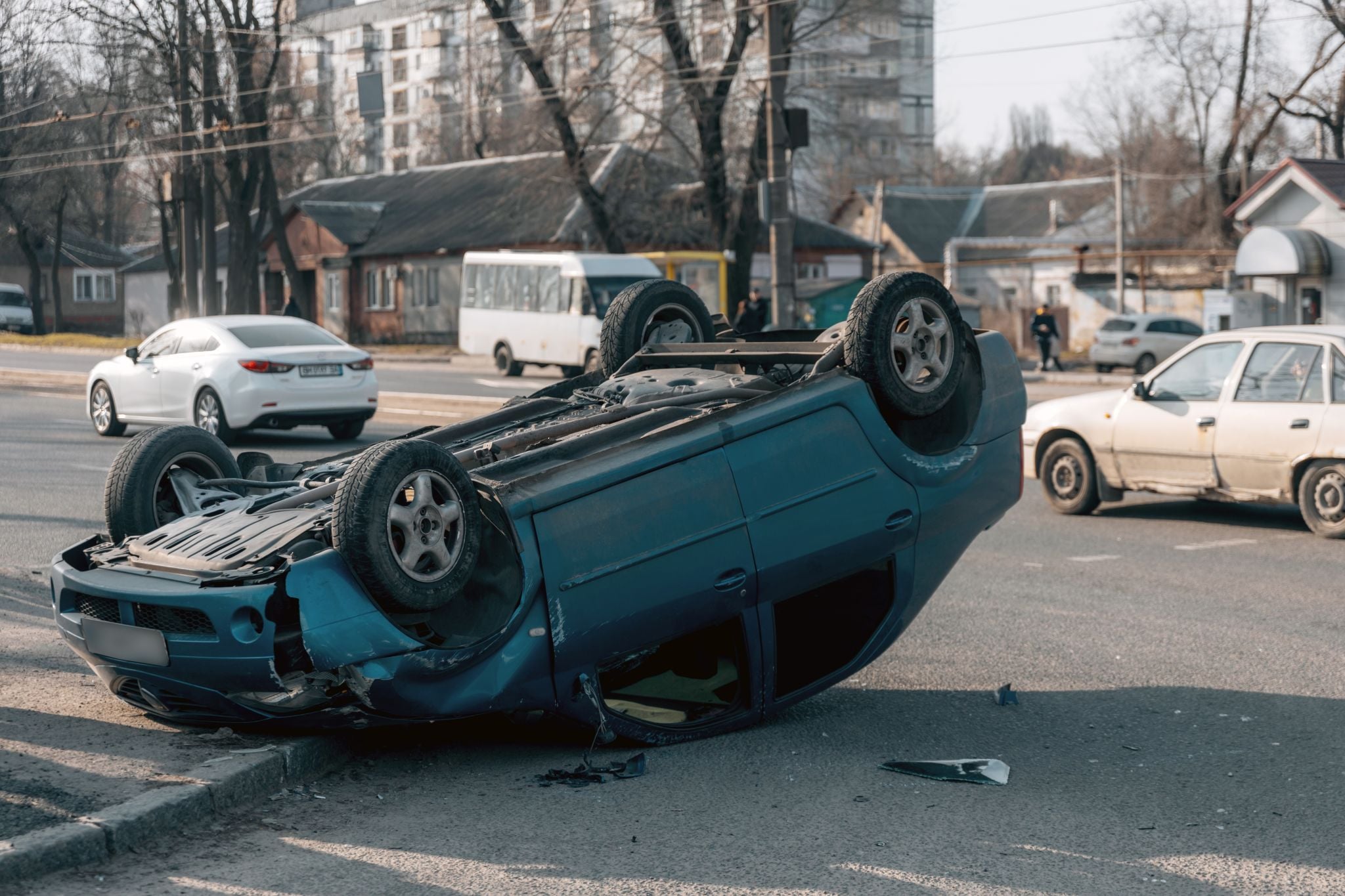
A rollover is among the most dangerous situations in traffic and can generate the most panic, both in those involved and in the people trying to provide help. This type of accident is usually associated with high speed, reckless actions and adverse road conditions, so they require careful and assertive reactions to reduce the risk and prevent victims from getting hurt.
However, desperation often speaks louder and the people involved end up making wrong decisions that can make the situation worse, such as unfastening the seat belt. Check out the risk factors in a rollover, safety tips and how to provide help below.
SEE ALSO:
- If your car rolls over, don’t unbuckle your seatbelt! Here’s what to do to get out safely
- There is no more traffic accident, now it’s a traffic accident; understand the difference
- Do you know all the fluids present in your car?
What risks does a victim face when the car overturns?
A rollover or overturn happens when the vehicle, due to some impact or maneuver, rotates around its own axis and ends up on its side or upside down. This situation involves a very large transfer of energy and movements in various directions.
For this reason, the 1st Lieutenant of the Military Fire Department of Minas Gerais (CBMMG), Elias Cristovam de Souza Júnior, says that, even if the victim is apparently well, the possibility of trauma to the head, neck and spine should be considered, as well as fractures, hemorrhages and internal injuries.
In addition to the injuries themselves, there are risks related to the scenario:
- The vehicle should be considered potentially unstable, especially if it is on its side, on the roof, in a ravine or supported by another object;
- There may be fuel leakage, fire outbreak, exposed windows and hardware, electrical wires, traffic passing close to the accident and, in hybrid or electric vehicles, high voltage components.
- The victim’s position in the overturned vehicle can also generate risks, as he can be ejected during the accident, be unconscious inside the vehicle or with disabling injuries, trapped in hardware, retained in a seat belt or even in postural asphyxiation, in which the victim’s own weight on the airways blocks the flow of air to the lungs.
What the victim of a rollover should do to stay safe
According to the CBMMG representative, if the car is turned upside down or taken, but there is no immediate danger, the victim should not be in a hurry to get out of the car. The person should:
- Remain calm;
- Avoid sudden movements, especially of the head and neck;
- Check if there is any part of the body attached;
- Call the Fire Department at 193 or ask someone to do so.
However, if there is an immediate threat to life, such as a fire, intense smoke, risk of submersion or other danger that makes staying inside more risky, the indication is for the emergency exit. In this case, you should try to reduce sudden movements as much as possible.
A video published by the City Hall and the Municipal Traffic Superintendence of Senador Canedo (GO) that went viral on social networks teaches how to get out of this situation safely. According to the instructions of the publication, which exceeds 2 million views, the recommendation is never to remove the seat belt immediately.
Correct evacuation procedure:
- Look for firm support: place one hand on the door or other hard surface to control the descent.
- Steady your feet: position your feet firmly against the roof of the vehicle (facing down) to support your body weight.
- Unfasten your seat belt: only after your body is completely stabilized and supported, unbuckle your seat belt.
- Kneel: Rest your knees carefully on the roof of the car.
- Leave on your back: head towards the available door or window and leave on your back, maintaining slow and controlled movements.
- One at a time: if there are more passengers, the evacuation must be done individually, in an orderly manner.
What a person who is going to provide aid should NOT do
The main rule of thumb for those who are going to help a victim of a traffic accident is: do not turn a stable situation into a major emergency. 1st Lieutenant Elias Cristovam de Souza Júnior states that you should not try to carry out a rescue for which you do not have training or equipment.
The main mistakes that should be avoided are:
- do not forcibly remove the victim from the vehicle, pulling on the arms or legs;
- do not ask the victim to get up, walk or turn their head to “see if everything is okay”;
- do not abruptly release the belt of someone who is suspended upside down, because the victim may fall on their head or neck;
- do not shake, push or try to “turn around” the vehicle;
- do not get into an unstable car unnecessarily;
- do not handle hardware, electrical components, airbags or high voltage systems;
- do not remain close if there is fire, smoke, intense smell of fuel, electrical wires or other serious risk;
- do not offer water, food or medicine to the victim.
First of all, it is necessary to understand that to provide aid is Ensuring their own safety, as a second accident can turn the person who was trying to help into another victim. The person must observe the scene of the accident, including traffic, possible fires, oil and fuel leaks, electrical wires and the position of the car. The most important thing is to consider the stability of the vehicle: the final position of the rollover is unstable and can generate new movements, so this risk must be constantly monitored.
Then, whoever is going to provide the aid can follow this step by step:
- Immediately call the Military Fire Department by the number 193, informing the location, number of victims, position of the vehicle and if there are people trapped;
- Signal the place, as long as this can be done without placing yourself in the flow of vehicles;
- Approach only if it is safe;
- Talk to the victim and reassure him. Advise him not to move his head or try to get out of the vehicle.
- Observe if the victim breathes and is conscious, as well as if he has heavy bleeding while help arrives.
- If there is a high-flow hemorrhage and it is possible to reach it safely, make the first care by pressing the place with gauze, bandage or clean fabric available clean.
- If there is a fire or other immediate threat to the victim’s life, emergency evacuation may be necessary, as long as the rescuer is able to carry it out without exposing himself to serious risk. One should not enter an area taken by fire to attempt a rescue without protection and training.
- It is possible to shim the victim so that he has stability.
Children, the elderly or people with reduced mobility require greater care
In the case of more vulnerable individuals, such as children, people with disabilities and the elderly, for example, extra care must be taken, especially to avoid improvised movements, according to the Lieutenant of the Fire Department.
Babies and children are at risk of postural
asphyxiation In the case of children and babies, there is already a risk of postural asphyxiation in a normal situation, in the car seat itself. This happens because babies, especially the younger ones, have less control of their bodies, so if they are poorly positioned, their head can fall forward and their chin get closer to the chest, narrowing the airway and making it difficult to breathe. This phenomenon, in an accident, can be aggravated.
In the case of children, if they are properly attached to the restraint device (car seat or car seat) and there is no immediate danger, it is also not recommended to remove it to check that it is okay. First aid guidelines recommend that babies and children remain in the restraint device when there is a possibility of injury to the head, neck or spine.
Except when it is necessary to carry out a vital intervention, such as emergency evacuation due to a fire outbreak. In case of possible postural asphyxia, it is recommended to align the airways carefully so that the victim breathes more easily.
Elderly people and people with reduced mobility have similar
recommendations You should not try to put them on their feet or carry them in an improvised way. In addition to the possibility of trauma, these people may have greater difficulty supporting their own bodies during the exit. In these cases, whenever there is no immediate threat, the guidance is to wait for the specialized team, which will be able to stabilize the vehicle, create an adequate access road, and make a controlled removal.
SEE MORE ABOUT

0 Comments
Comments are the sole responsibility of their authors and do not represent the opinion of this site. Comments containing profanity or offensive language will not be published. If you identify anything that violates the terms of use, please report it.