


If your car rolls over, don’t unbuckle your seatbelt! Here’s what to do to get out safely
Wrong decisions can cause serious injuries; Understand the correct safety procedure and how to trigger the rescue
By
Julia Vargas
Published on 2026-08-01 at 01:00 PM
Published on 2026-08-01 at 01:00 PM
Be the first to comment.
Summarize with:
Traffic accidents involving rollovers are among the most serious and scary occurrences on the roads. This type of accident is usually associated with high speed, reckless actions and adverse road conditions, so they require quick reactions to avoid aggravating injuries and save lives.
However, desperation often speaks louder and the people involved end up making wrong decisions that can make the situation worse, such as unfastening the seat belt. Check below for safety guidelines inside the vehicle and the correct safety procedures for dealing with a rollover.
SEE ALSO:
- Have you been in a traffic accident? Check out what to do
- There is no longer a traffic accident, now it is a traffic accident; understand the difference
- Your mobile phone can detect that you have been involved in a traffic accident and save your life
What to do if the car rolls over
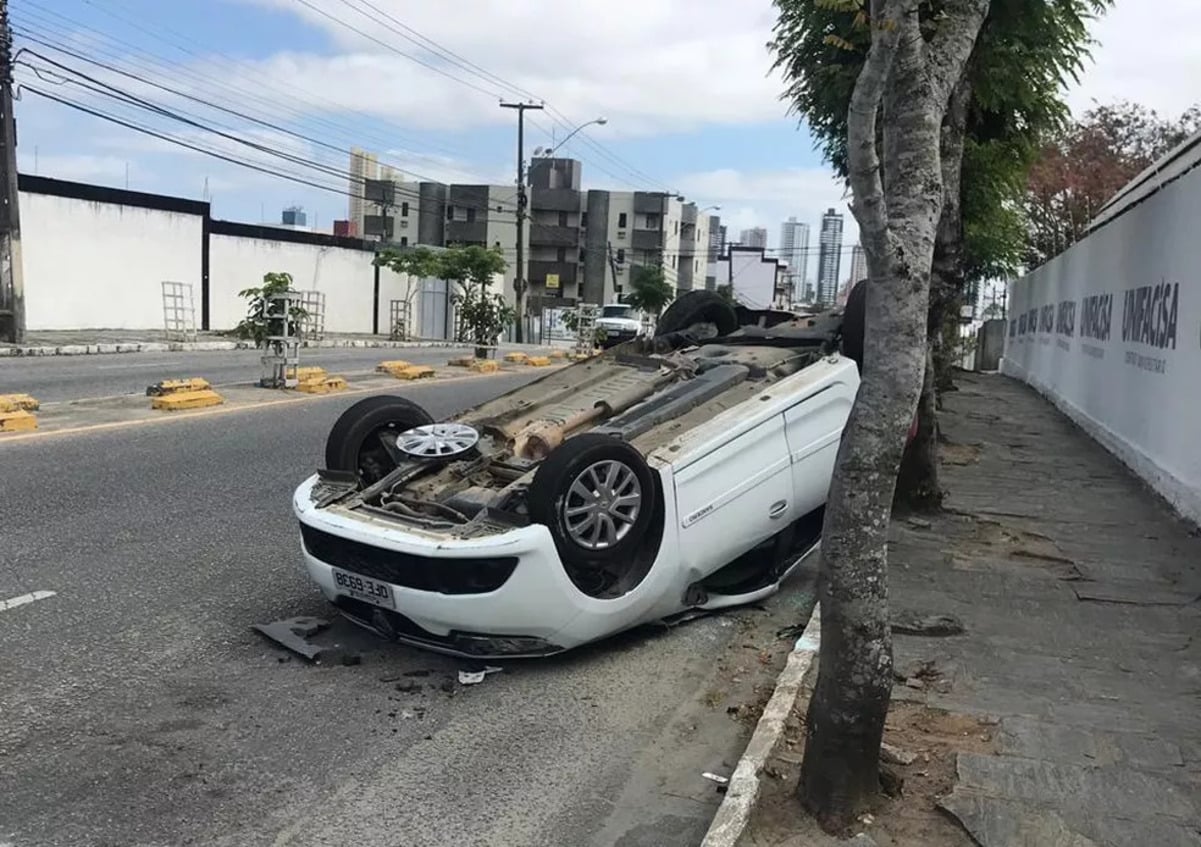
When the car flips over, it doesn’t just tip over to its side, it spins on itself and ends up stationary with the wheels facing up. This situation often generates panic, especially for those inside the vehicle, but adopting the correct evacuation technique drastically reduces the risk of trauma.
A video published by the City Hall and the Municipal Traffic Superintendence of Senador Canedo (GO) that went viral on social networks teaches how to get out of this situation safely. According to the instructions of the publication, which exceeds 2 million views, the recommendation is never to remove the seat belt immediately.
As the vehicle is inverted, unfastening the belt instinctively causes the occupant to fall directly against the ceiling (which then acts as the floor), which can cause or aggravate serious injuries to the neck, head and spine.
Correct evacuation procedure:
- Look for firm support: place one hand on the door or other hard surface to control the descent.
- Steady your feet: Position your feet firmly against the roof of the vehicle (facing down) to support your body weight.
- Unfasten the seat belt: only after your body is completely stabilized and supported, unbuckle the seat belt.
- Kneel: Rest your knees carefully on the roof of the car.
- Exit on your back: head towards the available door or window and exit on your back, maintaining slow and controlled movements.
- One at a time: if there are more passengers, the evacuation must be done individually, in an orderly manner.
If there is no imminent danger (such as fire or intense smoke) and serious injuries are suspected, especially to the spine, the safest thing is to remain motionless inside the vehicle and wait for specialized rescue to arrive.
How to proceed in accidents and call for help
When witnessing or being involved in a rollover, the first step is to assess the severity of the damage and check for the presence of victims.
- Site preservation and signage
The area of the accident must be immediately signaled to avoid further collisions. If there are injuries, never move the victims, as incorrect handling can generate irreversible sequelae.
- Useful emergency telephone numbers
If there are any injured people, immediately call the public rescue and security services:
- SAMU: 192
- Fire Department: 193
- Federal Highway Police (PRF): 191
- Military Police (PM): 190
- Occurrence record
In accidents with victims, even with minor injuries, the preparation of the Occurrence Report (B.O.) is mandatory and must be done at the nearest police station.
SEE MORE ABOUT

0 Comments
Comments are the sole responsibility of their authors and do not represent the opinion of this site. Comments containing profanity or offensive language will not be published. If you identify anything that violates the terms of use, please report it.