


“National Blue Belt”: understand how it will work and its rules
Bill that creates motorcycle corridors inspired by the São Paulo model advances in the Chamber of Deputies
By
Julia Vargas
Published on 2026-05-08 at 08:00 AM
Updated on 2026-05-08 at 08:28 AM
Published on 2026-05-08 at 08:00 AM
Updated on 2026-05-08 at 08:28 AM
Be the first to comment.
Summarize with:
The creation of preferential lanes for motorcycles, inspired by the “Blue Belt” model of São Paulo, took a step towards national implementation. The Traffic and Transport Commission of the Chamber of Deputies approved Bill 1656/25, which provides for the signaling of these preferential lanes in Brazilian capitals, in the Federal District and on federal and state highways.
The rapporteur of the proposal, Deputy Flávio Nogueira (PT-PI), presented a substitute to the original text of Deputy Fred Linhares (Republicanos-DF). The main change was the exclusion of the obligation for smaller municipalities, aiming to preserve municipalities with fewer financial resources and prioritize urban centers and highways where the volume of motorcycle traffic is high.
SEE ALSO:
- Chamber of Deputies wants plaques to have city and state again
- Blue stripe: it is not enough to demarcate, it is necessary to be civility in front of the handlebars
- Traffic lane and its colors: learn the meaning to avoid fines
Check out the main questions about the operation of the blue belt that has existed in São Paulo for years.
What is the blue belt? Is it exclusive to motorcycles?
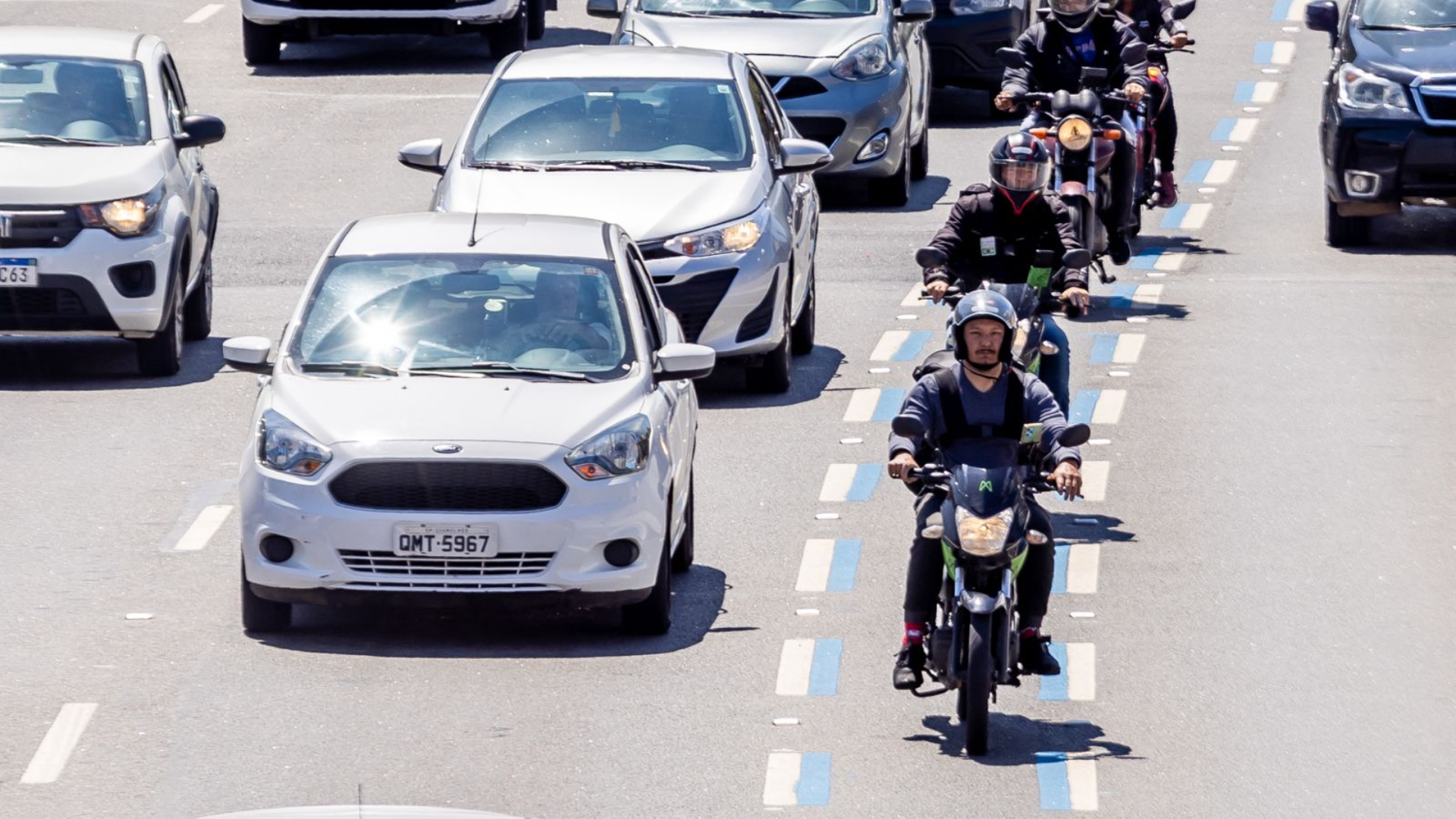
The Blue Lane is a safety sign for motorcycles, usually located between the leftmost lanes of the road. São Paulo is 232.7 km long in the Blue Belt and contrary to what many think, its use is not mandatory, it is preferential.
Therefore, it is not exclusive to motorcycles, but works as a demarcation between lanes so that motorcycles can travel with more discipline and safety, and without changing the dynamics already existing on the road.
With a preferential space for motorcycles, will the other lanes change?
Many drivers are afraid that, with the delimitation of this area, the space for vehicles in the other lanes will be reduced and impaired, but this is not what happens in São Paulo and what is proposed in the PL.
The lanes do not get narrower and are approximately 2.70 m wide, even with the preferential delimitation for motorcyclists.
Does the blue belt change the dynamics of changing lanes?
Drivers also do not have to worry about changing the lane, as it follows the same logic. There must be signs and signs on the asphalt throughout the road warning of care in exchange and circulation.
The project foresees that the motorcycle corridor will be strategically installed between lane 1 (far left) and lane 2 (the second leftmost lane) to make official the space where motorcyclists already usually travel, but now with specific signage to increase predictability and safety for all drivers.
Next steps of the national blue belt bill
The project now goes to the Constitution and Justice and Citizenship Commission (CCJ) for analysis in a conclusive manner. If approved without reservations, the proposal will not need to go through the plenary of the Chamber, going directly to the Senate before becoming law.
SEE MORE ABOUT

0 Comments
Comments are the sole responsibility of their authors and do not represent the opinion of this site. Comments containing profanity or offensive language will not be published. If you identify anything that violates the terms of use, please report it.