CNH PwD: check out step by step to obtain and what are the requirements
Understand who is entitled to the special license, what documents are required and mandatory steps to obtain the document
One of the main steps is the Special Medical Board, which qualifies aptitude and defines which data should be included in the CNH PwD (Photo: Shutterstock | AutoPapo)
By law, people with disabilities (PwD) have the right to acquire a license and drive autonomously and safely, if their condition allows it. Therefore, this group needs a special process to obtain the National Driver’s License (CNH) with extra and specific steps, as well as adapted vehicles.
The CNH PwD, also called a special license, is a different document from the conventional license and confers some benefits to the driver. It describes the adaptations or needs and its carrying grants some rights.
In this article you can check out the process to get the license, who has it can get it, how the renewal works and what are the rights of drivers with disabilities.
Step by step to obtain the CNH for PwD
The main difference in relation to the application for a common driver’s license is that, in order to get the Special CNH, the PwD has to go through a medical board that will examine the extent of their disability.
To obtain the document, the first step is to gather the necessary documentation. This includes filling out the application for Special Medical Board Evaluation, available on the website of the State Traffic Department (Detran) of your state.
Required documents
Apart from the application, it is necessary to pay the registration fee for the CNH, as well as all other candidates and also present:
Original medical report, issued by a doctor accredited by the DMV;
Copies and originals of RG, CPF and proof of residence;
If you already have a CNH and are looking for a change of category, it is important to also take the current CNH.
Prepare for the special medical examination
Before scheduling the evaluation of the medical board at an accredited clinic with the DMV, the PwD must prepare some documents to prove that they are able to drive safely, even with adaptations in the vehicle.
According to consultant and professor of Traffic Law Julyver Modesto:
There are situations in which the disability or clinical condition can make the candidate unfit to drive, especially when there is no possibility of compensation for vehicle adaptation or when the condition irreversibly compromises driving safety. In these cases, the result may be unfitness, according to the criteria of Resolution No. 927/22 of the National Traffic Council (Contran).”
Mara Ligia Kiefer, partner and leader of inclusion projects at Somar Diversidade and member of SAE (Society of Mobility Engineers) Women, points out that it is essential to bring a report containing the history of disability in detail to the medical board. This includes:
the cause of the disability;
whether it is congenital or has been acquired;
what the sequelae are, with detailed explanations;
what are the limited motor and/or sensory conditions;
what are the impediments;
the International Classification of Diseases (ICD).
According to the inclusion specialist, “the more detailed the report, the greater the chance of recognizing the limitations to also obtain the Special CNH for Persons with Disabilities, including Non-Visible Limitations”. The DMV medical board is responsible for validating all documentation presented, so it is extremely important to provide a complete report and complementary exams, if any.
These exams that support the document may include:
MRIs, X-rays and CT scans;
Psychiatric Diagnosis;
Ophthalmic or auditory diagnoses;
Functional and Occupational Examinations that show the extent of the limitation or range of motion.
Steps to get the license
After providing all the necessary documents and reports, the aspiring driver must follow the following steps:
Evaluation by the Special Medical Board of the DMV;
Registration of these restrictions with the DMV and, if necessary, request for prior authorization for vehicle modification;
Theoretical course;
Biometric collection;
Psychological evaluation;
Theoretical exam;
Practical course in vehicle driving;
Vehicle driving test.
With the result provided by the medical expert, even if the PwD has not been considered fit to drive, she can still acquire a vehicle and define another individual responsible for her driving. Now, if she gets a positive opinion of driving safely, she can move on to the next step.
The special medical board produces a document that, in addition to qualifying the aptitude, also defines what data must be included in the Special CNH and what will be the technically available restrictions and adaptations that must be made when purchasing a vehicle.
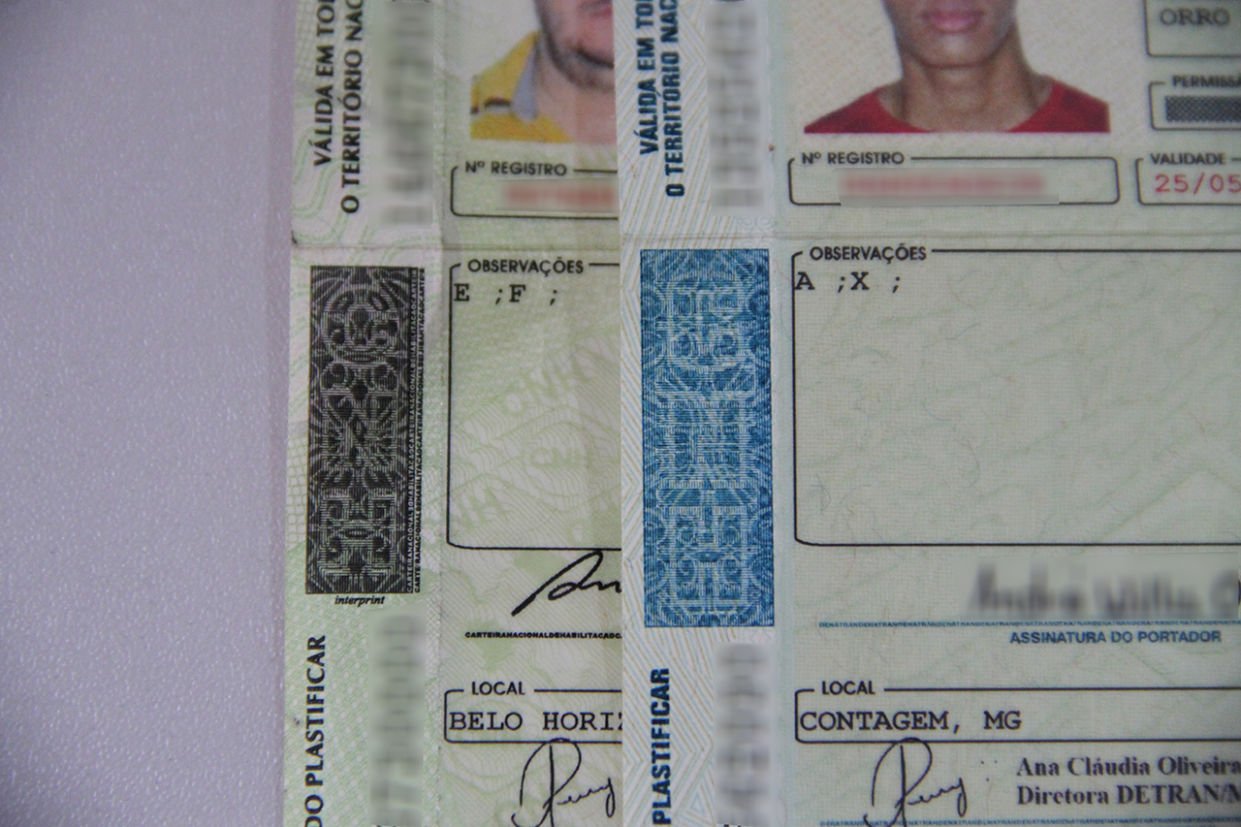
In the “observations” field, the letters will indicate the type of disability of the driver and what adaptations are necessary in the vehicle. (Photo: AutoPapo)
Once approved by the doctors, the candidate must take the theoretical classes, the legislation exam and the practical classes, just like any other aspiring driver, but with the necessary adaptations for the category sought.
In the practical exam, the candidate will take the test in a vehicle inspected by a DMV expert. If it is adapted to the needs of the future driver, the test is carried out normally. Depending on the case, the candidate can use his own car to take the driving test.
It is worth remembering that the changes in the qualification process established at the end of 2025 and which are in the consolidation phase in the Brazilian territory also apply to people with disabilities. In this way, the candidate can access the steps of the process through the CNH do Brasil application, take the free online theoretical course and hire an autonomous instructor, for example.
Who is entitled to CNH PwD
According to Brazilian legislation, especially Law No. 8,989, of February 24, 1995, 52 conditions are included in the special CNH. They are:
A person with a disability is considered to be one with a long-term physical, mental, intellectual or sensory impairment that, in interaction with one or more barriers, may obstruct their full and effective participation in society on an equal basis with other people”
How to change your license to CNH PwD if you are already qualified
In cases where the driver became a PwD after getting his license, for example, it is necessary for him to make a change in the license to include in the remarks field the letter that corresponds to his disability/limitation. They are:
Lyrics
Constraint description
A
mandatory use of corrective lenses
B
Mandatory use of hearing aid
C
Mandatory use of left accelerator
D
Mandatory use of a vehicle with automatic transmission
And
Mandatory use of handle/handle/pommel on the steering wheel
F
Mandatory use of a vehicle with power steering
G
Mandatory use of a vehicle with a manual clutch or with clutch automation or with an automatic transmission
H
Mandatory use of accelerator and manual brake
I
mandatory
use of dashboard controls to the steering wheel
J
mandatory use of adaptation of the panel controls for the lower limbs and/or other parts of the body
K
It
is mandatory to use a vehicle with extension of the gear lever and/or (fixed) height and/or depth compensation pads
L
The
use of vehicles with pedal extensions and floor elevation and/or fixed height or depth compensation pads is mandatory
M
Mandatory use of a motorcycle with adapted gear pedal
N
Mandatory use of a motorcycle with the adapted rear brake pedal
The
Mandatory use of motorcycle with adapted front brake handle
P
The
use of a motorcycle with an adapted clutch grip is mandatory
Q
The
use of a motorcycle with a sidecar or tricycle is mandatory
A
The
use of a scooter with a sidecar or tricycle is mandatory
S
The
use of a motorcycle with gear shift automation is mandatory
T
Prohibited to drive on highways and rapid transit
U
Prohibited driving after sunset
V
Mandatory use of a safety helmet with a protective visor without visual field limitation
W
Retired due to disability
X
Other restrictions
Y
hearing impaired (restriction appears as x in the observations)
Z
monocular vision (restriction appears as x in observations)
For this, the driver needs to go through the medical board, as mentioned earlier, and present the report to the DMV. If it is necessary to repeat any stage of the qualification process, the person with disabilities may be entitled to exemption from registration fees, medical examination, classes and tests. It is recommended to consult the traffic agency for specific information on the subject.
How to renew CNH PwD
To renew your driver’s license for PwD, simply fill out the form that is usually available on your state’s DMV website. Then, it is necessary to pay the state collection document (DAE) and undergo medical examinations again.
The process is similar to that of renewing the common CNH and it is not necessary to take classes and tests again. But, it is important to pay attention to the dates, as the deadline for renewing the special CNH may be reduced by the examining expert.
Comments are the sole responsibility of their authors and do not represent the opinion of this site. Comments containing profanity or offensive language will not be published. If you identify anything that violates the terms of use, please report it.