


Why do cars protect men more? Study reveals historical mistake of the industry
Research shows that high risk of serious injury remains even in low-speed collisions due to the use of dolls based on the male body
By
Tom Schuenk
Published on 2026-06-01 at 04:00 PM
Published on 2026-06-01 at 04:00 PM
Be the first to comment.
Summarize with:
Despite technological advances that have made automobiles drastically safer in recent decades, women still do not benefit equally from these innovations. New research conducted by the Graz University of Technology in Austria has revealed that female drivers and female passengers face a 60% higher risk of serious injuries in road crashes compared to men.
SEE ALSO:
- Copperhead: Dodge’s bet to revive the spirit of the Viper, now with a V8 of more than 800 hp
- Brazil’s fastest charger takes 13 minutes to add 300 km of range to electric cars
- Who is Ferrari Luce made for?
The test dummy problem and the driving position
The data that most caught the attention of experts is that female vulnerability remains high even in low-speed collisions. By analyzing records of accidents that occurred in Austria between 2012 and 2024, the study showed that they are significantly more likely to suffer severe injuries to the chest, spine and limbs. Among all demographic groups, older women represent the highest risk range.
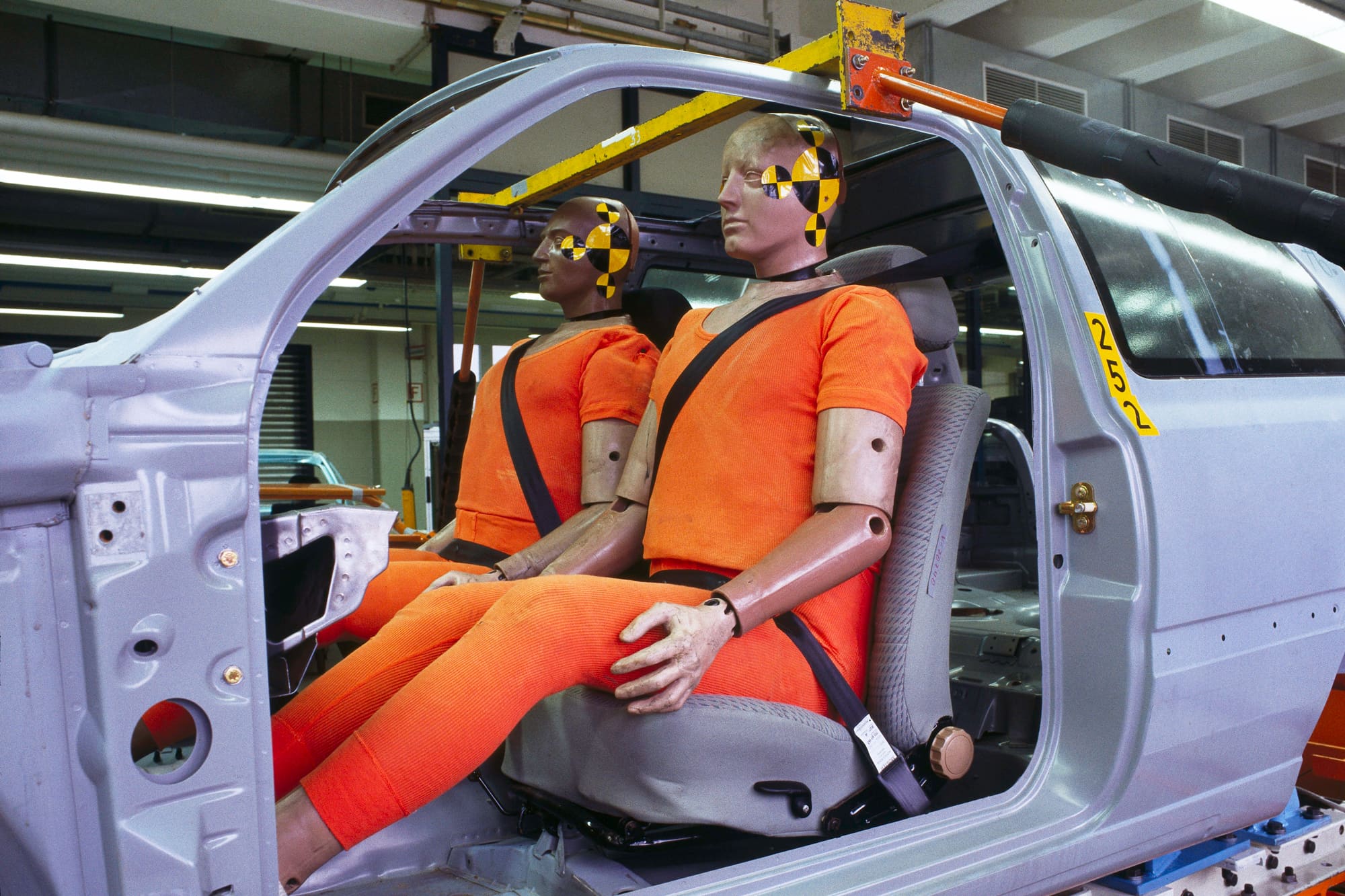
The root of this historical disparity lies in the very pattern of development of the automotive industry. For decades, crash tests have been calibrated based on the average man’s body. The female doll used by the automakers does not reflect real biology: it is just a reduced version of the male mannequin, simulating a very short and thin woman. In practice, 95% of women in the real world have dimensions larger than this standardized reference.
In addition to height, anatomical differences — such as the wider pelvic structure, the shape of the chest, and the smaller muscle mass in the neck region — completely alter the dynamics of impact absorption. Women also tend to sit closer to the wheel to reach the pedals, which modifies the programmed effectiveness of airbags and traditional seat belts.
Industry Response with Smart Belts
Faced with this abyss in road safety, manufacturers are beginning to develop adaptive restraint systems. Volvo, for example, has implemented an intelligent seat belt in the new EX60 model.
Unlike traditional equipment with fixed-configuration tensioners, this device monitors in real time the size of the occupant, posture, seat position and the severity of the collision. From this data, the strength of the belt is adjusted instantly, ensuring more precise and equal protection for all physical biotypes at the moment of impact.
SEE MORE ABOUT

0 Comments
Comments are the sole responsibility of their authors and do not represent the opinion of this site. Comments containing profanity or offensive language will not be published. If you identify anything that violates the terms of use, please report it.