


Brazil’s fastest charger takes 13 minutes to add 300 km of range to electric cars
Equipment installed in Porto Alegre reduces recharging time and inaugurates a new level of national electrical infrastructure
By
Júlia Haddad
Published on 2026-06-01 at 08:00 AM
Published on 2026-06-01 at 08:00 AM
Be the first to comment.
Summarize with:
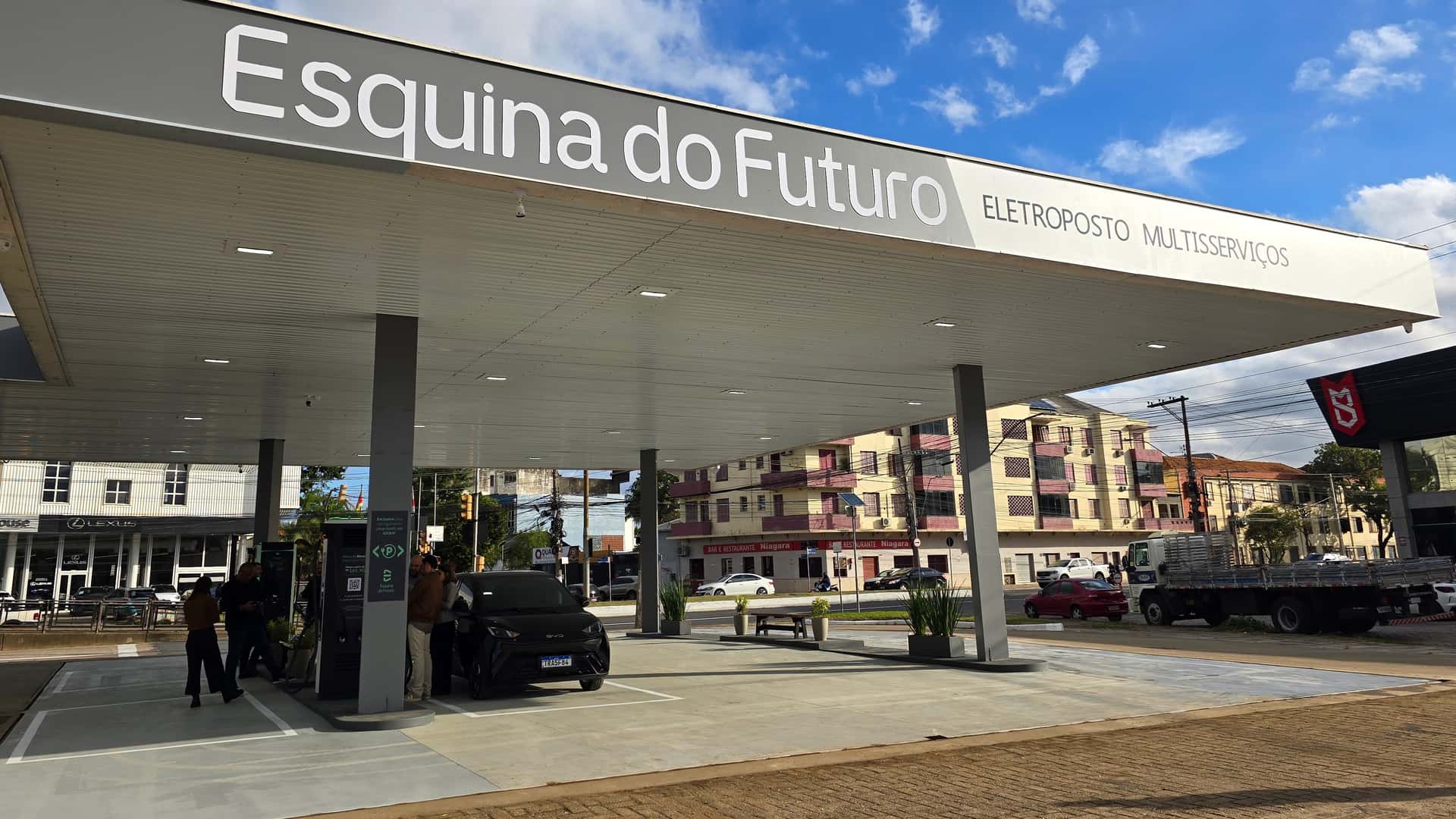
Brazil has inaugurated its first ultra-fast public charger for electric vehicles with a power of up to 480 kW. The equipment, installed by the company Esquina do Futuro in Porto Alegre (RS), promises to drastically reduce the waiting time at charging stations and raises the level of the national electromobility infrastructure.
To handle such power, the vehicle must have a robust 800-volt electrical system. This is the case, for example, of the Zeekr 7X: by recharging the SUV at 480 kW, the driver will gain about 300 km of range in just 13 minutes, according to official data.
With an investment of approximately R$ 1 million, the HPC (High Power Charger) type charger was developed in partnership with the companies WEG and Tupi. Installed in the newly created Complexo do Futuro, on Avenida Sertório, the system is capable of fueling up to four vehicles simultaneously. The power supplied far exceeds the capacity of the strongest totems in operation in the country so far, which usually vary between 150 kW and 350 kW.
According to those responsible for the project in Rio Grande do Sul, an electric car with compatible technology can have its battery recharged from 10% to 80% in just 15 minutes. The actual speed at the pump, however, still comes up against the technical limitations of a large part of the current fleet that circulates on Brazilian streets.
This is because most electric models sold today in the country support direct current (DC) charging powers limited to a range between 80 kW and 200 kW. Only higher-end vehicles, usually equipped with modern 800-volt electrical architectures, can absorb energy at higher speeds and take advantage of the full potential of the new equipment.
Even for the smallest capacity cars, the high power of the system brings practical benefits. Surplus energy allows for better operational efficiency by dividing the load between several vehicles at the same time, mitigating the formation of queues and increasing turnover at points.
The novelty in the South marks only the first step in an escalation of power. The race for charging infrastructure is expected to accelerate in the coming months, as BYD has already confirmed the arrival in Brazil of superequipment of up to 1.36 MW, developed to meet the next generation of batteries.
SEE MORE ABOUT

0 Comments
Comments are the sole responsibility of their authors and do not represent the opinion of this site. Comments containing profanity or offensive language will not be published. If you identify anything that violates the terms of use, please report it.