The Brazilian automotive industry is on its way to rediscovering a level it has not reached for more than a decade. Anfavea (National Association of Automotive Vehicle Manufacturers) revised upwards its projections for 2026 and now estimates that the country will close the year with about 3.01 million autovehicles (cars, light commercial vehicles, trucks and buses) registered – the first time above the symbolic mark of 3 million since 2014.
The new forecast represents a growth of approximately 12.1% over 2025, when 2.69 million units were sold. The number is surprising because, at the beginning of the year, the entity projected an increase of only 2.7% in registrations, equivalent to something close to 2.76 million vehicles. This means agrowth 4.48 times higher than what analysts initially predicted. The revision was driven by automobiles and light commercial vehicles, whose expansion expectation rose to around 13%, while the heavy segment goes against the grain, with a projection of a 6% contraction in the year.
Production was also recalculated: the estimate went from a high of 3.7% to 5.8%, which should lead the industry to manufacture around 2.8 million units, the best result since 2019. Even so, domestic manufacturing grows at a slower pace than sales – a mismatch that Anfavea attributes to the accelerated advance of imports.
Why the market grew higher than expected
The first half of the year explains much of the optimism. Between January and June, 1.42 million units were licensed, an increase of 18.5% and the best result for the period since 2014. Production totaled 1.37 million vehicles (+8.8%), the best semester since 2019.
The main driver was electrification. In June, electrified vehicles reached a record share of 20.9% in light vehicle sales, and have already exceeded 130 thousand units in the year. Much of this breath, however, has foreign origins, which has intensified competition in the concessionaires. In the semester, 280 thousand imported vehicles entered, about half of them coming from China, whose shipments to Brazil doubled in twelve months. Added to this are policies to promote local industry — Carro Sustentável and Move Brasil — and a domestic market that resisted even with the Selic rate at a high level.
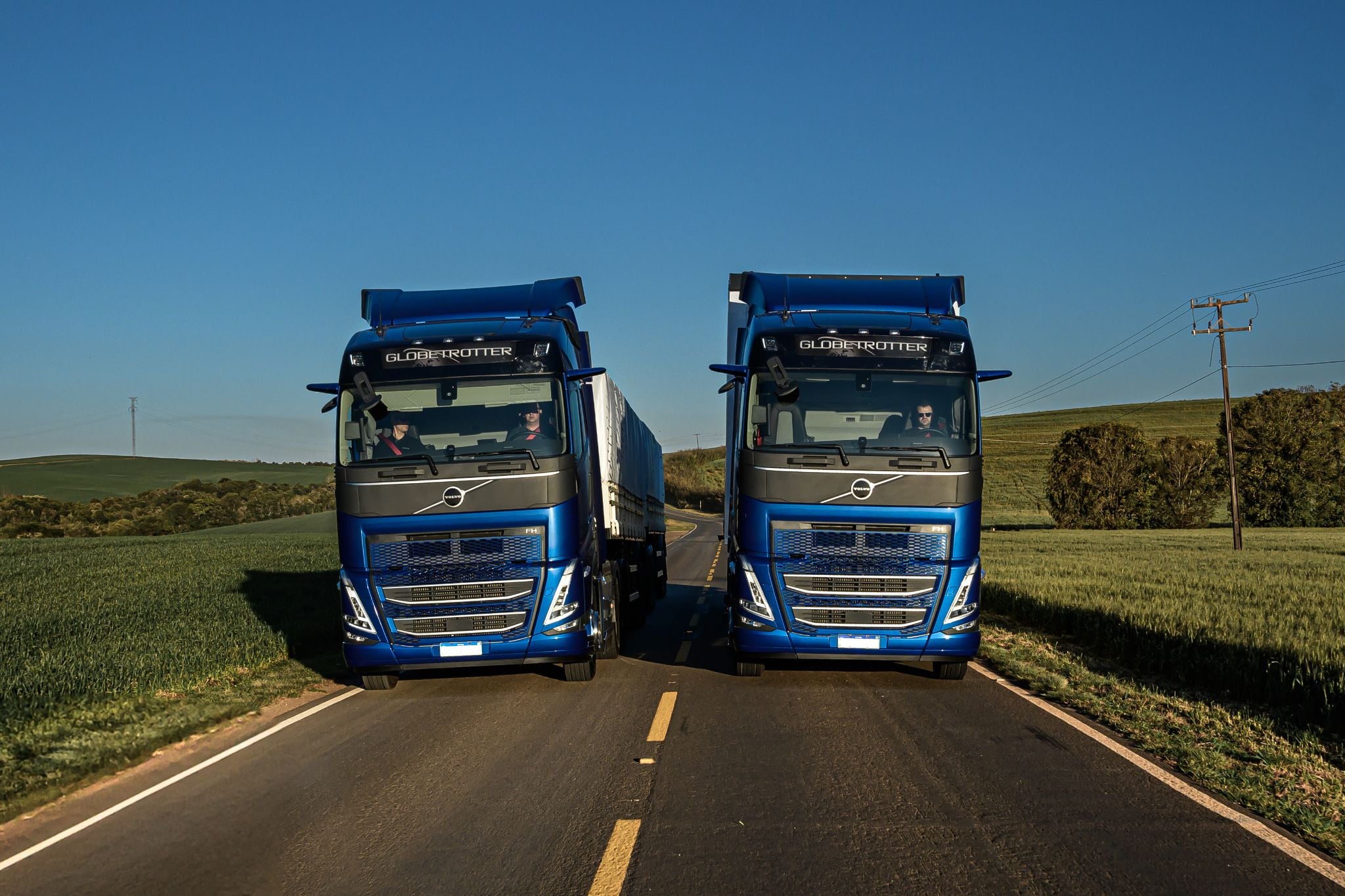
Despite the good number, the export of autovehicles and the production of trucks fell in the year (Photo: Volvo Trucks | Disclosure)
The fall and the slow recovery
To understand why 3 million became a milestone, it is necessary to go back to 2014, when the country reached its historical peak of 3.5 million units. The recession of 2015 and 2016, with two consecutive years of GDP contraction, rising unemployment, scarce credit and political crisis, dropped sales to just over 2 million – a drop of about 41% in relation to the top. The recovery began timidly between 2017 and 2019 and was interrupted by the pandemic in 2020.
In the following years, the global shortage of semiconductors limited supply, while high interest rates held back demand, keeping the market stationary at around 2.1 million. From 2023 onwards alone, the sector has had three consecutive years of growth, although contained by the high Selic rate – a factor that penalizes heavy vehicles above all.
Falling exports
If the domestic market accelerates, foreign trade is moving in the opposite direction: exports totaled 216.6 thousand units in the first half of the year, a decrease of 21.2%. The projection for the year was revised from a slight increase, forecast in January, to a drop of 12.8%.
The main factor is Argentina, the largest destination for Brazilian vehicles: to the neighboring country alone, shipments fell by almost 60 thousand units, reflecting the Argentine economic downturn and the loss of space to Chinese and Mexican competitors in Latin America. The movement also has a base component for comparison: in 2025 exports had soared 32.1%, with an 85% jump in sales to Argentina.
The weight of public policies
In the heavy segment, the federal government tried to stop the fall with Move Brasil, a credit line operated by BNDES for fleet renewal. The first phase, of R$ 10 billion, was launched in January and sold out in about two months, with more than 8 thousand operations and 15.6 thousand trucks financed. In April, the program won a second stage of R$ 21.2 billion, which now includes buses, minibuses and road implements, with interest reduced to 11.3% per year and terms of up to ten years for self-employed workers.
The stimulus, however, has not yet reversed the situation: in the semester, sales of trucks fell 10.5% and those of buses, 11.6%. June brought the best numbers of the year for both segments, but insufficient to change the downtrend. The recovery of heavy vehicles and the direction of the balance between imports and exports are precisely the variables that will define whether the 3 million mark is confirmed in December.
Auto vehicle sales in Brazil (2014–2025)
Year
Vehicle registrations*
Annual change
2014
3,498,012
—
2015
2,568,976
−26.6%
2016
2,050,321
−20.2%
2017
2,239,943
+9.2%
2018
2,566,001
+14.6%
2019
2,787,850
+8.6%
2020
2,058,437
−26.2%
2021
2,120,503
+3.0%
2022
2,104,508
−0.8%
2023
2,308,966
+9.7%
2024
2,634,717
+14.1%
2025
2,690,000
+2.1%
2026
3.100.00 (est.)
+12.7%
*Automobiles, light commercial vehicles, trucks and buses. Source: Anfavea.
Comments are the sole responsibility of their authors and do not represent the opinion of this site. Comments containing profanity or offensive language will not be published. If you identify anything that violates the terms of use, please report it.