Who has never wondered, as a child, what would happen if a paper airplane was launched into space? The question, which seems like child’s play, became the subject of a serious academic study, published in the scientific journal Acta Astronautica. Aerospace engineers Maximilien Berthet and Kojiro Suzuki of the University of Tokyo decided to answer it methodically.
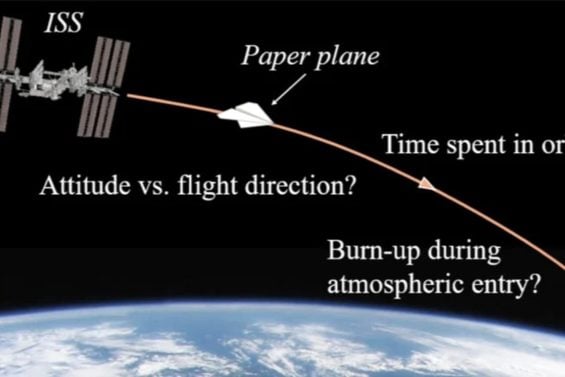
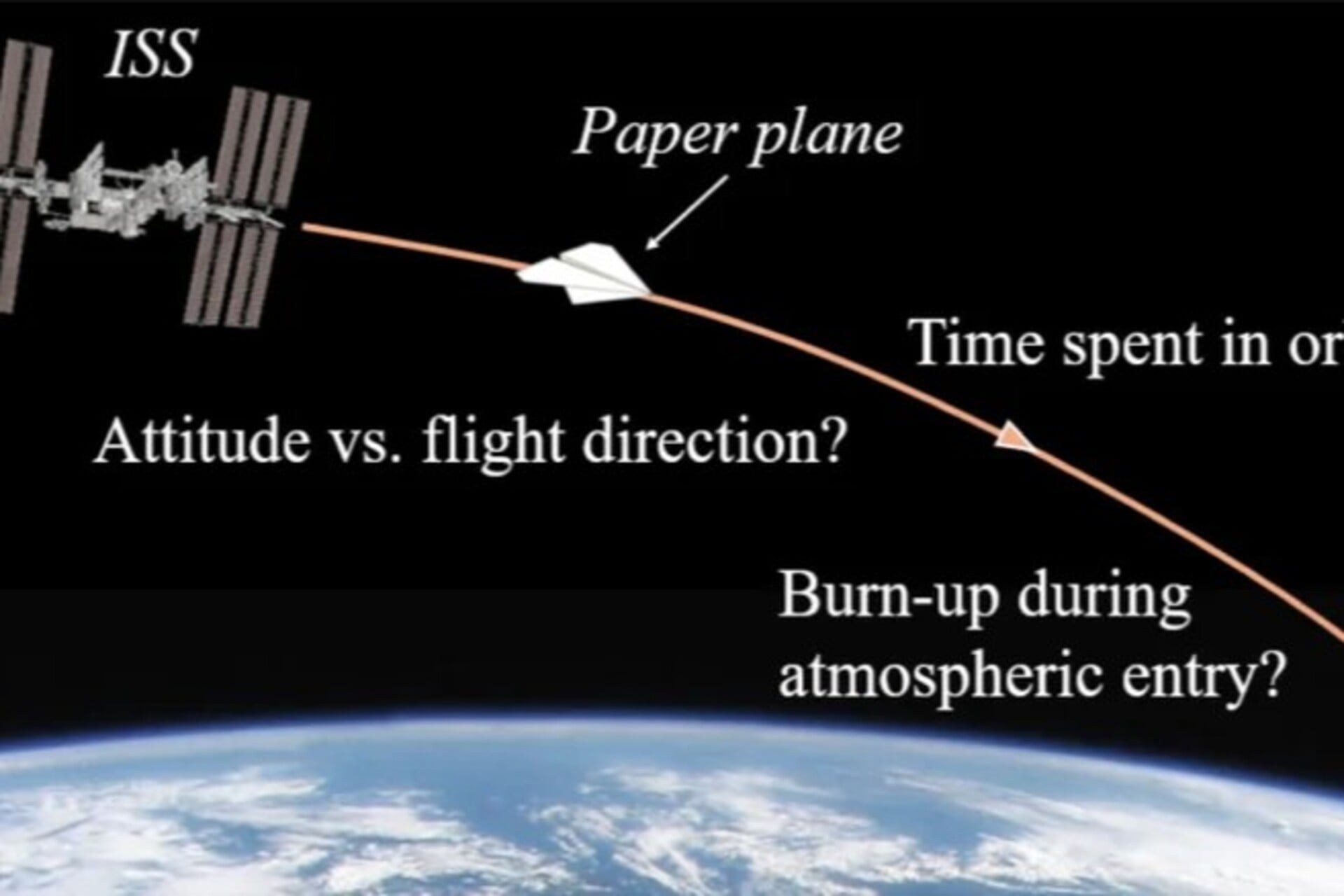
The pair analyzed the behavior of a paper airplane — folded from an A4 sheet — that was flung from the International Space Station (ISS), at about 400 km (250 miles) altitude. To do this, it combined an advanced numerical model, processed on a computer, with tests in a wind tunnel capable of reproducing extreme conditions. Among the questions they intended to answer were how long the orbit would take to decay and whether the toy would fall immediately, as it usually happens here on Earth.
Contrary to what one might imagine, the small aircraft would not plummet immediately. According to the model, in low Earth orbit the plane would maintain a relatively stable trajectory and continue to point in the more or less correct direction for about 80 hours, before plunging sharply into the atmosphere — a pattern that resembles that of any paper airplane launched in a classroom.
The calculations, however, are only valid above approximately 120 km of altitude. Below that, the denser air makes the calculations inaccurate, and that’s where the concrete part of the experiment came in. The researchers built a prototype and subjected it, in the wind tunnel, to a speed of Mach 7 and temperatures of about 377 °C — the conditions predicted on reentry.
The paper model resisted longer than expected: it even generated shock waves, probably the first paper airplane to achieve such a feat, even though the nose bent upwards and the edges were singed. The outcome, however, is inevitable. Friction with the denser layers of the atmosphere causes overheating and destruction of the structure: the plane ends up incinerated on re-entry.
Despite the burning end, the authors see a possible application. As they point out in the article, the very low cost of a paper airplane would allow it to launch several at the same time. Swarms of these aircraft, each with small research instruments, could, in theory, collect data collectively. The method would hardly replace conventional satellites, but, as the authors themselves admit, it is only possible to know after putting the idea to the test.
Comments are the sole responsibility of their authors and do not represent the opinion of this site. Comments containing profanity or offensive language will not be published. If you identify anything that violates the terms of use, please report it.