


Startup creates retractable solar panel for the roof of electric cars that extends autonomy
Dart Solar's modular system promises 24 km to 34 km of daily autonomy, but requires panels collected while the car is in motion
By
João Paulo Profeta
Published on 2026-09-09 at 08:00 AM
Published on 2026-09-09 at 08:00 AM
Be the first to comment.
Summarize with:
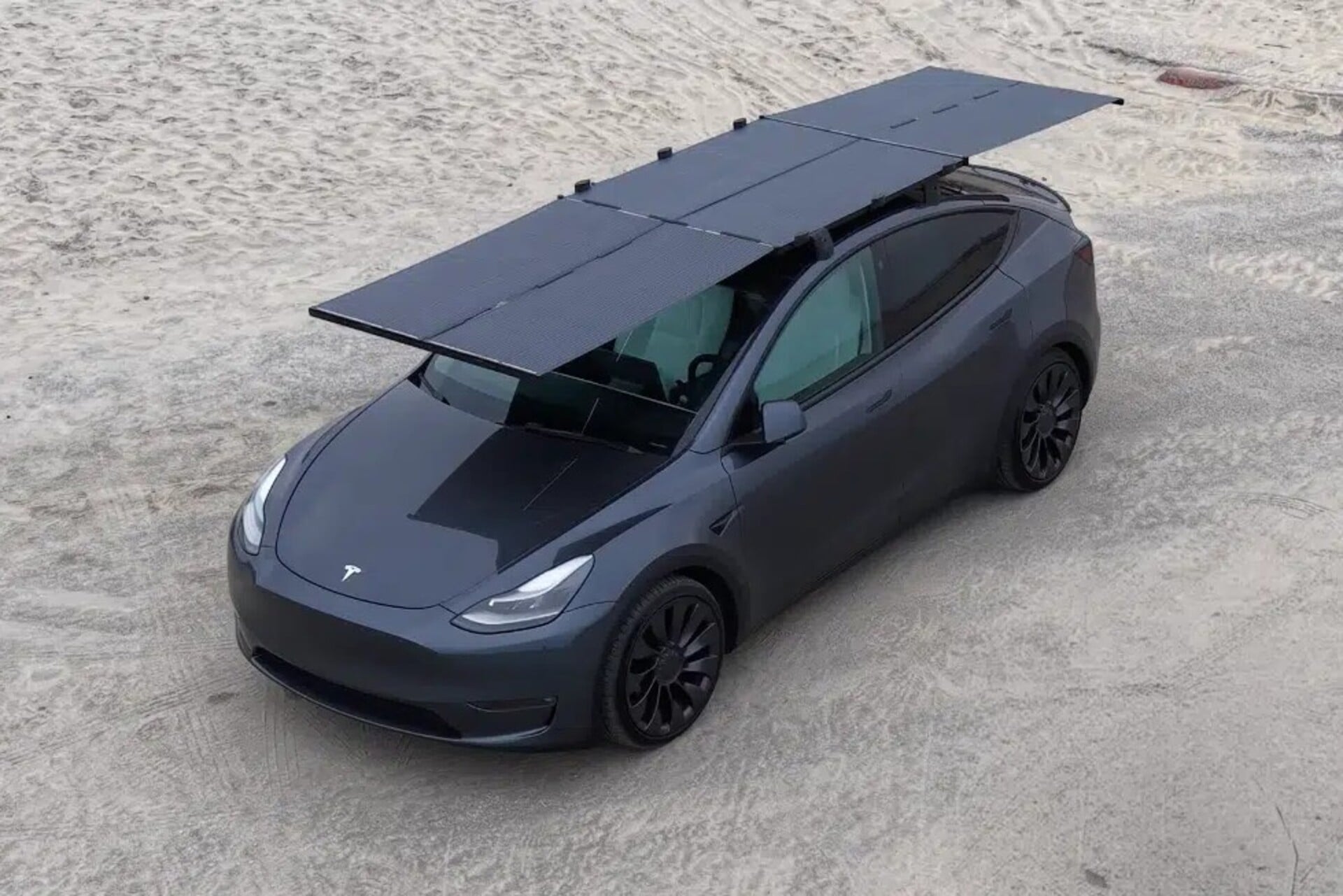
A Californian startup wants to turn the roof rack of the electric car into a portable power plant. Dart Solar has developed a modular system of retractable solar panels that, according to the company, can be installed on virtually any electric and recover 24 km to 34 km of range per day in favorable sunny conditions.
Each module generates 500 W and triples in size when opened: it measures 1.47 m closed and reaches about 4.3 m extended, in an operation that takes around ten seconds, according to the manufacturer. Two of them fit in a conventional roof, which forms the set of 1,000 W used as a reference in the company’s accounts. Vans, motorhomes and pickup trucks accept modules mounted side by side, which also work as awnings, and reach configurations of 1,500 W, 2,000 W or 2,500 W. On the flat roof of the Tesla Cybertruck, informs Dart Solar, for example, it is possible to install 1,500 W.
The company was founded in 2024 by inventor Omid Sadeghpour, owner of a Tesla, and arrived at the current product after a sequence of prototypes that were getting lower and less bulky.
What the system doesn’t solve
The set produces energy when the vehicle is stationary and in motion, but when running, the panels need to remain retracted — which drastically reduces the area exposed to the sun. That leaves the aerodynamic effect, a sensitive point in a car whose efficiency is measured in kilometers per kilowatt-hour. Dart Solar maintains that the structure invades only 3.8 cm of the airflow, that it was tested at 160 km/h and that, in measurements made with a Tesla Model Y, the increase in drag was between 1% and 2%. The data has not been independently verified.
In previous versions, the 960 W kit was advertised at US$ 2,950, about R$ 15,1 thousand in the current conversion, with the unit that converts solar energy into alternating current, or from US$ 1,950, approximately R$ 10 thousand, for those who already had this equipment. The system weighs about 41 kg and supports up to 23 kg of extra load on the roof, through an adapter. The projected useful life is ten years. The product is not sold in Brazil.
Why the bill would be different in Brazil
The estimates of recovered autonomy are based on favorable conditions of insolation, and this is precisely where the country has an advantage. Global horizontal solar irradiation in Brazil is about 5.15 kWh/m² per day on the national average, according to Inpe’s Brazilian Atlas of Solar Energy, with the Northeast in the range of 5.5 kWh/m² — above that recorded in European countries that lead photovoltaic generation.
The proposal does not eliminate the need for the electricity grid, but is presented as a way to reduce the dependence on fast chargers on routine routes and in regions with little charging infrastructure.
SEE MORE ABOUT

0 Comments
Comments are the sole responsibility of their authors and do not represent the opinion of this site. Comments containing profanity or offensive language will not be published. If you identify anything that violates the terms of use, please report it.