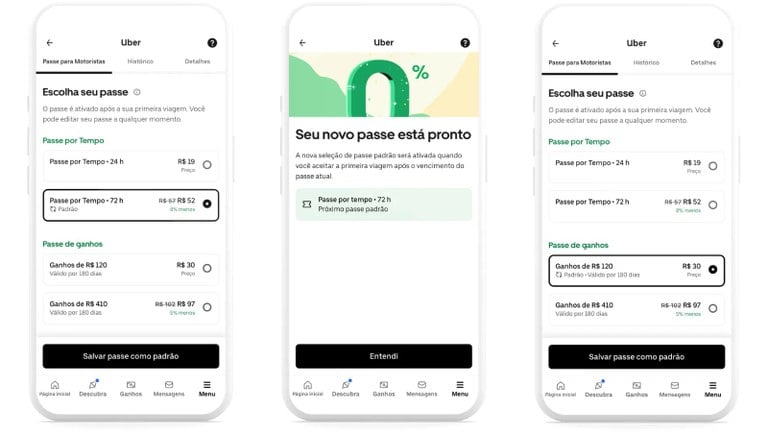
The Public Ministry of Labor (MPT) has filed a public civil action against Uber do Brasil challenging the “Pass for Drivers” program. The entity asks for the immediate suspension of the subscription model, which charges drivers a small fee so that they can accept rides through the app.
The agency also demands compensation for the amounts paid by the workers and compensation of BRL 321 million for collective moral damages.
questions The “Pass for Drivers” launched in May this year, currently being tested in 29 Brazilian cities, requires the prior payment of a fee to obtain the pass. By paying this fee, the driver may be entitled to use the application for a period (24 or 72 hours) or per billing goal, to exempt the collection of the traditional service fee per trip.
Driver can choose to pay a fee to receive rides for a period (24 or 72 hours) or until he hits a billing goal. (Photo: Uber/MPT | Reproduction)
According to the MPT, the modality can cost more than R$ 1,000 per month to the worker.
The main points pointed out by the labor inspection include:
Transfer of business risk: the driver pays in advance without guarantee of a minimum volume of rides, assuming the financial risk alone. That is, the worker has to pay in advance to have access to the conditions provided for by the program, with no guarantee that he will be able to perform enough rides to recover the amount disbursed.
Debt bondage: in cases of insufficient balance, the platform automatically withholds future earnings from the driver, creating a permanent debt structure.
Indirect loyalty: as the amount has already been invested in Uber, the worker reduces the use of competing apps so as not to lose the amount paid. This is because each hour worked on a competing platform would represent a period in which the driver would not be using the service for which he has already paid.
Contractual insecurity: the terms of service allow the company to change the rules or deactivate the pass at any time without a refund of the money.
No guarantee of rides: Uber informs that the purchase of the pass does not guarantee a minimum number of trips. Rides can also be directed by the algorithm to drivers who have not joined the program.
Requests for access to the algorithm
In the process that runs in the 9th Labor Court of Salvador (No. 0000773-47.2026.5.05.0009), prosecutors also demand access to the source code of Uber’s algorithm . The measure aims to audit the criteria for call distribution, dynamic pricing and the percentages passed on to drivers.
Uber’s pronouncement and court
decision In a statement, Uber denied the accusations and said that the “Pass for Drivers” is a commercial alternative already practiced by competitors in Brazil, designed to give predictability of costs to partners. The company also said that the accusations about drivers’ indebtedness, withholding of payments and concentration of work in the app cannot be treated as proven facts at this time.
The judge in charge of the case, Luciano Carreiro, highlighted the need for “caution” and “procedural prudence”, stating that allegations about indebtedness and competitive impact require investigation and cannot be considered definitively proven facts before the procedural investigation phase.
The lawsuit will still be analyzed, therefore, the allegations presented by the Labor Prosecutor’s Office are the subject of contestation in the process and do not represent, at this time, a definitive decision on the legality of the program.
Comments are the sole responsibility of their authors and do not represent the opinion of this site. Comments containing profanity or offensive language will not be published. If you identify anything that violates the terms of use, please report it.