


How does the new breathalyzer that reads the driver’s fingerprints work?
System uses infrared light and artificial intelligence to read alcohol under the skin, just by placing the finger on the dashboard
By
Eduardo Passos
Published on 2026-07-21 at 10:00 AM
Published on 2026-07-21 at 10:00 AM
Be the first to comment.
Summarize with:
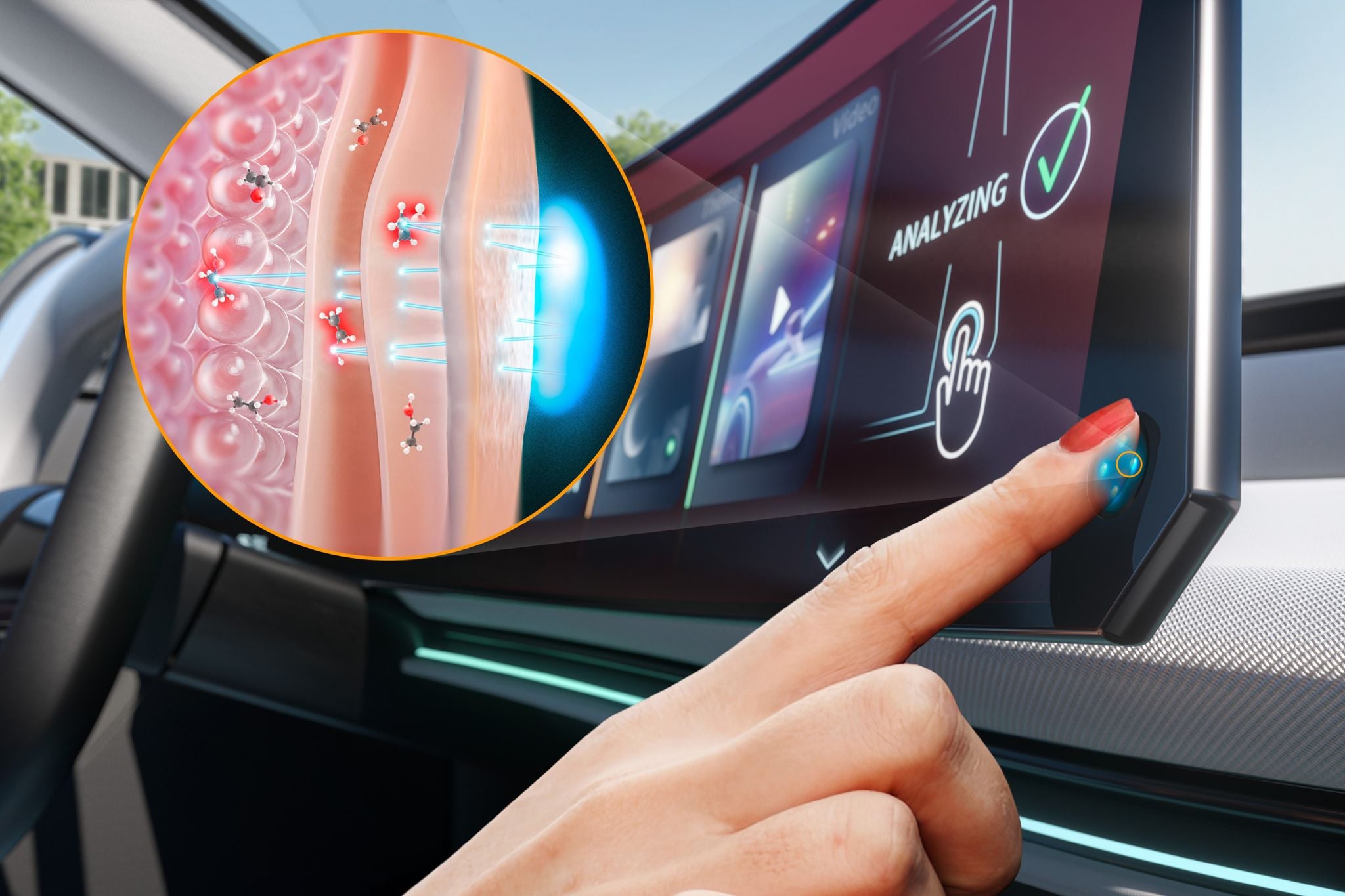
Aumovio (a company that was born from Continental’s automotive division) and trinamiX (a subsidiary of BASF) presented a system that measures the driver’s blood alcohol level by touching a finger on a sensor installed inside the car. According to the companies, the reading takes a few seconds and does not require the driver to blow into any nozzle. For now, the technology is only available in Europe.
The sensor uses near-infrared (NIR) spectroscopy: when the finger touches the surface, pulses of invisible light pass through the skin and seek ethanol molecules in the tissues. The reflection of this light is interpreted by artificial intelligence algorithms to estimate blood alcohol levels.
“The experience is intuitive and as simple as using fingerprint scanning on a smartphone. The sensor system can be discreetly integrated into existing elements of the cockpit, preserving a clean and non-intrusive internal design,” says Ricardo Rodrigues, head of Aumovio in Brazil.
According to trinamiX, the method was tested in a clinical study registered with DRKS, the German registry of clinical studies. The manufacturers claim that the hardware can be embedded in elements that already exist in the cabin, without changing the internal design.
Growing trend in the industry
The idea of embedding alcohol detection in one’s own vehicle is not new. In the United States, the DADSS (Driver Alcohol Detection System for Safety) program, run since 2008 by the NHTSA traffic agency in partnership with automakers, develops two fronts: a breathing sensor, which evaluates the air in the cabin without requiring effort from the driver, and a touch sensor, similar to Aumovio’s.
The federal infrastructure law passed in 2021 determined that the NHTSA will require this type of device in new cars, but the rule has not yet come out — in March 2026, the agency informed Congress that it continues to evaluate the technical requirements. Volvo even designed a similar system for the EX90 electric SUV in 2022, but the function was left out of the final version.
In Brazil, enforcement is still supported by the Dry Law, which set zero tolerance for alcohol driving, and the Traffic Code, which treats drunkenness as a very serious infraction. There are, however, projects that target the on-board equipment.
PL 2176/07, for example, requires automakers to install a passive breathalyzer in new cars that locks the ignition when it detects alcohol in the air of the cabin. PL 4394/12 provides for the blocking of departure in fleet vehicles, such as school transport, taxis and buses. PL 1437/20, on the other hand, proposes to extend the requirement to all cars sold in the country. None has been approved so far.
SEE MORE ABOUT

0 Comments
Comments are the sole responsibility of their authors and do not represent the opinion of this site. Comments containing profanity or offensive language will not be published. If you identify anything that violates the terms of use, please report it.