


Honda gets full marks from the FIA in road safety – without any crash test for it
Japanese manufacturer is the first to achieve five stars in the FIA index, which audits the safety management of companies, and not cars
By
João Paulo Profeta
Published on 2026-09-09 at 02:00 PM
Published on 2026-09-09 at 02:00 PM
Be the first to comment.
Summarize with:
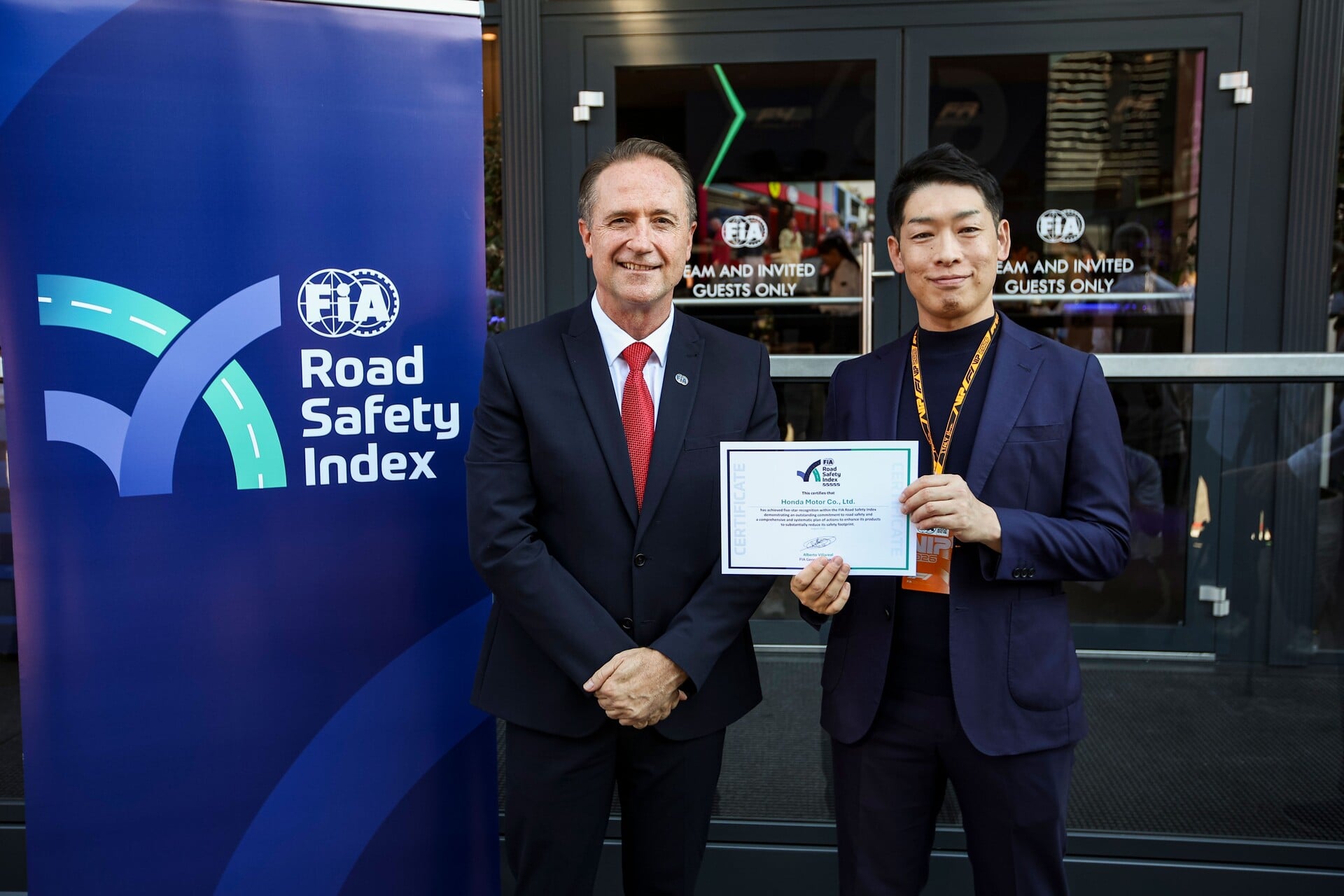
Honda has become the first company in the world to achieve the maximum score of five stars in the products and services category of the International Automobile Federation’s (FIA) Road Safety Index. The recognition was presented at Monza at the Italian Formula 1 Grand Prix last weekend.
Created in 2022, the index does not evaluate cars: it evaluates companies. The tool allows companies and public agencies to calculate their own “road safety footprint” — how many deaths and serious injuries are associated with their operations and value chains — in a logic similar to that of carbon emissions accounting. Its creation responded to the Stockholm Declaration, of 2020, which called for more involvement of the private sector in global traffic goals.
This is where the difference lies in relation to NCAP programs: Latin NCAP and Euro NCAP subject a specific model to crash tests and give stars to the performance of that vehicle. The FIA index does not crash a car into a barrier or use test dummies: it audits corporate management — whether the company measures the problem, plans actions, monitors results and sustains an internal safety culture — and feeds sustainability and governance reports. The five stars do not say that a Honda is safer than a rival in a frontal impact, but that the brand’s road safety management has reached the highest level of the method.
The system has two tracks: one for the supply chain and the other for products and services, applicable only to organizations with products related to traffic safety. It was on Monday that the Japanese company received the highest score.
Brazil is among the 17 countries evaluated
The methodology was expanded from three to five stars this year. To the two original pillars — commitment and safety footprint — were added planning, performance monitoring and safety culture management. To comply, Honda extended the audit to 17 countries, including Brazil, which account for more than 90% of its global sales of cars and motorcycles.
In February 2025, when the ceiling was still three stars, the automaker had already obtained the maximum score, but with an evaluation restricted to the Japanese operation. According to the company, it was the first in the automotive industry to get there — the FIA’s announcement at the time included nine other companies, such as Amazon, Scania, Shell, Uber and Waymo.
The assessment highlighted the involvement of senior management in the strategy, the global tracking of deaths and injuries in collisions, and the active dissemination of data.
Goals for 2030 and 2050
Honda’s public commitment is to reduce by half, by 2030, deaths in collisions involving its cars and motorcycles – not in absolute numbers, but in proportion per 10 thousand units sold, with 2020 as a baseline. The next goal is to zero these deaths by 2050. For FIA president Mohammed Ben Sulayem, progress depends on action at scale in the public and private sectors. The entity has advocated that governments incorporate the methodology into regulatory frameworks.
SEE MORE ABOUT

0 Comments
Comments are the sole responsibility of their authors and do not represent the opinion of this site. Comments containing profanity or offensive language will not be published. If you identify anything that violates the terms of use, please report it.