


China’s solar capacity surpasses coal’s for the first time in history
Chinese photovoltaic park reached 1,286 GW at the end of July, compared to 1,285 GW for coal-fired thermal plants, according to the national energy agency
By
Júlia Haddad
Published on 2026-09-04 at 10:00 AM
Published on 2026-09-04 at 10:00 AM
Be the first to comment.
Summarize with:
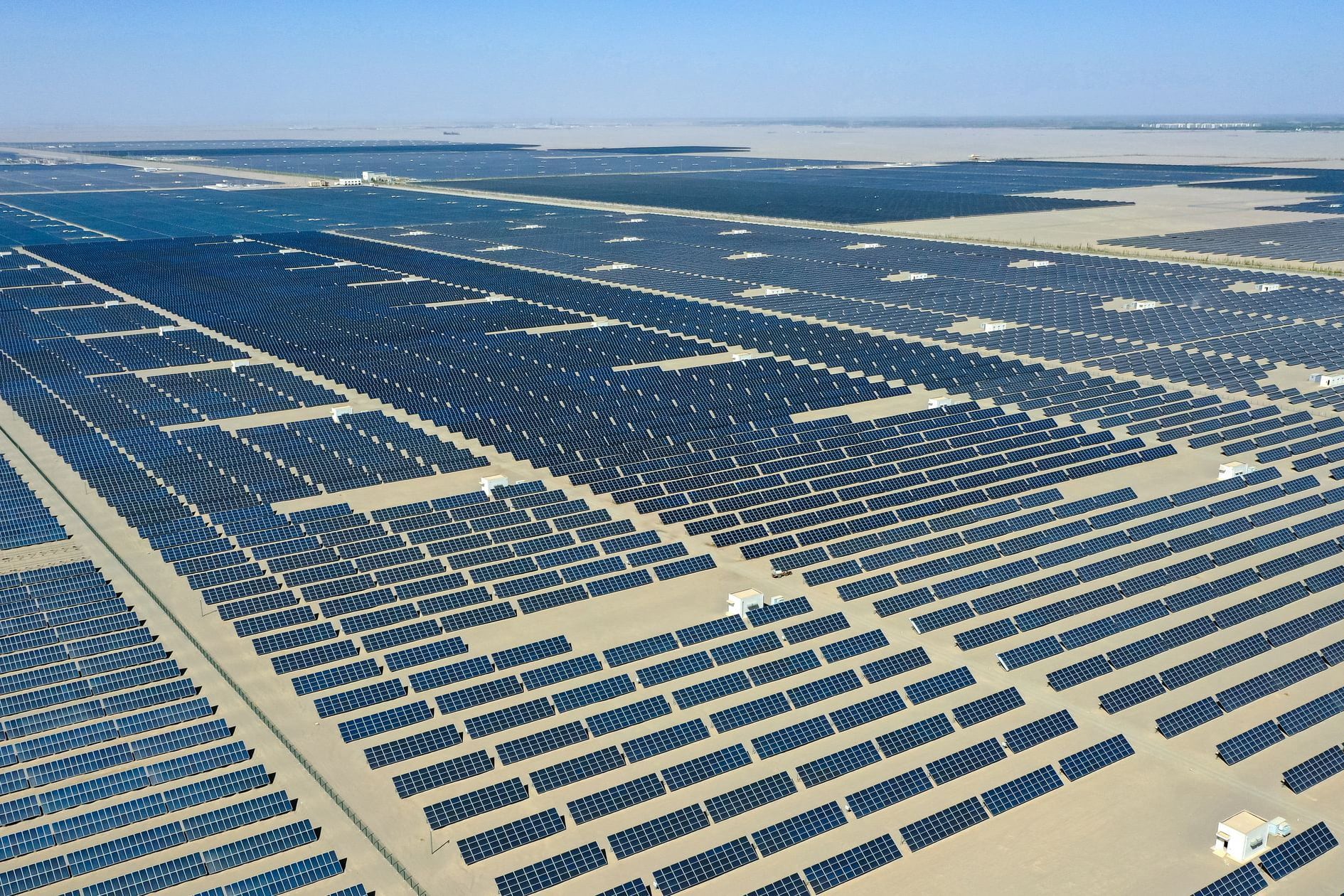
The installed capacity of solar energy in China surpassed that of coal-fired plants for the first time in history. According to the National Energy Administration (NEA), the Chinese photovoltaic park reached 1,286 GW at the end of July, against 1,285 GW of coal-fired thermal plants. As a result, solar now accounts for 31.5% of all generation capacity in the country and has become the largest source of the Chinese electricity matrix in nominal power.
Of the total photovoltaic, 704 GW are in centralized plants and 582 GW in distributed generation — smaller systems, installed next to consumption points. Chinese solar capacity alone is about five times larger than the entire Brazilian generation park, which adds up to approximately 260 GW also considering distributed generation, according to Absolar.
Installed capacity is not the same as generation
The milestone does not mean that solar already produces more electricity than coal. Installed capacity measures how much a source can generate under ideal conditions; effective production depends on how many hours each plant can operate. Solar generation is limited by daylight and weather, while coal-fired thermal plants run for longer periods and more predictably.
In the first half of the year, coal generated about 2.5 trillion kWh, or 49.7% of China’s electricity — the first time the source has fallen below 50% in a half. Renewables accounted for 41.2% of generation, with solar and wind adding up to 24.6%, or more than 1.2 trillion kWh. Between January and July, solar generation grew 15.5% and reached 802.4 billion kWh, equivalent to one out of every eight kilowatt-hours produced in the country.
In Brazil, coal accounts for 1.4% of the matrix
The comparison with Brazil exposes opposite starting points. The country started 2026 with 215.9 GW of installed power in centralized plants, of which 84.63% came from renewable sources, according to Aneel’s SIGA. Coal represents 1.4% of the Brazilian electricity matrix, against almost a third of Chinese capacity. Here, hydroelectricity is the leader, with 42.4%, and solar is already the second source, with 24.5% and 63.7 GW installed, in Absolar’s account — a percentage share close to China’s, although on a much smaller scale. In the first seven months of 2026 alone, China added 85.65 GW of solar capacity, more than the entire photovoltaic park installed in Brazil to date.
Chinese expansion remains steady even after the change in the sector’s remuneration rules, which exposed new projects to market conditions: in the first half of the year, 72.1 GW were added, down 66% compared to the same period in 2025, according to data from the Chinese press. The advance follows a rising demand: electricity consumption grew 5.3% in the first half of the year, to almost 5.1 trillion kWh, driven by the high-tech industry and the recharging of electric vehicles, which in China still depends on a grid in which almost half of the electricity comes from coal.
SEE MORE ABOUT

0 Comments
Comments are the sole responsibility of their authors and do not represent the opinion of this site. Comments containing profanity or offensive language will not be published. If you identify anything that violates the terms of use, please report it.