

Blue Belt advances in the Federal District, but security of the measure still divides experts
Project approved by the Legislative Chamber provides guidelines for the implementation of a preferential corridor for motorcycles inspired by the São Paulo model
By
Lucas Silvério
Published on 2026-05-20 at 04:31 PM
Published on 2026-05-20 at 04:31 PM
Be the first to comment.
Summarize with:
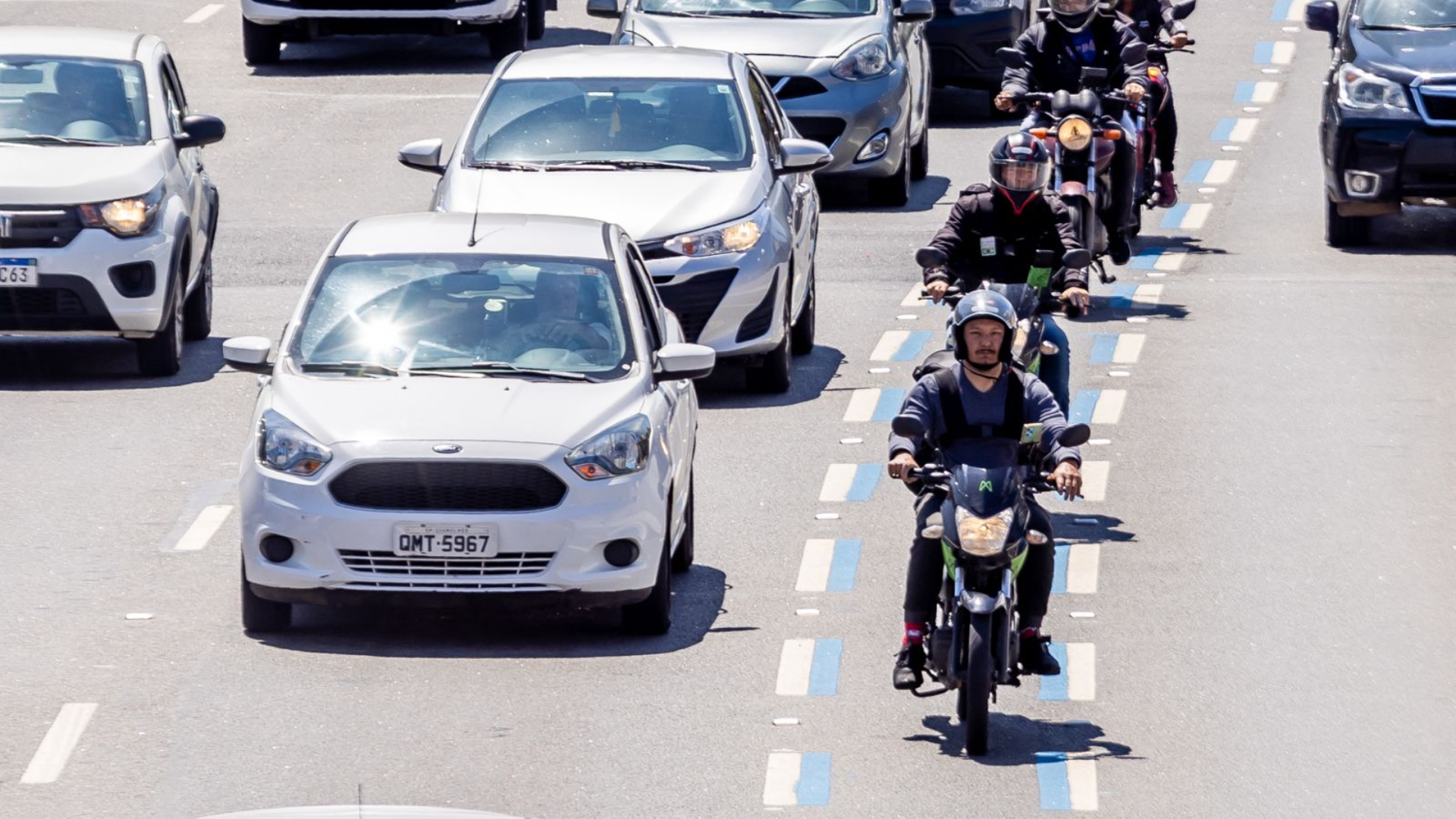
The Legislative Chamber of the Federal District approved on Tuesday (19) Bill No. 2,685/2022, which creates guidelines for the implementation of the so-called “Blue Belt” on the roads of the Federal District. The proposal provides for exclusive or preferential spaces for motorcycles, scooters and mopeds, with a focus on improving road safety and traffic organization.
SEE ALSO:
- Will CFMOTO overcome the ‘trauma’ of Brazilians with Chinese brands?
- Do you want to get a car and motorcycle driver’s license? You will have to pass the toxicology test
- Honda Pop arrives in the 2027 version: the left lever is back, but as a brake
Authored by district deputy Fábio Felix, the text does not require the immediate implementation of the measure, but establishes parameters so that the Government of the Federal District can adopt the signaling in a technical and planned way.
Among the guidelines foreseen are the prioritization of roads with the highest number of accidents involving motorcycles, the planning of special circulation schemes in congested corridors and even the temporary use of exclusive bus lanes while there is no definitive space for motorcyclists.
According to the parliamentarian, the project was developed based on urban mobility studies and experiences already adopted in cities such as São Paulo, where the Blue Belt already operates on several avenues.
With the processing completed in the Legislative Chamber, the proposal now goes to Governor Celina Leão for sanction.
National project also advances in the Chamber
The movement of the Federal District follows a national trend. In Brasilia, the Traffic and Transport Commission of the Chamber of Deputies recently approved Bill 1656/25, which provides for the implementation of preferential lanes for motorcycles in Brazilian capitals, in the Federal District and on federal and state highways.
The rapporteur of the proposal, deputy Flávio Nogueira, removed from the text the obligation for smaller municipalities, concentrating the application in regions with a large flow of motorcycles.
The proposed model also follows the pattern already used in São Paulo: the preferential lane is located between the far left lane and the lane next to it, organizing the space where motorcyclists traditionally travel between cars.
Despite the name, the Blue Belt is not exclusive to motorcycles, but preferential. The proposal also provides for specific horizontal and vertical signage to alert drivers during lane changes.
The project will now be analyzed by the Commission on Constitution and Justice and Citizenship (CCJ). If approved without changes, it will go directly to the Senate.
Studies diverge on the safety of the Blue Belt
Even with the political advance of the proposal, the real impacts of the Blue Belt still divide experts and researchers.
Data released by the Traffic Engineering Company of São Paulo point to an improvement in safety rates after the implementation of signaling. According to a CET-SP report, the severity of accidents involving motorcyclists fell by 26.6% in the stretches analyzed between 2022 and 2025.
The study evaluated more than 233 kilometers of Blue Belt implemented on 36 roads in the capital of São Paulo. Also according to the agency, accidents outside the lane were 9.5 times more serious than inside the signals.
The CET also states that there was a reduction in the average speed of motorcyclists and a drop in the rates of disrespect for speed limits in regions monitored by radars.
On the other hand, researchers from the University of São Paulo, the Federal University of Ceará and the Cordial Institute came to different conclusions.
The survey pointed to an increase between 100% and 120% in fatal accidents involving motorcyclists at intersections located on roads with the Blue Belt. The study also indicated an increase in the average speed of motorcycles in the stretches analyzed.
The main difference between the works is in the methodology used. While CET compared the results of the same roads before and after implementation, university researchers used similar avenues as a basis for comparison.
Even with the divergence, the progress of the projects shows that the Blue Belt continues to gain space in the debate on urban mobility and safety for motorcyclists in Brazil.
SEE MORE ABOUT

0 Comments
Comments are the sole responsibility of their authors and do not represent the opinion of this site. Comments containing profanity or offensive language will not be published. If you identify anything that violates the terms of use, please report it.