What is a car like for PwD: understand adaptations in vehicles
Adjustments in vehicles range from manual levers to robotic ramps, depending on the type of disability; influencer shows what his adapted car looks like
Adaptations in the car for PwD must be made in companies approved by the DMV (Photo: Shutterstock | AutoPapo)
By
Julia Vargas Published on 2026-06-01 at 07:00 AM
Updated on 2026-06-01 at 01:34 PM
People with disabilities (PwD) have the right guaranteed by law to drive autonomously and safely, so they can enjoy tax exemption when buying a new car. This reduction in the final price of the car is important to make the adaptation of cars more accessible.
Contrary to what many imagine, there is no ‘standard PwD car’. Depending on the type of disability the individual has, changes to the vehicle can be simpler or more complex and that’s where assistive engineering comes in, a specialized sector that transforms series cars and other items into customized models for greater autonomy and accessibility.
Each vehicle is surgically modified to meet the needs pointed out by the owner and the DMV medical report. In this article you can see how the main automotive adaptations for some types of disabilities work.
Ergonomics for people with dwarfism or short stature
For drivers with dwarfism or shortened limbs, the focus is on bringing the controls closer to the driver’s body. This must be done without impairing the activation of safety systems, such as the airbag.
Stephanie Marques, who makes “accessible content about fashion, beauty and fitness” for social media, has dwarfism and showed on her Instagram profile what her adapted car looks like. The influencer owns a Chevrolet Onix that has been modified with:
Spare seat with raised seat and backrest to be in the position closest to the steering wheel and view the road. The item is secured by Velcro straps that pass behind the car seat;
Pedal extenders, which consist of metal structures attached to the original brake and accelerator pedals, at the specific distance for each driver. In Stephanie’s case, this model has a two-part fitting, one removable that locks on the car’s own pedals and the other fixed to the floor.
The content producer also points out that the steering wheel of her car does not have any equipment that helps driving, such as rotating pommels, since she uses both hands to guide it. In addition, according to her, the São Paulo DMV determines that your vehicle has an automatic transmission for greater safety.
Hand controls for those with lower limb limitations
For drivers with paraplegia, stroke sequelae or lower limb amputations, full control of the vehicle is transferred to the upper part of the passenger compartment. The main solutions are:
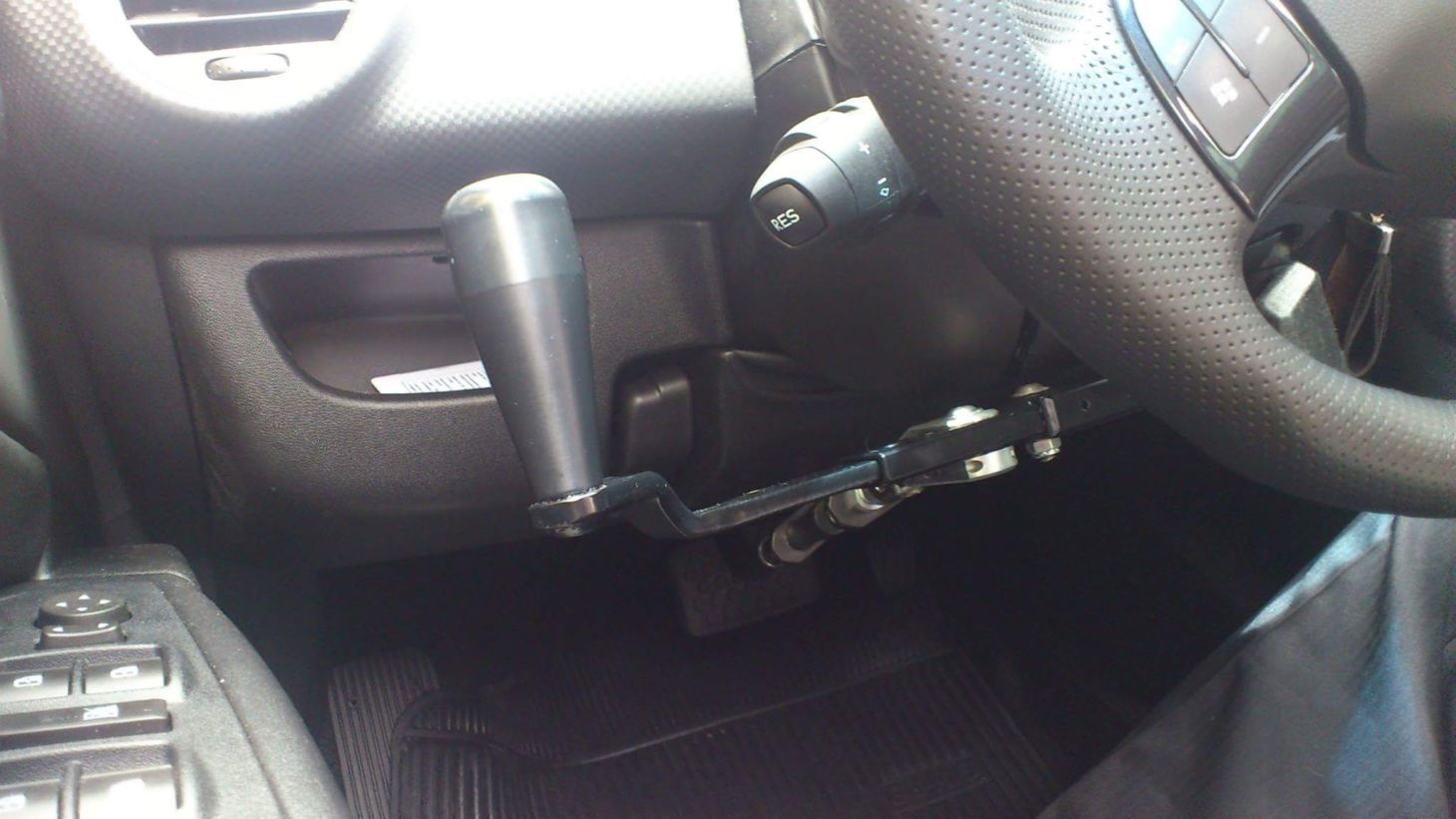
Accelerator and Manual Brake: lever installed next to the steering wheel (in vertical or horizontal position) replaces the pedals. The driver pushes forward to brake and pulls back (or down) to accelerate.
Left Throttle: for those who have limitation only in the right leg, the accelerator pedal is duplicated on the left side of the brake through a mechanical or electronic system. When the vehicle is used by a person without a disability, the adapted pedal can be folded down or removed to avoid accidents.
Automatic Transmission: practically mandatory item in most adaptations, eliminating the need for the clutch pedal.
Lever positioned over the brake to activate it. (Photo: AutoPapo)
Centralized control for people with compromised upper limbs
The loss of strength, range of motion or the absence of one of the upper limbs requires adaptations that allow the vehicle to be safely steered using only one hand or, in severe cases, alternative commands:
Rotary Pommel (Steering Wheel Knob): a device attached to the steering wheel rim that allows the driver to rotate it 360º continuously using only one hand. There are models of one, two or three pins for fitting the wrist.
Steering Wheel Control Center: a button panel (or joystick) is installed next to the rotary pommel. Through it, the driver can activate turn signals, headlights, windshield wipers and horn without having to take his hand off the steering wheel.
For those who use wheelchairs, accessibility is required in the transfer
When the user, whether driver or passenger, needs to enter the vehicle while remaining in the wheelchair or needs assistance for the transfer, the car’s structure undergoes more complex modifications, usually applied to vans, minivans or SUVs.
Swivel and Advanced Seats: the driver’s or front passenger’s seat is replaced by a mechanism that rotates up to 90º in the direction out of the car and, in some cases, reduces the height to facilitate the boarding of those who transfer the chair.
Automatic Ramps and Lifts: these items are installed at the rear or side of the vehicle and the floor of the car can be lowered to ensure the necessary internal height. Four-point attachment systems secure the chair rigidly to the chassis, ensuring the safety of the occupant on the move.
Comments are the sole responsibility of their authors and do not represent the opinion of this site. Comments containing profanity or offensive language will not be published. If you identify anything that violates the terms of use, please report it.