

The solar car that promises to run without an outlet passed the test: see how many km it yielded
Two-seater electric tricycle has been promised since 2006, has 50,000 pre-orders and still depends on US$ 50 million to get off the line
By
Júlia Haddad
Published on 2026-09-02 at 06:00 PM
Published on 2026-09-02 at 06:00 PM
Be the first to comment.
Summarize with:
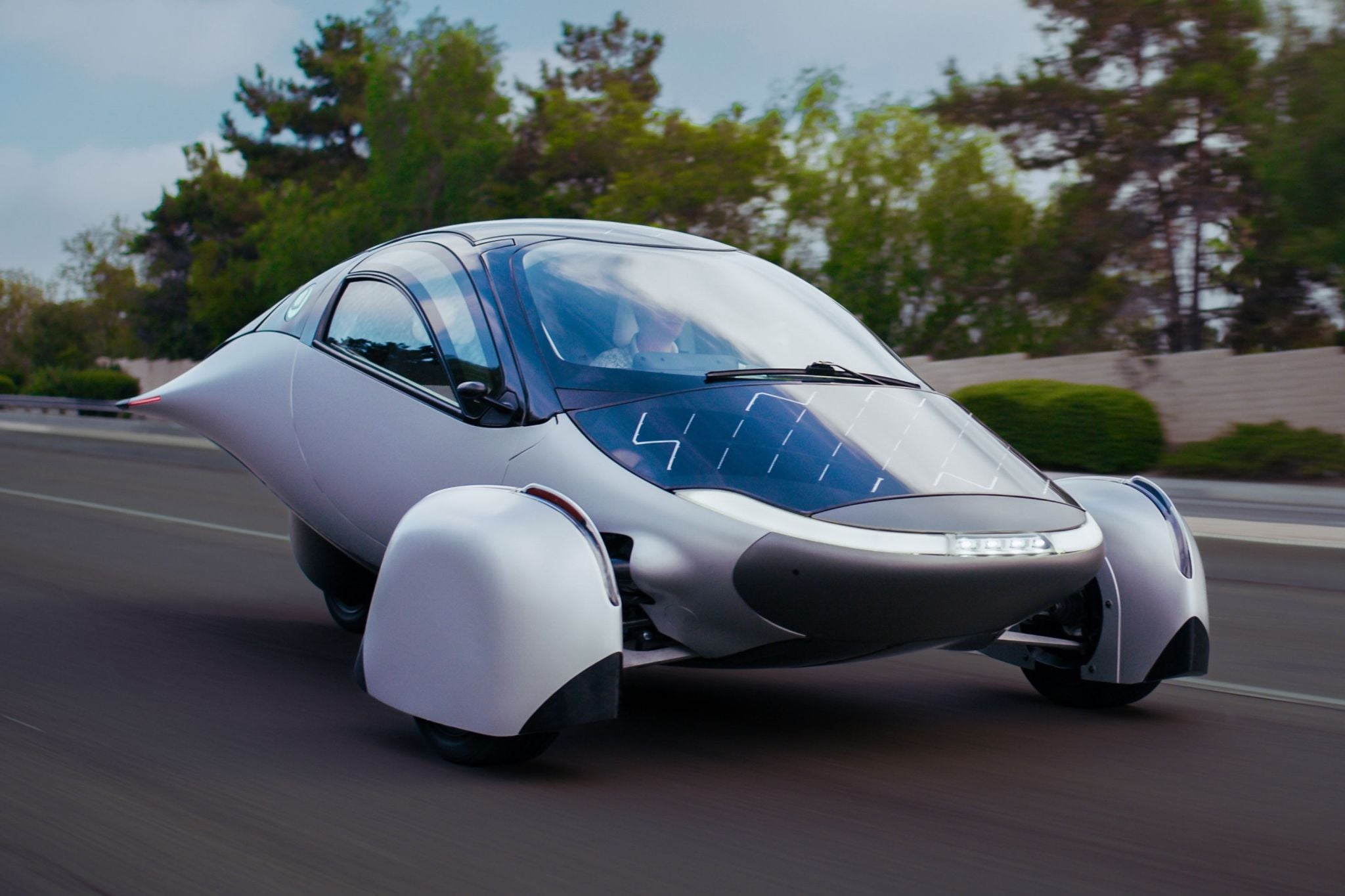
The Aptera, a solar electric vehicle under development in California for two decades, had its main promise measured by an independent laboratory. In three days of tests in July, Germany’s TÜV Rheinland recorded more than 4 kWh of solar energy delivered to the prototype’s battery per day, the number the company has been chasing since 2006 and which is equivalent to about 64 km driven only with sun.
The measurements were taken from sunrise to sunset, with calibrated TÜV instruments, at the Aptera factory in Carlsbad. The energy was measured at the battery intake, after conversion losses, and not at the panels. With the car stopped in the same position all day, it was 4.23 kWh, equivalent to 68 km. Repositioned once at solar noon, 4.40 kWh, or 71 km. With the rear raised and tilted towards the sun, 4.75 kWh and 76 km, precisely on the day with the lowest solar incidence of the three. The autonomy calculations are based on the company’s efficiency goal of 62 Wh per kilometer, not yet proven in a series car.
A 20-year-old project that never hit the streets
The Aptera is a two-seater tricycle with a drop shape and an aerodynamic coefficient of 0.13, one of the smallest ever announced for a street car. The solar panels are integrated into the bodywork, and the model also accepts recharging by outlet or electric station. Because it has three wheels, it is classified as a motorcycle in the United States, which exempts it from part of the safety requirements of automobiles.
Created in 2006 by Steve Fambro, Chris Anthony and Michael Johnson, the company went bankrupt in 2011 without delivering a single car, had its intellectual property sold to a Chinese group and returned to the hands of the founders in 2019. Today there are about 50 thousand pre-orders.
The plan foresees versions of 400 to 1,609 km of autonomy. The first, the Launch Edition, would have 640 km, front-wheel drive and an estimated price of R$ 205 thousand (US$ 40 thousand). The tricycle is 4.50 m long, 2.23 m wide and 998 kg.
Production depends on new investment
On the Nasdaq since October 2025, under the SEV code, Aptera closed last year with a loss of US$ 43.9 million and US$ 10 million in cash. In March, it reported that the low-volume line will only start operating in March 2027 and depends on raising another US$ 50 million. In documents submitted to the SEC, the regulatory body of the American market, recognizes substantial doubt about its ability to continue operating. In August, it announced a partnership with Launch Design, of up to US$ 44 million, to produce the first 40 units in the last quarter of this year.
Aptera itself points out that the results refer to a single validation vehicle, tested on three specific days and in a single location, and that TÜV’s monitoring does not certify the car or its components. The validation program continues with tests of other parameters.
SEE MORE ABOUT

0 Comments
Comments are the sole responsibility of their authors and do not represent the opinion of this site. Comments containing profanity or offensive language will not be published. If you identify anything that violates the terms of use, please report it.