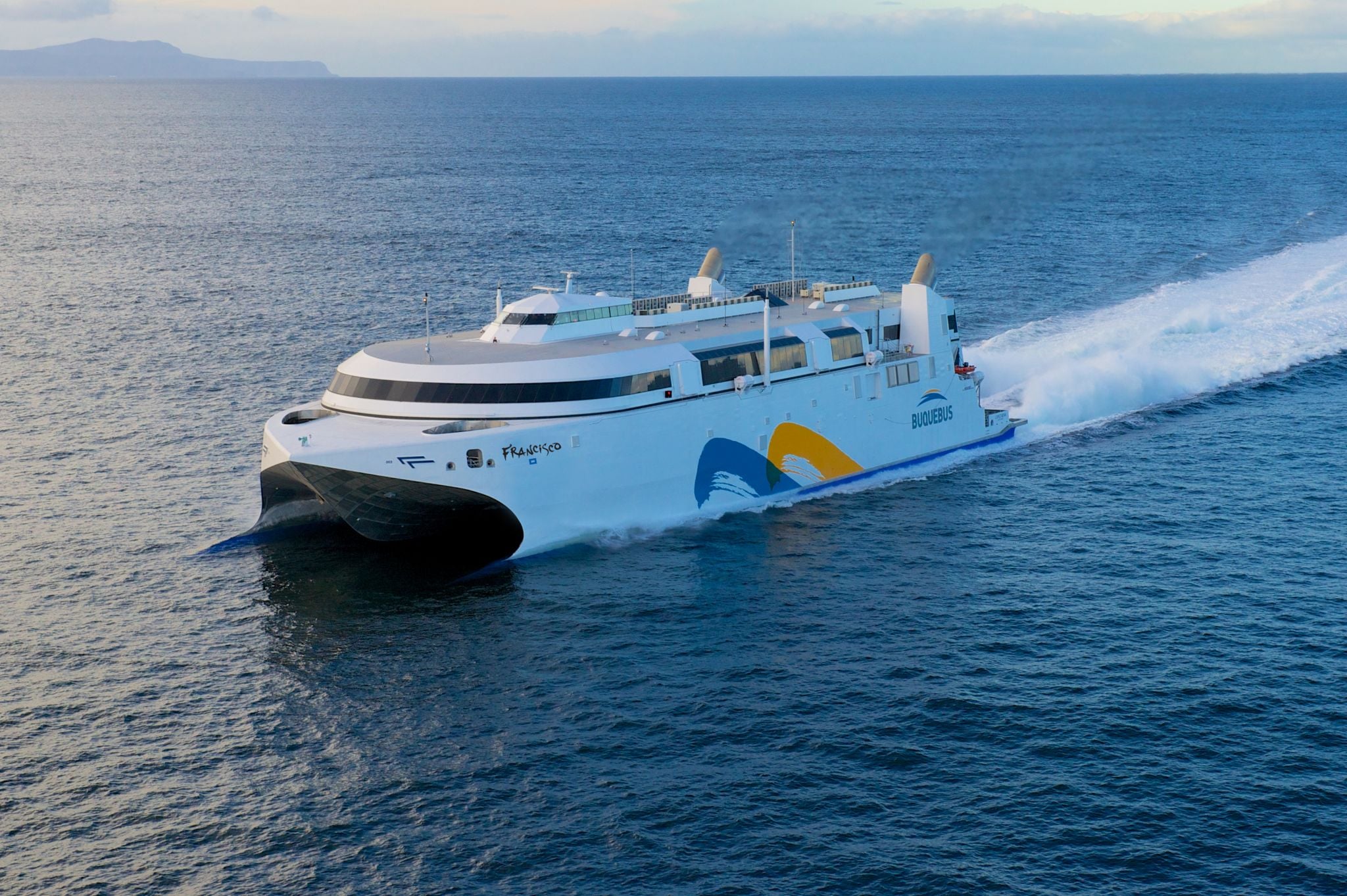
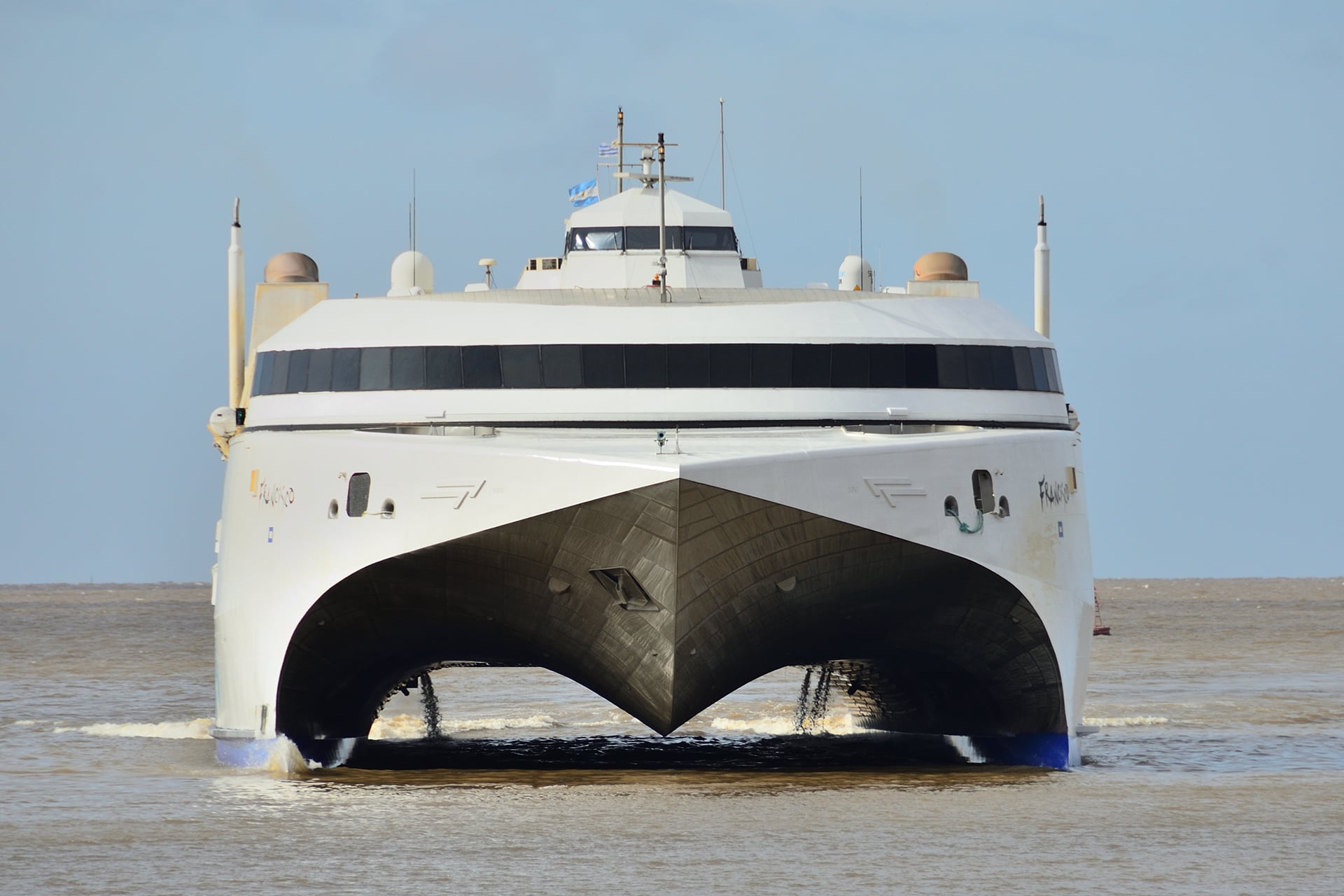
Reaching 108 km/h may seem trivial for a car – it is cruising speed on many highways – but for a 99-meter-long vessel that carries more than a thousand passengers and 150 vehicles, it is surprising. The mark is reached by HSC Francisco, pointed out as the fastest passenger ferry in operation in the world.
Built by the Australian shipyard Incat, in Hobart, Tasmania, and operated by the Argentine Buquebus, the vessel crosses about 225 kilometers between Buenos Aires, Argentina, and Montevideo, Uruguay, over the waters of the Río de la Plata. The route is one of the main links between the two countries and, made at high speed, significantly shortens the travel time compared to conventional vessels. Named in honor of Pope Francis, Argentine, it holds up to 1,024 passengers and 150 cars and has a duty-free shop, bar and VIP areas.
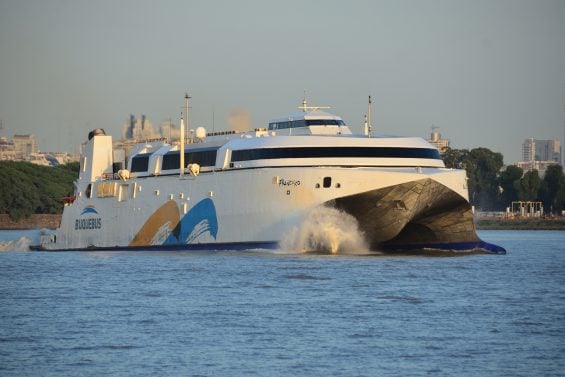
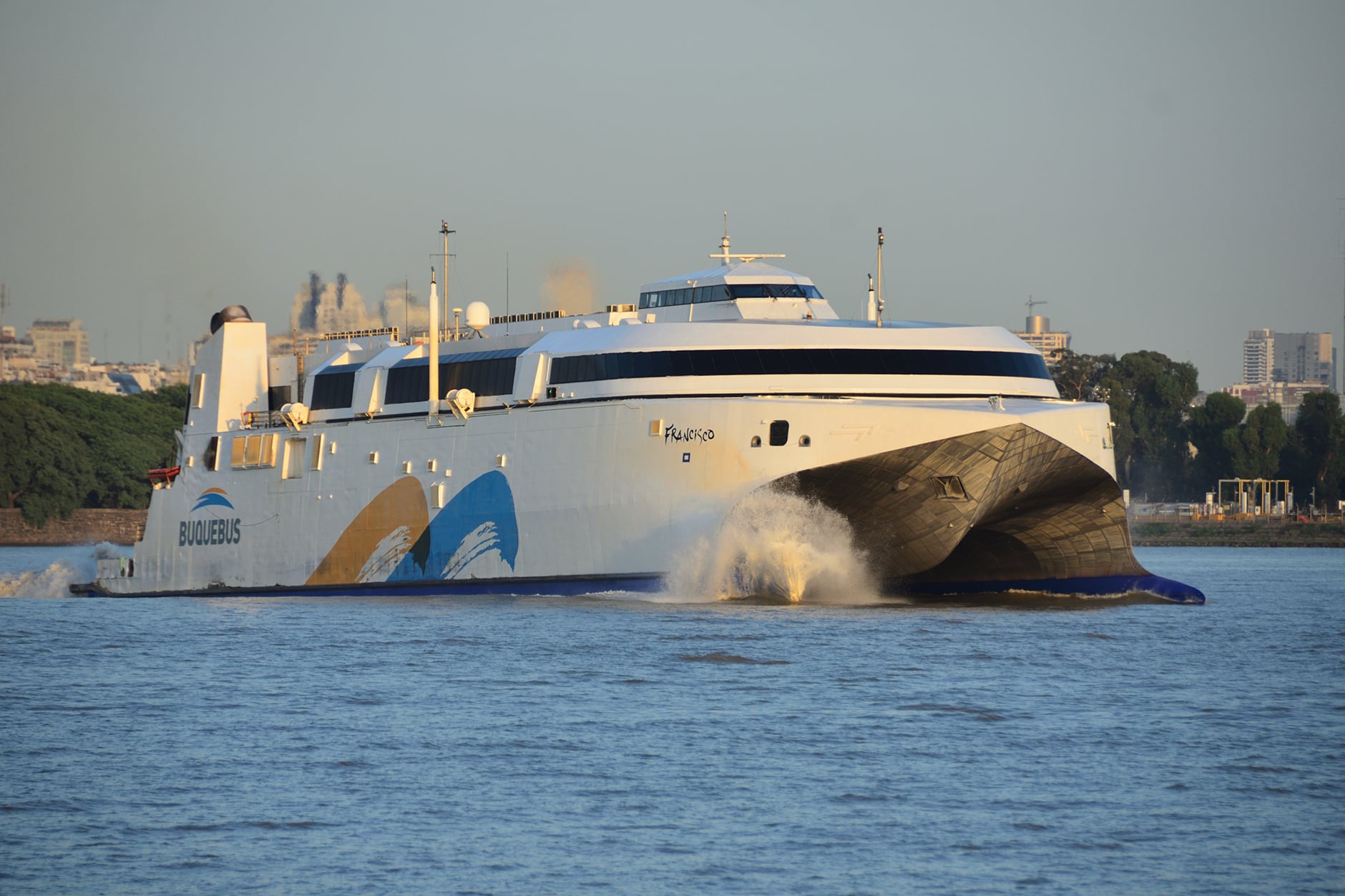
Gas-powered raft was made in Australia (Photo: Manuel Mohedano Torres | Shipspotting)
The performance comes from two GE LM2500 gas turbines, of aeronautical origin, each with about 59,800 hp, adding up to approximately 119,600 hp. The set drives two Wärtsilä LJX 1720 SR axial water jets, responsible for taking the vessel to up to 108 km/h (about 58 knots). Each system moves around 24 thousand liters of water per second. According to GE, the LM2500 family, in continuous development since 1969, accumulates a reliability rate of more than 99% and equips a large part of the fleet of turbine ships of the United States Navy.
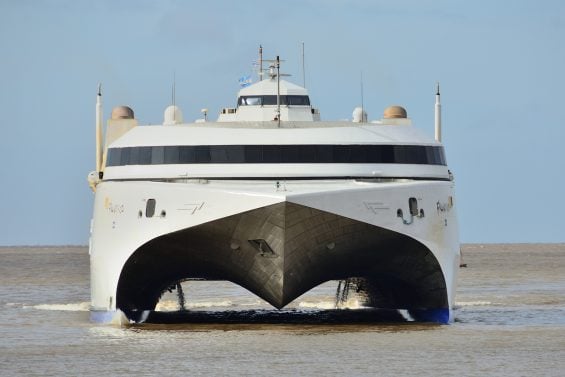
In addition to power, performance depends directly on engineering. Just as a powerful car is useless if it cannot transfer power to the ground, a vessel needs a design capable of harnessing all the available energy. HSC Francisco adopts a catamaran with a wave-piercing hull, a configuration that cuts through the water with less resistance, maintains stability at high speed and reduces passenger discomfort during the crossing.
Hull shape helps break the waves of the Río de la Plata basin (Photo: Manuel Mohedano Torres | Shipspotting)
The two hulls also house the tanks of liquefied natural gas (LNG), the vessel’s fuel, which frees up space for the passenger area. The interior is distributed on different levels: garage for vehicles at the base, economy class with shops, toilets and bars on the intermediate level and first class lounges and VIP areas above. The combination of two hulls makes it possible to reconcile high load capacity with record speed, which is difficult to achieve in single-hull designs.
Comments are the sole responsibility of their authors and do not represent the opinion of this site. Comments containing profanity or offensive language will not be published. If you identify anything that violates the terms of use, please report it.