


Stellantis’ ‘legalized dismantling’ completes one year with 1,150 cars reused
Osasco unit dismantled 1,150 cars in 12 months, recovered more than 20 thousand parts and operated at about 14% of installed capacity
By
João Paulo Profeta
Published on 2026-09-16 at 12:00 PM
Published on 2026-09-16 at 12:00 PM
Be the first to comment.
Summarize with:
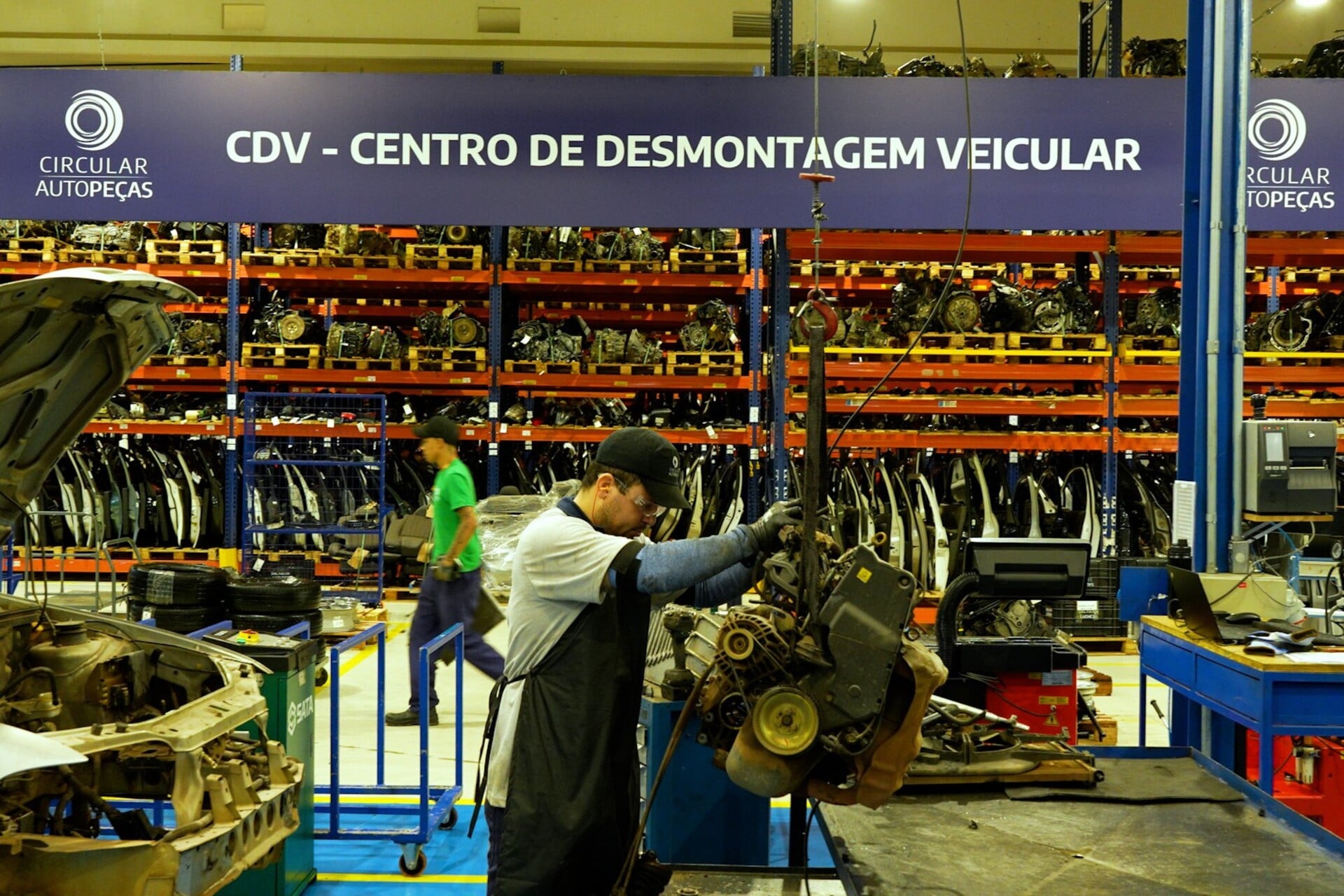
The Vehicle Disassembly Center (CDV) of Circular AutoPeças, maintained by Stellantis in Osasco (SP), completed one year of operation with 1,150 cars disassembled. The number is equivalent to about 14% of the unit’s installed capacity, designed to process up to 8 thousand vehicles per year.
In practice, the CDV is the opposite of the corner junkyard: instead of pressing the entire car as scrap, the unit disassembles end-of-life vehicles piece by piece, catalogs each component with an invoice and resells what is still in a condition of use. It is the first structure of its kind maintained directly by an automaker in South America.
The activity is regulated by Law 12.977/2014, known as the Dismantling Law, which requires companies in the sector to register with the DMV of the state where they operate, issue an invoice for the entry of each vehicle and cancel the registration of the car. The rule was born to stifle clandestine dismantling, which supplied the market with parts of stolen origin.
What the center delivered in the first year
Of the 1,150 disassembled cars, more than 20 thousand parts were recovered for sale, of which more than 11 thousand have already been sold. In the same period, about 862 tons of materials and almost 14 thousand liters of automotive fluids received proper disposal, including more than 4,600 liters of oil and about 1,830 liters of cooling fluid.
According to Stellantis, reusing components instead of manufacturing new parts reduces raw material consumption by up to 80% and cuts CO2 emissions by up to 50%. For the car owner, the appeal is more direct: the used part with documented origin is usually well below the price of the new one, especially in old models, whose original components have already been discontinued.
An ecosystem that goes beyond Osasco
The CDV is one of the ends of the circular economy strategy that Stellantis has maintained in South America since 2023, organized around the so-called 4Rs: remanufacturing, repair, reuse and recycling. Under the Circular AutoParts brand, the after-sales portfolio already brings together more than 500 components including remanufactured, repaired and reused parts.
Another end is in Betim (MG), where the Vehicle Reconditioning Center has reconditioned more than 500 cars in just over three years. There is also the Motul NGEN Circular AutoParts line of lubricants, developed with Motul and Lwart, which reuses used oil collected in the operation itself. The next steps, according to the company, include expanding the offer of reused parts and expanding sales channels.
The reuse of components, however, is not a consensus in the chain. In a hearing at the Chamber of Deputies, Sindipeças, which represents auto parts manufacturers, took a stand against the reuse of end-of-life vehicle parts, alleging risks to safety and the environment. Recycling entities, such as Abcar, defend the practice as a viable alternative from an environmental and economic point of view.
SEE MORE ABOUT

0 Comments
Comments are the sole responsibility of their authors and do not represent the opinion of this site. Comments containing profanity or offensive language will not be published. If you identify anything that violates the terms of use, please report it.