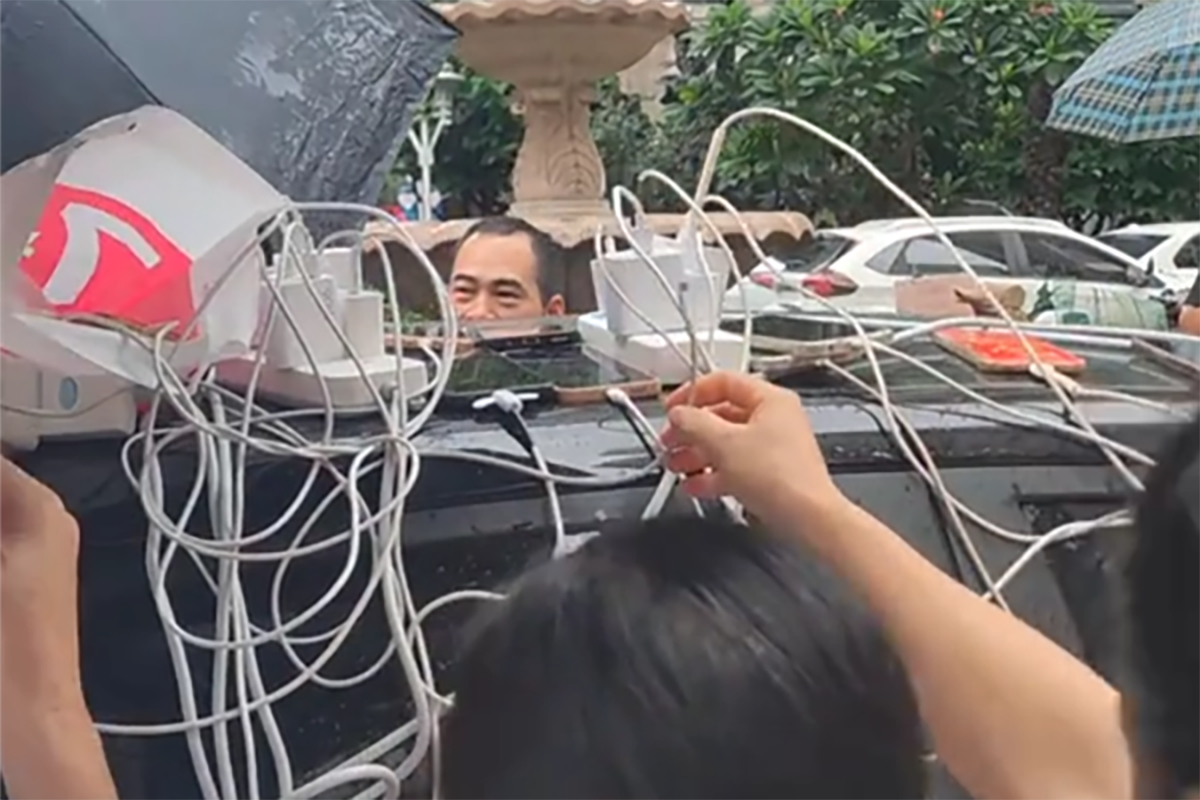
Amid the blackout caused by historic floods in southern China’s Guangxi province, owners of electric and hybrid cars have turned their vehicles into makeshift power points. Using V2L technology, they started to recharge cell phones and power essential equipment of neighbors left without power by the disaster through the batteries of EVs.
The rains were caused by Typhoon Maysak, the 10th of the season and the first to hit China in 2026. After making landfall on Hainan Island on July 3, the storm lost strength but remained over Guangxi for about 26 hours — twice the usual time for a typhoon in the region — which dumped record volumes of rain, above 900 mm in the hardest-hit areas.
The overflow and rupture of reservoirs in Hengzhou, in the Nanning area, flooded entire cities. According to local authorities, at least 39 people died – a number that skyrocketed after a dam collapse – 130 thousand were evacuated from their homes and 375 thousand were affected; drones and about 5,700 boats participated in the rescue.
Salvation by electric cars
Rains in China have already left 39 dead and 130 thousand homeless (Photo: Xinhua | Cao Yiming)
With the power grid and communications disrupted in several areas, the vehicles have become a lifeline, thanks to V2L technology. The acronym for vehicle-to-load describes the car’s ability to work as a large portable battery: electric, plug-in hybrids and modern extended range models have bidirectional chargers that, in addition to supplying the battery at the outlet, go the other way around — they convert the stored energy into 220 V alternating current, the same as that of domestic outlets. Available in an adapter attached to the parked vehicle.
To give you an idea, an electric car with a 60 kWh battery can supply about 3.3 kW for almost 18 hours, enough for the basic consumption of a house during the blackout. Some hybrids even bring a “camping mode”, which generates energy when the car is stationary.
The Southern Metropolis Daily newspaper showed residents gathered around a Geely EX2 (sold in China as Xingyuan) operating in V2L, and videos circulated of cars with charging cables scattered across the body. On the networks, netizens joked that “now no one talks bad about electric cars” and that the function “is used a few times a year, but it only takes one to compensate”.
Groups of landowners also organized volunteer convoys, articulated by messaging apps, to bring supplies to isolated communities, taking advantage of models capable of wading through flooded stretches.
Despite its usefulness in critical scenarios, experts warn that improvised adaptations — precarious extensions and many devices connected to the same point — increase the risk of overload and accidents. The trend is for the solution to repeat itself as the electric fleet grows: according to China EV DataTracker, new energy vehicles accounted for 62.9% of new car sales in the country in June 2026.
The available power varies depending on the model — while entry-level options, such as the Geely EX2 itself, deliver around 3.3 kW, the Geely Riddara RD6 pickup reaches 36 kW in three-phase current, capable of even recharging drones.
Comments are the sole responsibility of their authors and do not represent the opinion of this site. Comments containing profanity or offensive language will not be published. If you identify anything that violates the terms of use, please report it.