


Italian police win Lamborghini to transport donated organs
Model that reaches 343 km/h reinforces partnership started in 2004, which already has more than 200 organ transport missions in Italy
By
Júlia Haddad
Published on 2026-09-08 at 07:00 PM
Published on 2026-09-08 at 07:00 PM
Be the first to comment.
Summarize with:
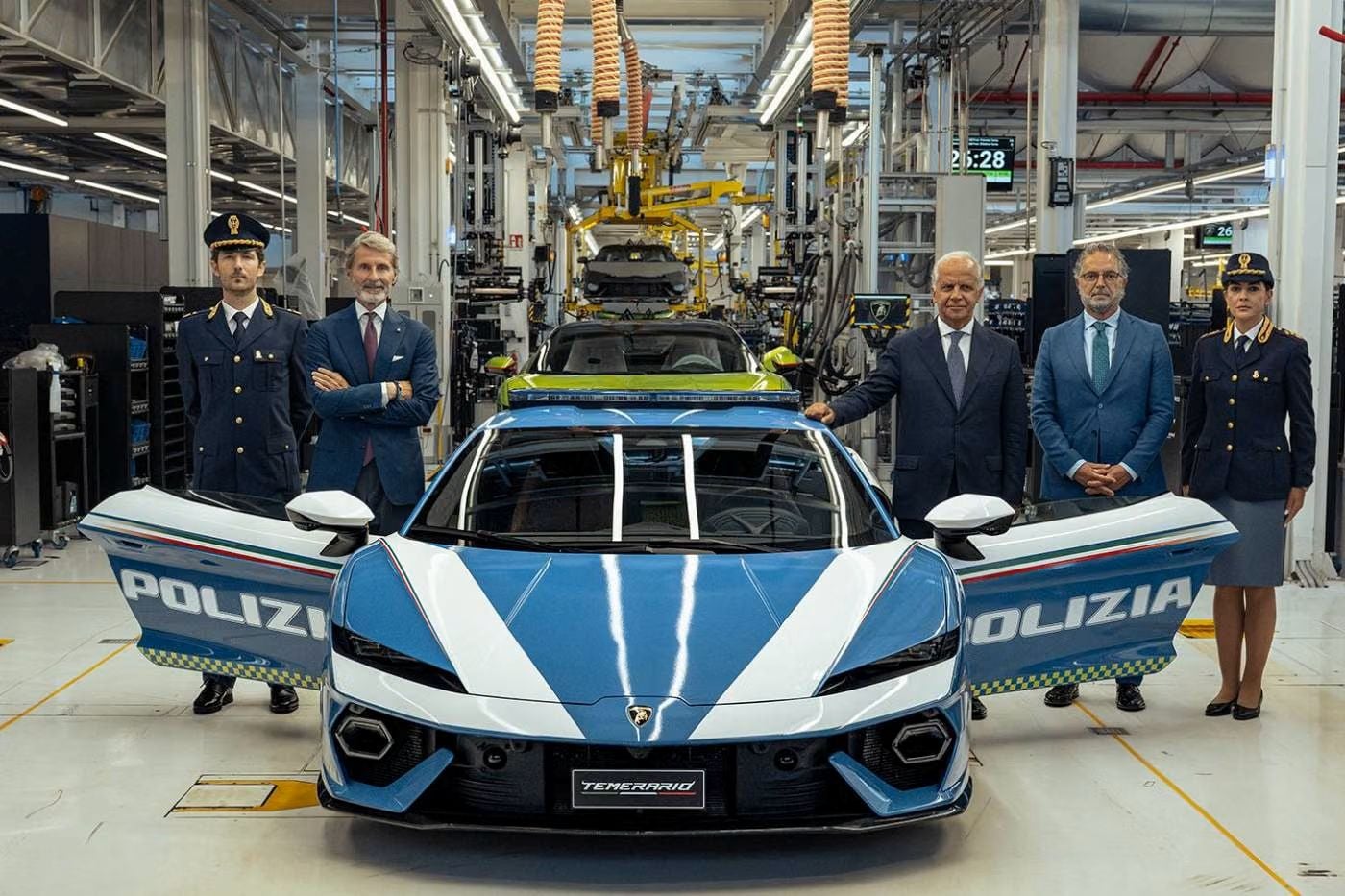
Lamborghini has delivered to Italy’s Polizia di Stato a Temerario prepared for a task that does not involve persecution: the urgent transport of organs and medical supplies on the roads of Italy. The 920 hp hybrid super sports car was presented at the manufacturer’s headquarters in Sant’Agata Bolognese and is the latest chapter in a partnership that began in 2004.
The award ceremony was attended by Italy’s Minister of the Interior, Matteo Piantedosi, and Stephan Winkelmann, president and CEO of Automobili Lamborghini. According to the manufacturer, six cars of the brand have already been part of the Italian police fleet in more than two decades, with participation in more than 200 organ transport missions and more than 1,500 traffic education actions.
The list includes the Gallardo, the Gallardo LP 560-4, the Huracán and the Urus Performante, incorporated in 2023 and which is still in service. The first Gallardo arrived in 2004 and fulfilled its initial mission of transporting organs in September of the same year, according to Lamborghini. In December 2022, the corporation itself announced the use of a Huracán to take two kidneys from Padua to hospitals in Modena and Rome, a journey of more than 500 km.
The V8 that spins at 10,000 rpm
The Temerario is the brand’s first plug-in hybrid intended for the Italian police. The set combines a 4.0 biturbo V8 engine, with 800 hp and 74,4 kgfm, capable of rotating at 10,000 rpm, with three electric motors: two on the front axle and one coupled to the eight-speed dual-clutch transmission. The combined power reaches 920 hp, enough to accelerate from 0 to 100 km/h in 2,7 seconds and reach 343 km/h. In Brazil, the model is sold from R$ 5,8 million.
Why haste makes a difference
The urgency has a medical explanation. The time of cold ischemia, the period in which the organ remains viable outside the body, is about four hours for the heart, six for the lungs, 12 for the liver and pancreas, and up to 48 hours for the kidney, according to the São Paulo Municipal Health Department. Every minute saved on the road increases the chance of the transplant happening.
In Brazil, this logistics is done by ambulances, flights and escorts of the Federal Highway Police and the military police, which make their way on congested highways, such as the stretch of BR-324, in Bahia, used in July to take organs to Salvador. Super sports cars, here, are not included in the account.
Visually, the Temerario maintains the identity of the Polizia di Stato, with blue and white paint, “Polizia” graphics, stripes in the colors of the Italian flag and a luminous bar on the roof. The manufacturer did not detail the internal adaptations, but previous models of the fleet received a specific compartment for the thermal boxes in which the organs are stored.
SEE MORE ABOUT

0 Comments
Comments are the sole responsibility of their authors and do not represent the opinion of this site. Comments containing profanity or offensive language will not be published. If you identify anything that violates the terms of use, please report it.