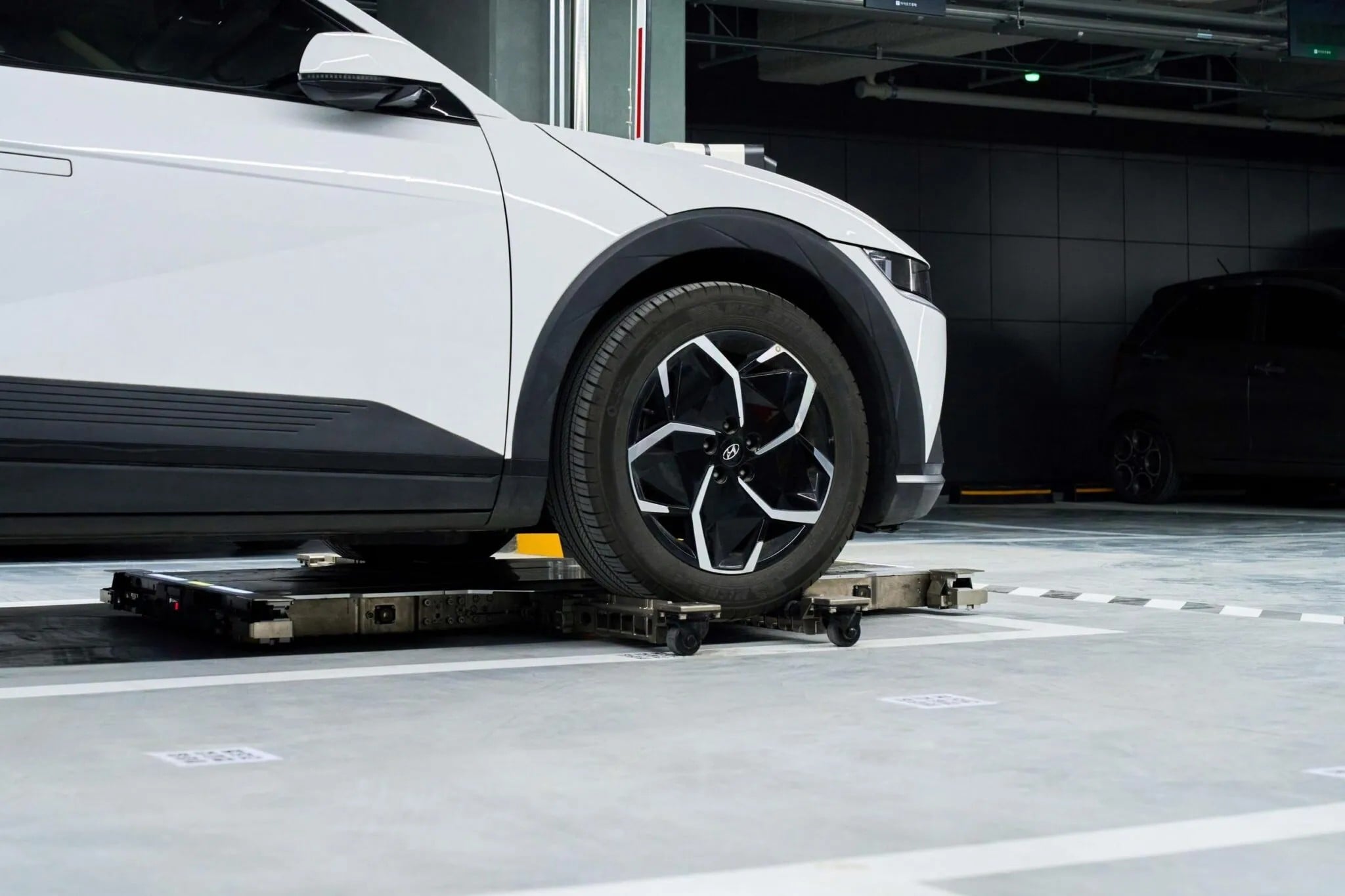
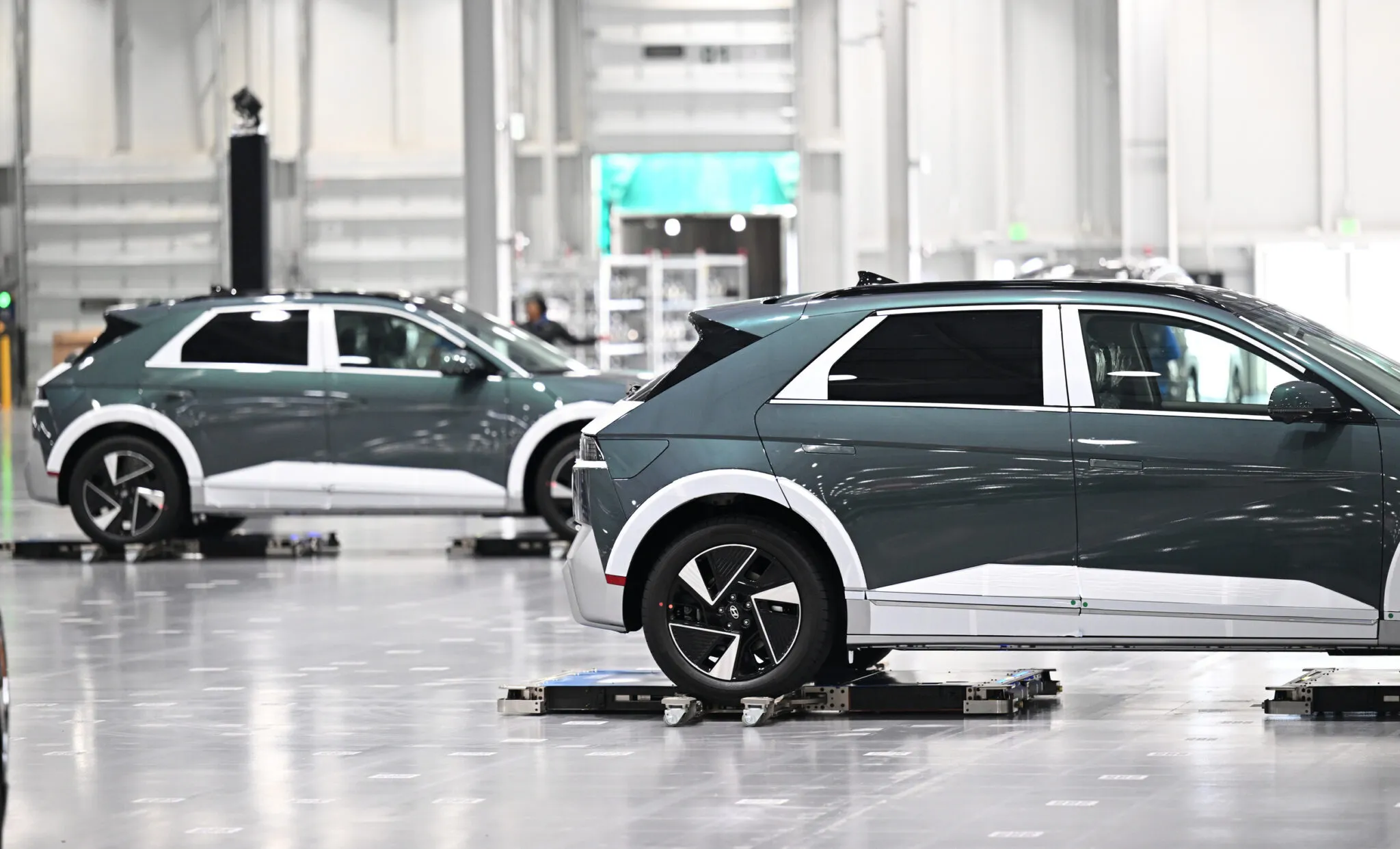
Two 11 cm tall robots crawl under the car, lift the wheels and carry the vehicle to the parking space. This is Hyundai Motor Group’s bet to solve the squeeze of condominium garages. A consortium formed by Hyundai Motor, Hyundai Wia and Hyundai E&C started this week a pilot project of this type in South Korea. The company’s expectation is to increase the parking capacity of a local condominium by up to 50%.
The test is the first of its kind in a South Korean residential building and has received approval and public funding from the Ministry of Land, Infrastructure and Transport, through the regulatory sandbox of smart cities, a mechanism that authorizes testing in the real world technologies that the legislation does not yet cover. Two sets of robots will take care of 53 parking spaces in an isolated area of the first basement.
How it works
The robots work in pairs. LiDAR sensors read the size and position of each wheel so that the two units, thin and wide, fit under the car. Together, they lift the wheels and transport vehicles of up to 3,400 kg at a maximum of 4.3 km/h.
Photo: Hyundai | Disclosure
For the driver, the process boils down to stopping at a drop-off area and driving away. On the way back, the order is placed at a kiosk in the condominium itself, and the robots return the car to the pick-up point.
Speed, therefore, is not the argument. The gain is in space. Because no one has to open doors or move between vehicles, cars can be parked much closer together, and robots move in all directions, allowing them to occupy narrow spaces that a driver would have difficulty taking advantage of.
What Hyundai wants to measure
According to the group, the system also tends to reduce accidents inside garages, because it separates the circulation of cars and pedestrians, and to reduce emissions, since no one is idling in search of a parking space.
During the pilot, the consortium will monitor how long each car takes to be parked and recovered, how much the user really waits and how often the maneuver works. It also intends to reach the ideal ratio between the number of parking spaces and robots for each type of building.
“We plan to verify the operational stability, efficiency and user convenience of the parking robot in a real living environment, and build a standard model that can spread across a variety of spaces,” a Hyundai Motor Group spokesperson said.
The technology is not an absolute debut. The robots were presented to the public in January at CES 2026 in Las Vegas, and since 2024 they have been operating at Factorial Seongsu, an office building in Seoul where Hyundai Wia is also testing a system capable of managing up to 50 robots at the same time.
Comments are the sole responsibility of their authors and do not represent the opinion of this site. Comments containing profanity or offensive language will not be published. If you identify anything that violates the terms of use, please report it.