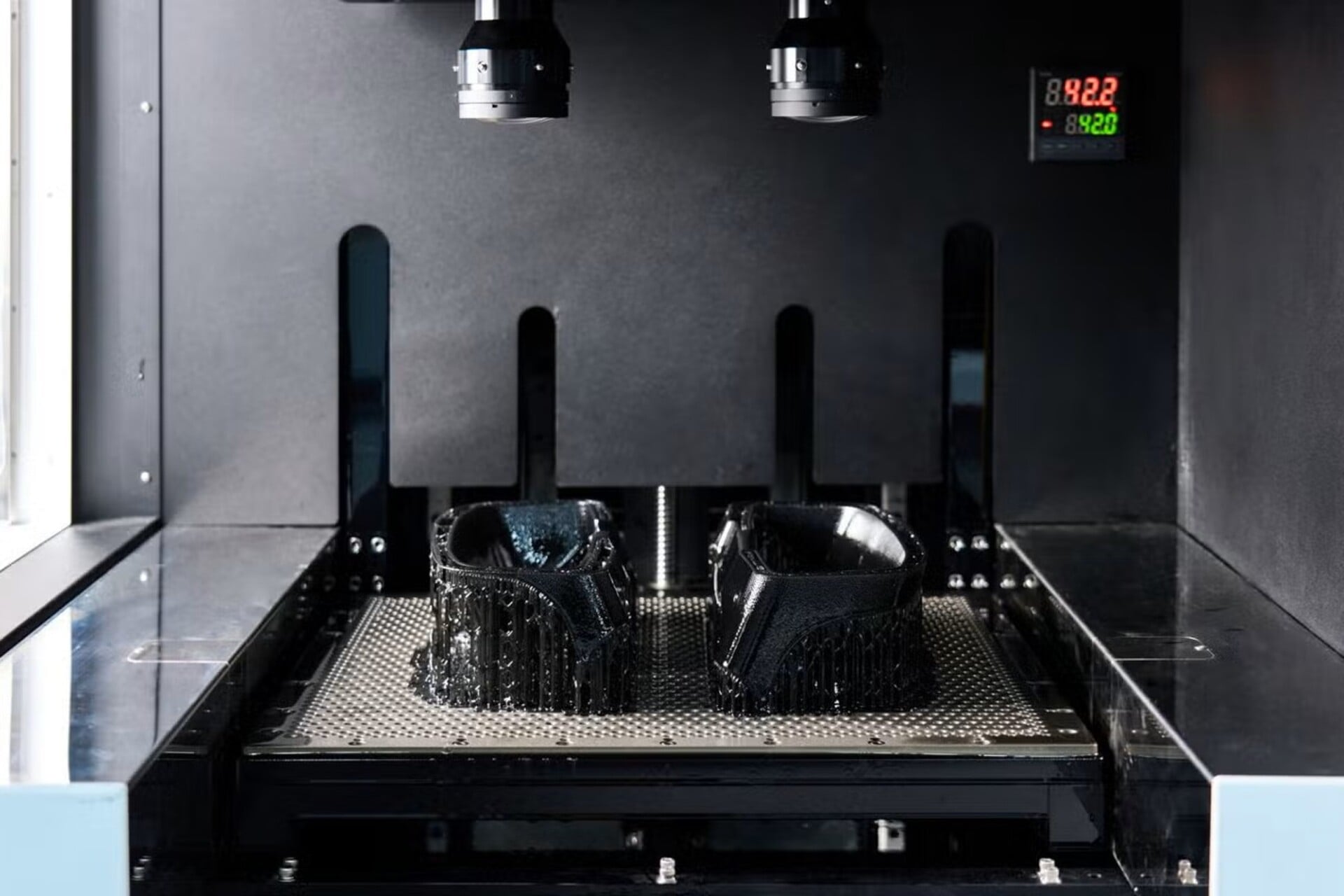
Hyundai and Kia have started to manufacture components that conventional production lines cannot deliver. The two South Korean automakers detailed the operation of the Additive Manufacturing Solutions Center (AMSC), installed at the Namyang Research and Development Center in South Korea, the first Hyundai Motor Group unit built specifically for research and production in 3D printing.
The center was built nearly three decades after the group adopted its first industrial 3D printer in 1996. The logic is to invert the traditional process: instead of starting from molds, dies and machining, which remove material and limit the geometry of the parts, additive manufacturing deposits material layer by layer until it reaches exactly the shape predicted in the digital file.
Photo: Hyundai | Disclosure
Freedom of design
In practice, this means producing lighter parts with unfeasible geometries by casting or stamping. For polymers, AMSC uses vat light curing, in the Digital Light Processing (DLP) and stereolithography (SLA) variants, as well as powder bed fusion, which does not require support structures and reduces material waste. For metals, the center operates powder-bed laser fusion and directed energy deposition systems, including DED-WAAM, which uses arc welding to stack steel, stainless steel, aluminum and titanium into large structural components.
Piece-by-piece inspection
Every printed part goes through the Quality Inspection Cell, which checks the dimensions and submits the components to tests of tensile strength, flexural stiffness and impact resistance. There is also verification of materials and metallurgical analysis done internally, to ensure that the result meets the same standards as serial production, according to the manufacturers.
Photo: Hyundai | Disclosure
The applications have already gone far beyond the prototype. AMSC manufactures jigs and devices used in assembly lines and spare parts for off-line models, whose original tooling would be unfeasible to reactivate. On the restoration front, engineers recreated a component of the Hyundai Pony’s side sill from 3D scanning and reverse engineering, with a finish equivalent to the original. In motorsport, 3D printing already accounts for stabilizer bar blades, shock absorber mounts and brake ducts, in which lightness and rigidity weigh at the same time.
Photo: Hyundai | Disclosure
The group is also working on the concept of Design for Additive Manufacturing, in which the part is designed from the beginning to be printed, which makes it possible to unify components that were previously assembled separately and to adopt lattice structures to reduce weight without losing strength.
“We are rapidly internalizing additive manufacturing technologies,” said Hanwoo On, senior manager of the Additive Manufacturing Solutions team. According to the executive, the use is already expanding to high-value items outside the car, such as equipment consumables and manufacturing tools.
Comments are the sole responsibility of their authors and do not represent the opinion of this site. Comments containing profanity or offensive language will not be published. If you identify anything that violates the terms of use, please report it.