

Driver lying in front is bet to make this sports car more exciting
New Dutch brand bets on a riding position inspired by MotoGP bikes for its first mid-engine sports car
By
João Paulo Profeta
Published on 2026-06-25 at 10:00 PM
Published on 2026-06-25 at 10:00 PM
Be the first to comment.
Summarize with:
For decades, the development of hypercars has revolved around more power, refined aerodynamics and cutting-edge technology. The Dutch Sanrivatti decided to change another, much more basic point: the way the driver sits. The startup, founded by 23-year-old Santiago Sánchez Rivero, who interned at Donkervoort, wants to position the rider as a MotoGP rider.
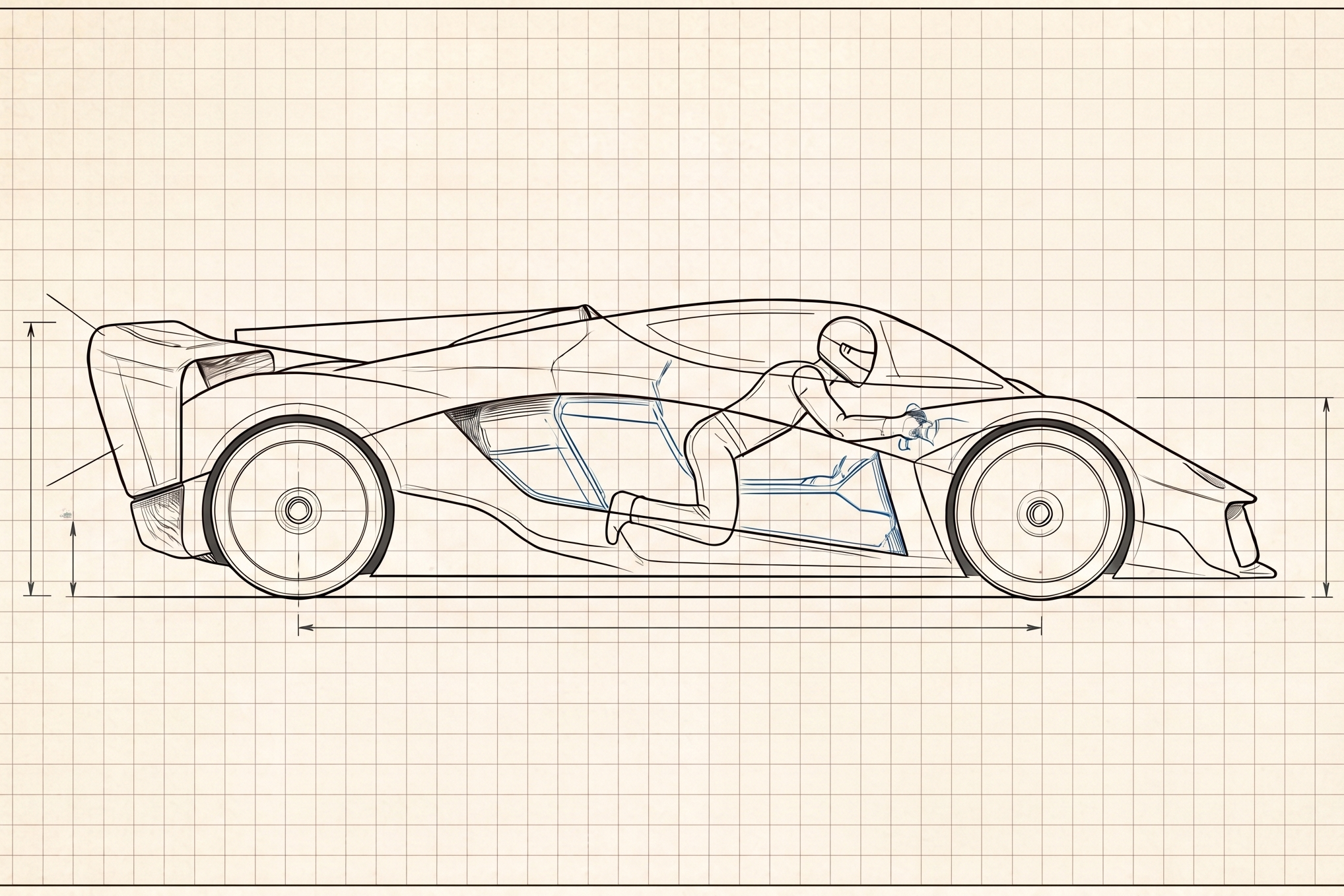
The proposal is what the company calls an “apex position“. Instead of the traditional ergonomics of a mid-engine coupe, the driver sits in the center of the cockpit, lying and leaning forward, feet back and legs flanking the center tunnel—a posture closer to that of a motorcyclist leaning over a superbike than to that of an ordinary driver. There is no space for passengers: the car is a single-seater.
According to the brand, the idea is to fuse the stability of four wheels with the visceral connection of a motorcycle, transforming the driver into an active participant in the dynamics. “The question has never been how to create more power or speed, but how to create a deeper connection between driver and machine,” says Rivero, for whom even the most capable cars isolate the driver by layers of architecture, electronics and convention.
Despite being young, the company brought together big names. Among them is Paul Arkesden, former head of engineering at Singer and leader of the McLaren P1 program, as well as professionals who have worked for Bentley and Lotus. For Arkesden, what attracted the team was the originality of the proposal, in a sector that, according to him, has become efficient in refining established ideas, but rarely explores new paths. The first publicity images show a car with a wedge profile, with a fighter-style canopy, muscular rear and integrated wing. Sanrivatti says it is already working on prototypes.
It remains to be seen if the concept gets off the ground. Automotive ergonomics is a consolidated science for good reasons — comfort and control in extreme situations — and transposing a kind of “mount” to an enclosed cabin raises challenges in terms of visibility, safety, and even how to accommodate pedals and controls around this position.
For now, the project is more promise than product: there is no information about engine, chassis, price or launch date, and the hypercar does not even have a name. If engineering sustains the radical position, Sanrivatti can deliver a truly new way of driving; if not, it runs the risk of adding to the list of exotic projects that remained in the concept.
SEE MORE ABOUT

0 Comments
Comments are the sole responsibility of their authors and do not represent the opinion of this site. Comments containing profanity or offensive language will not be published. If you identify anything that violates the terms of use, please report it.