


‘They ruined our Interlagos!’
Eduardo Pincigher remembers one of the best articles he produced when he took track veterans to run at Interlagos
By
Eduardo Pincigher
Published on 2026-04-18 at 05:00 PM
Updated on 2026-04-18 at 05:26 PM
Published on 2026-04-18 at 05:00 PM
Updated on 2026-04-18 at 05:26 PM
Be the first to comment.
Summarize with:
When I joined the Motor Show magazine, published by Editora Três, in the year of grace of 1994, the idea of Domingo Alzugaray, owner of the publishing house, was to surf the wave of imported cars that invaded the Brazilian market. He called an old magazine maker, named Walter Arruda, to run the project. And WA invited the trio that had just left Quatro Rodas: Luiz Bartolomais Jr., Douglas Mendonça and me.
SEE ALSO:
- Not him! The lonely duel in the Clio Cup
- The Yolando, the Kombi, the Paulistinha and the CB400
- The breakdown at the Ford plant: a lesson for the future
Even though we gave a flavor of grease to the editorial content of the magazine, Arruda did not give up his original idea for the publication, which was to create a kind of “automotive Caras magazine”, that is, you always had the opinion of the specialized journalist in the evaluations and, in addition to his, you had the guesses of a celebrity.
Former director of the former TV Tupi in the 1970s, Arruda knew the entire casting of the stations. And it was during this period that several artists walked through the pages of the magazine participating in the productions of the reports, riding with the cars and giving their opinions. But here for us, huh? It was too forced… And it added nothing, at least for the traditional reader of a publication specializing in automobiles.
That was when we created a transition phase and instituted the participation of characters who were linked to the world of automobiles. They were pilots, former pilots, businessmen, merchants, in short, people who knew the difference between tire and carburetor and, obviously, contributed barbarously with the editorial content. The Motor Show rivaled, at the time, AutoEsporte for the position of second magazine with the largest circulation in the country, which was no small thing.
I was able to personally meet and do some reports with several renowned drivers of Brazilian motorsport. Here I give myself an aside, but it is totally related to this topic and has a very interesting content. I interviewed about ten or twelve F1 drivers. I asked everyone the same question. And from all of them, I received the same answer: “what impressed you the most when you drove F1 for the first time?” Ayrton, Nelson, Émerson, Rubinho, Gugelmin, Tarso, Christian, Raul… Everyone said: the brakes. Nothing equals an F1 like the power of the braking system. Competition cars do not need to have the same durability as the set of discs, pads, wheel cylinders and other items as street cars. That’s why you have much more efficient brakes on track cars.
Unlike the beginning of the magazine, where global stars struggled to drive cars with automatic transmissions, as some had never tried – the 1990s were another planet – hearing from an Emerson comments about the Dodge Viper RT/10 was incredible. Or Nelson’s opinion about BMW M3 versus Mercedes C43 AMG… We made a giant qualitative leap. They were classes.
I will allow myself the second aside. Anyone who is not a journalist has never participated in a “staff meeting”, which is nothing more than a brainstorm to define which reports will be part of the next edition. It is the chance to magnify ideas that are sometimes very modest.
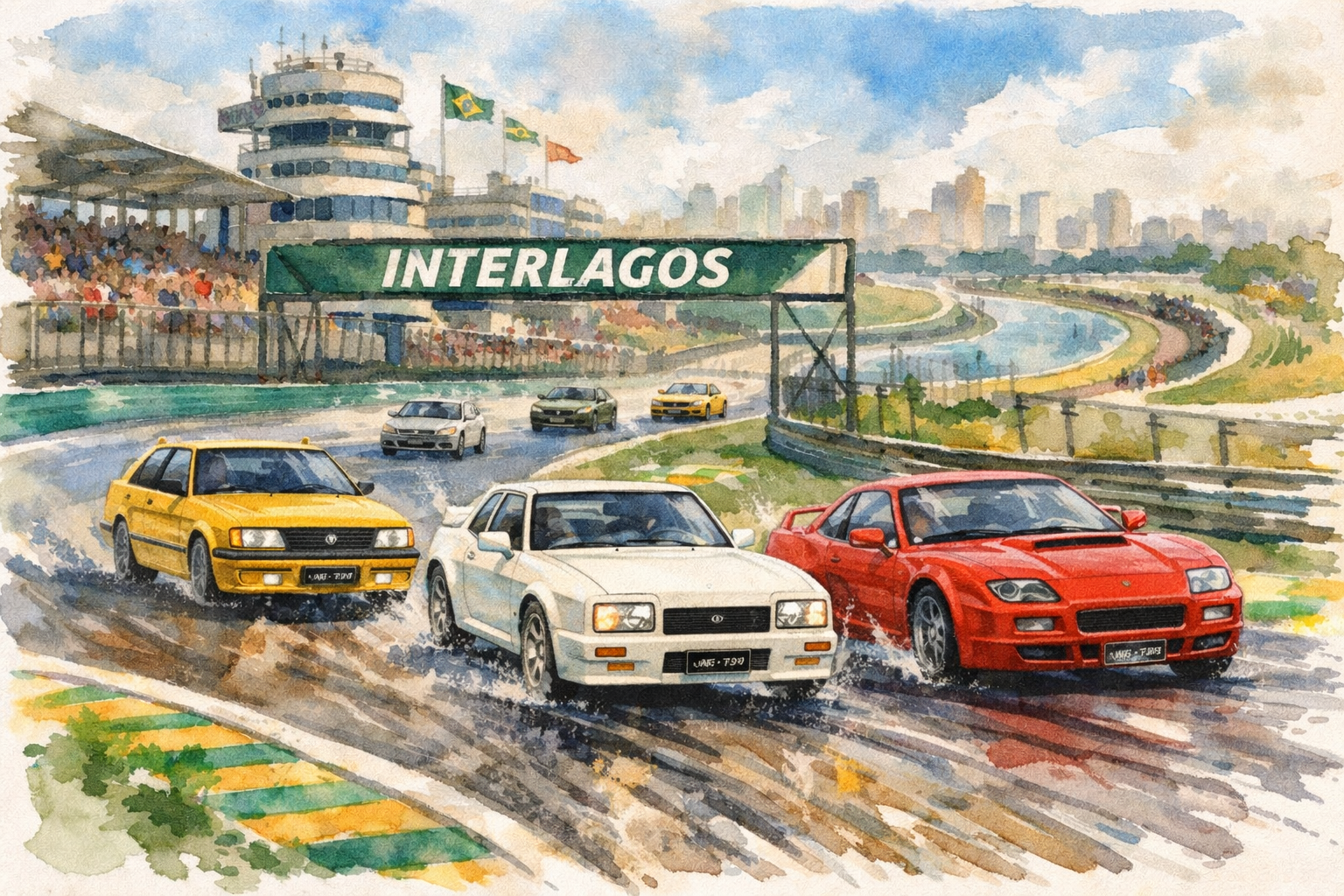
Around the end of the decade, we held another meeting at the Motor Show. And someone suggested that we invite a veteran driver, who had been one of the precursors of Brazilian motorsport, to drive a current sports car. I just remember that another colleague appeared and guessed that this would be done at Interlagos – the São Paulo racetrack had been renovated a few years before and it was possible that the pioneers of Interlagos did not even know the new layout.
The matter grew. Suddenly, we had gathered 6 sports cars of the time (Honda Prelude, Mitsubishi Colt, Renault R19 16V, Citroën ZX 16V, Peugeot 306 S16 and Fiat Tipo 16V) and invited eight veteran drivers to test them at the Interlagos Autodrome. I think it was the most sensational report I have had the pleasure of participating in my career. The invited drivers were not my idols, but my father’s. Guys who drove in the 1950s and 1960s, many of them before Emerson Fittipaldi himself.
To make it even more interesting, we hit the nail on the head: none of them knew the new layout. The characters hadn’t seen each other for decades and the reunion was extremely emotional.
True legends: Camilo Cristófaro, Eugênio Martins, Luiz Pereira Bueno, Marinho César, Fritz d’Orey, Chico Lameirão and Bird Clemente. If my memory doesn’t betray me, the eighth was Ciro Caires. As the story of the reunion of these stars ended up spreading, we still had two other unforgettable characters: Jorge Lettry and Toni Bianco.
The first exclamation of everyone was unanimous: “they ruined our Interlagos!” Everyone said the same. “It became a soft-ass piss! There is no longer any challenge. Nothing. It only brakes, goes around and accelerates”, was what they said. For you, who have never seen the old circuit of the Interlagos Autodrome, look for some reference on YouTube. Find some onboard camera to understand how magnificent the track layout was.
Another curious fact was the emphasis of the comments on grip and, especially, the BRAKES of the cars tested. “If only I had brakes like that on my trucks”, said Camilão.
As they got out of the cars, we picked up notes on some items, such as acceleration, resumption, grip, braking, comfort. Then we add it up and give the result in the article.
Do you want to know who won? I have no idea whatsoever! It must have been the Prelude, which was a much more endowed sports coupe than the other hatches. But that was what mattered least, honestly. Recalling this passage, I say with conviction: it doesn’t matter. Really.
The characters there were the pilots. Everyone was very special. But I still had a way to choose my favorites. First of all, CAMILÃO. There he was already close to (or more) than 70. And the tranquility with which he braked the Prelude at the end of the Opposite and took the Lake? To impress. Something of someone who drove a lot of bad cars all his life and, suddenly, found himself behind the wheel of cars much more neutral in their reactions. He even commented: “funny how this Hondinha does everything I want. I turn, he obeys. I brake, he also obeys… I’m not used to cars like this.”
And the Bird, putting the cars aside, just like he did with the unforgettable Willys Interlagos? The detail is that he did it with one arm, smiling, looking at my face (I was in the passenger seat).
But, I confess, even more than the two of them: I will never forget how fast the so-called LUIZ PEREIRA BUENO was. I immediately remembered my father telling me that he saw several races at Interlagos in the grandstands, in the late 1960s, and thought Luizinho was even more “booty” than Emerson himself.
God of heaven, how did he guide that guy… He didn’t test the cars: he did qualifying laps! I left the pit for an hour driving the Honda Prelude, which was going much further than the other cars, by the way. All the others were in the range of 140 to 155 hp. The Prelude had 190 hp. And I stuck to the back of the Renault. The difference, however, was that Louie was driving the car in front. He had never ridden an R19 16V or on the new circuit. But what a man was accelerating! And what I learned about the track just walking on his tail!!
Unforgettable to ride with these wizards of motorsport at Interlagos.
And just a postscript: I learned years ago that you should be severely suspicious of citizens who mistreat waiters, don’t like dogs, and don’t eat bacon. Yes. I have observed, as a struggling reporter, if this definition makes sense. And it does. But add to the original theorem: also be wary of those who don’t like cars. I have said.

SEE MORE ABOUT

0 Comments
Comments are the sole responsibility of their authors and do not represent the opinion of this site. Comments containing profanity or offensive language will not be published. If you identify anything that violates the terms of use, please report it.