Aston Martin team started 2026 having problems with the Honda engine, see five times something similar happened in the past
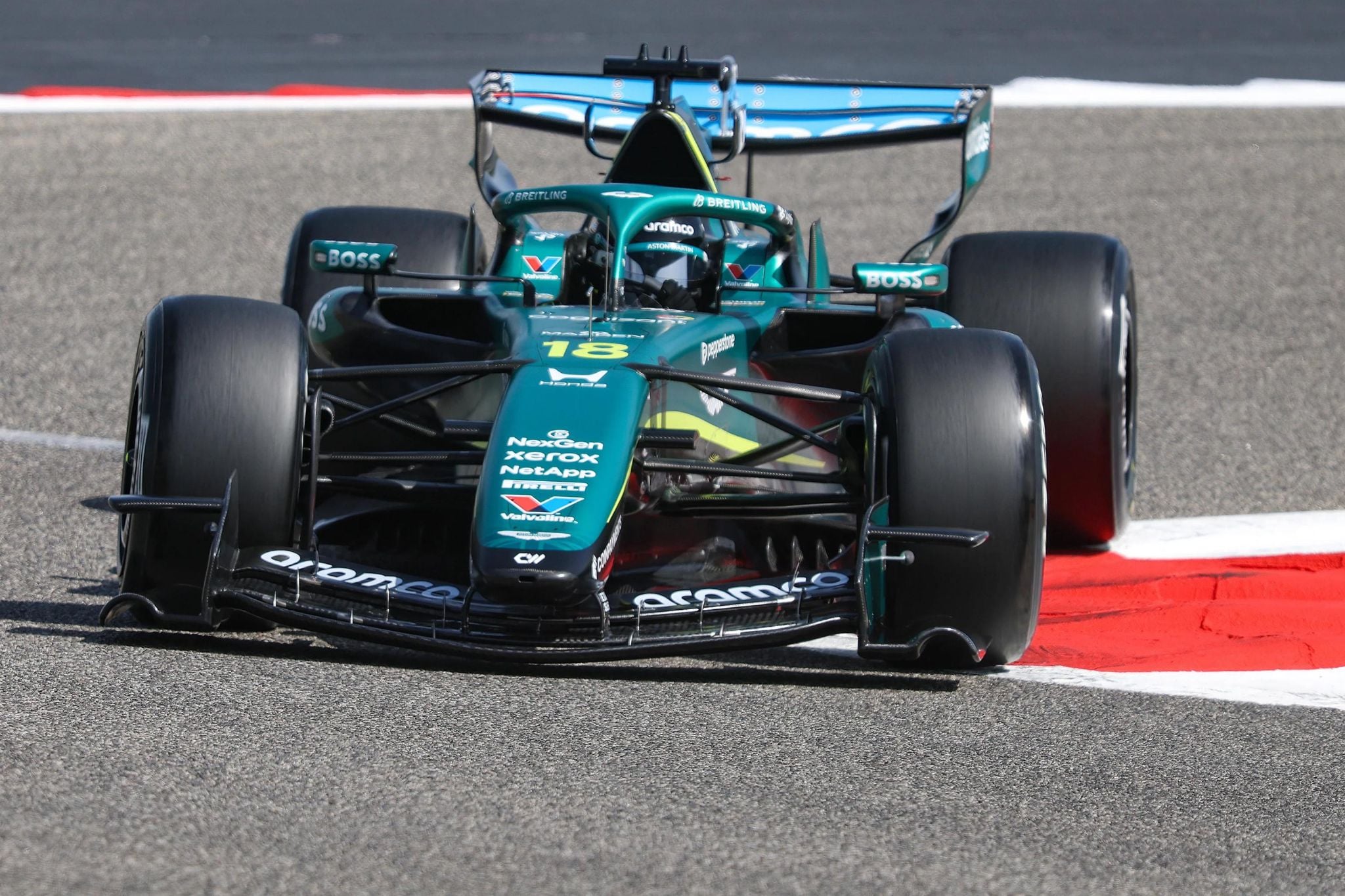
Honda is one of F1’s most traditional engine suppliers and has contributed to the success of several champions. But the manufacturer started the 2026 season very badly: its turbocharged V6 is making Aston Martin’s life difficult at the start of the season.
Honda’s new turbocharged V6 engine for Formula 1 suffers from excessive vibrations, which causes problems with the battery and has put drivers at risk of permanent nerve damage. Aston Martin used up all its spare parts during practice for the Australian Grand Prix.
SEE ALSO:
Driver Fernando Alonso completed only 21 of the 58 laps of the race until he stopped due to a mechanical failure. His teammate Lance Stroll stopped due to problems, but managed to finish the race completing 43 laps.
This misfortune for Honda may be temporary, as the brand is working to address the issues. Aston Martin has already considered looking for another supplier if they do not solve it.
Other traditional car factories have supplied engines to F1 in the past. The five below were unsuccessful, going through difficulties like Honda’s.

Porsche collects trophies at the 24 Hours of Le Mans, touring car competitions and even rallies. But in F1 it only did well with the turbocharged V6 made with TAG, used by McLaren. When he made a solo foray he was not so lucky.
It made a naturally aspirated V12 engine for the 1991 season, designed by the legendary Hans Mezger. It is designed to be used by Arrows Footwork.
The Porsche V12 engine participated in six races in the 1991 season. None of the three cars equipped with it finished the races were not classified.
It was heavier than the other V12s, it was 30 kg heavier than Honda’s, for example. And it didn’t fit in the car, Arrows Footwork had to start the season with a modified Arrows from the previous season until the new model was redesigned to fit the engine.
Instead of having the flywheel at one end, it was in the center. That is, there were two V6s united. This resulted in problems with the oil pressure.
With so many problems, Arrows Footwork abandoned the V12 Porsche in the middle of the season. From the seventh race onwards, the car started to use the V8 Cosworth-Ford DFR. The team managed to finish only four races of the season. The following year it started using Honda engines, with better results.
Porsche tried to make a V10 engine to succeed that V12, but gave up the category. His design was repurposed for a Le Mans prototype, which was also abandoned. The F1 V10 was not ruled out and was adapted for the Carrera GT.
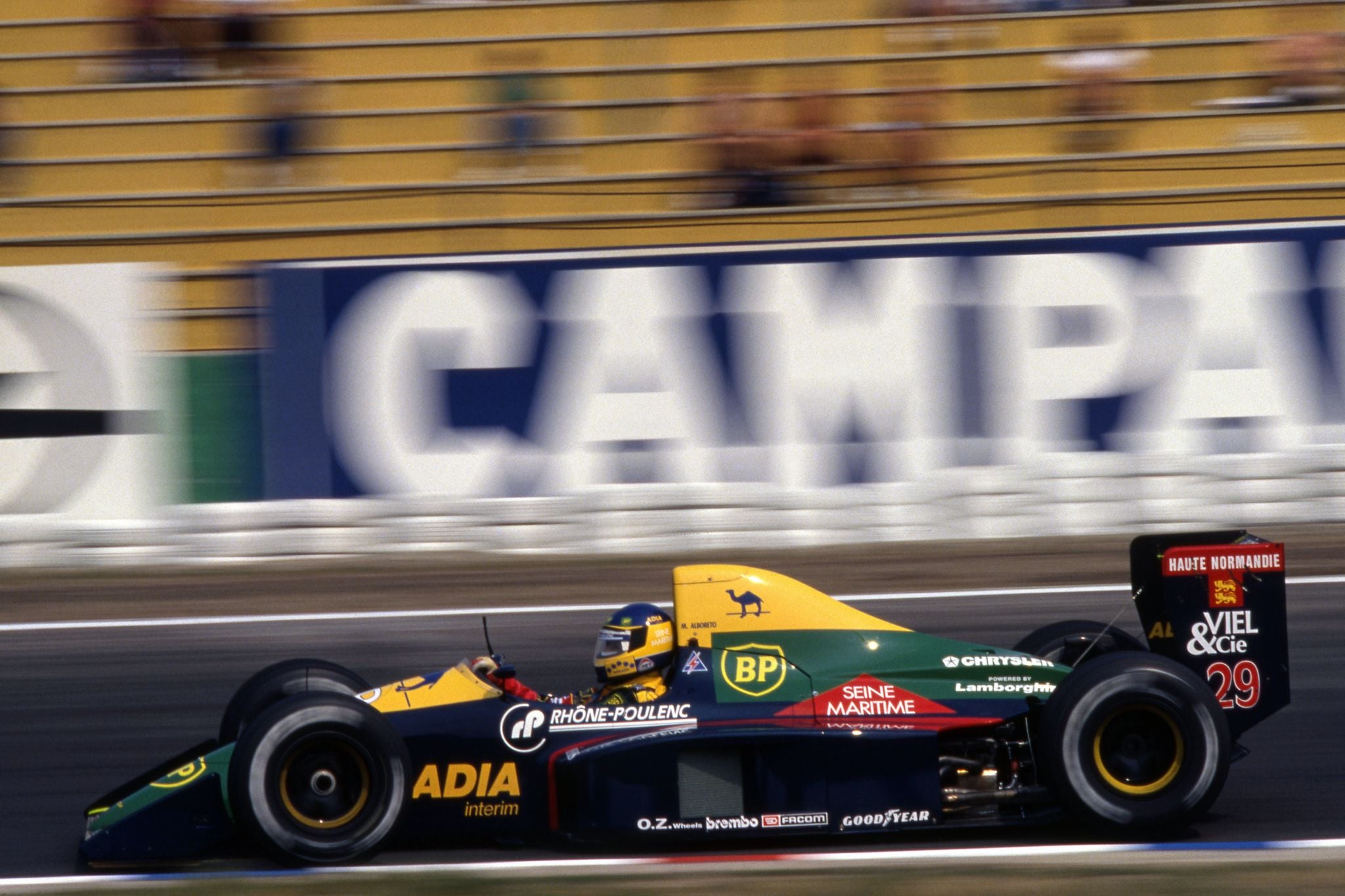
The Italian Ferruccio Lamborghini started making cars thinking about sports cars for the streets, true grand tourers. She entered competitions with sporadic participations.
In Formula 1, Lamborghini entered as an engine supplier in 1989, with a naturally aspirated V12. It began to be used by Larrousse and was later adopted by Lotus, Ligier and Minardi. There was also only in 1991 the official team of the brand, officially called Modena.
The Lamborghini F1 engine was one of the least reliable of that era. But when everything worked the riders got good positions, the best was with Aguri Suzuki coming in 3rd at the 1990 Japanese GP.
McLaren tested the Lamborghini engine in 1993. Ayrton Senna criticized the lack of power at medium revs, while Mika Häkkinen broke the V12 in testing. The project did not go ahead.
Peugeot was a manufacturer that was successful in long-distance racing. In 1988 a car with her engine broke the speed record of the La Sarthe circuit, during the 24 of Le Mans, she was champion in 1992 and was in third position in 1993.
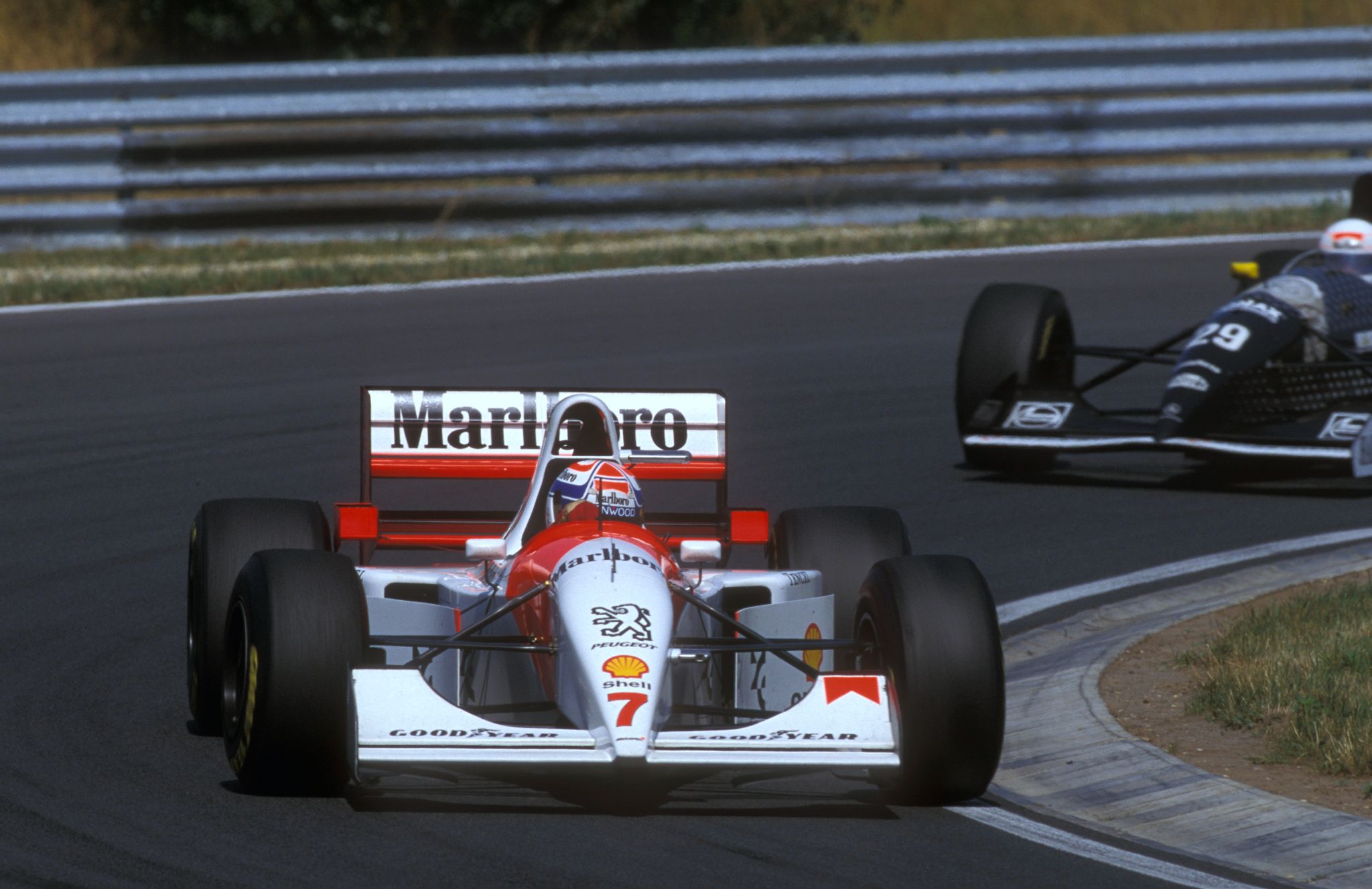
For 1994 Peugeot decided to change its focus on motorsport and entered Formula 1. Its 3.5-liter V10 engine from long-distance racing was adapted to the single-seater regulations.
The first team to use the Peugeot engine was McLaren, which preferred the French supplier to Lamborghini. Team boss Ron Dennis believed that the rivalry between the brand and Renault would result in a competitive engine.
The result was the opposite of previous years, where Ayrton Senna was always putting the team’s car at the top of the podium. Driver Mika Häkkinen only managed to finish eight of the 16 races of the season, while Martin Brundle only finished seven of them.
The V10 Peugeot was compared to a grenade, as it failed in spectacular ways. At the British GP, the engine of Martin Brundle’s car caught fire seconds after the start.
The following year, McLaren started using Mercedes-Benz engines, a partnership that lasted a long time. The V10 Peugeot continued in use until 2000, with Jordan using it until 1997 and Prost for the last three years. After this failure, the French brand focused on the world rally championship, where it won many victories with the 206.
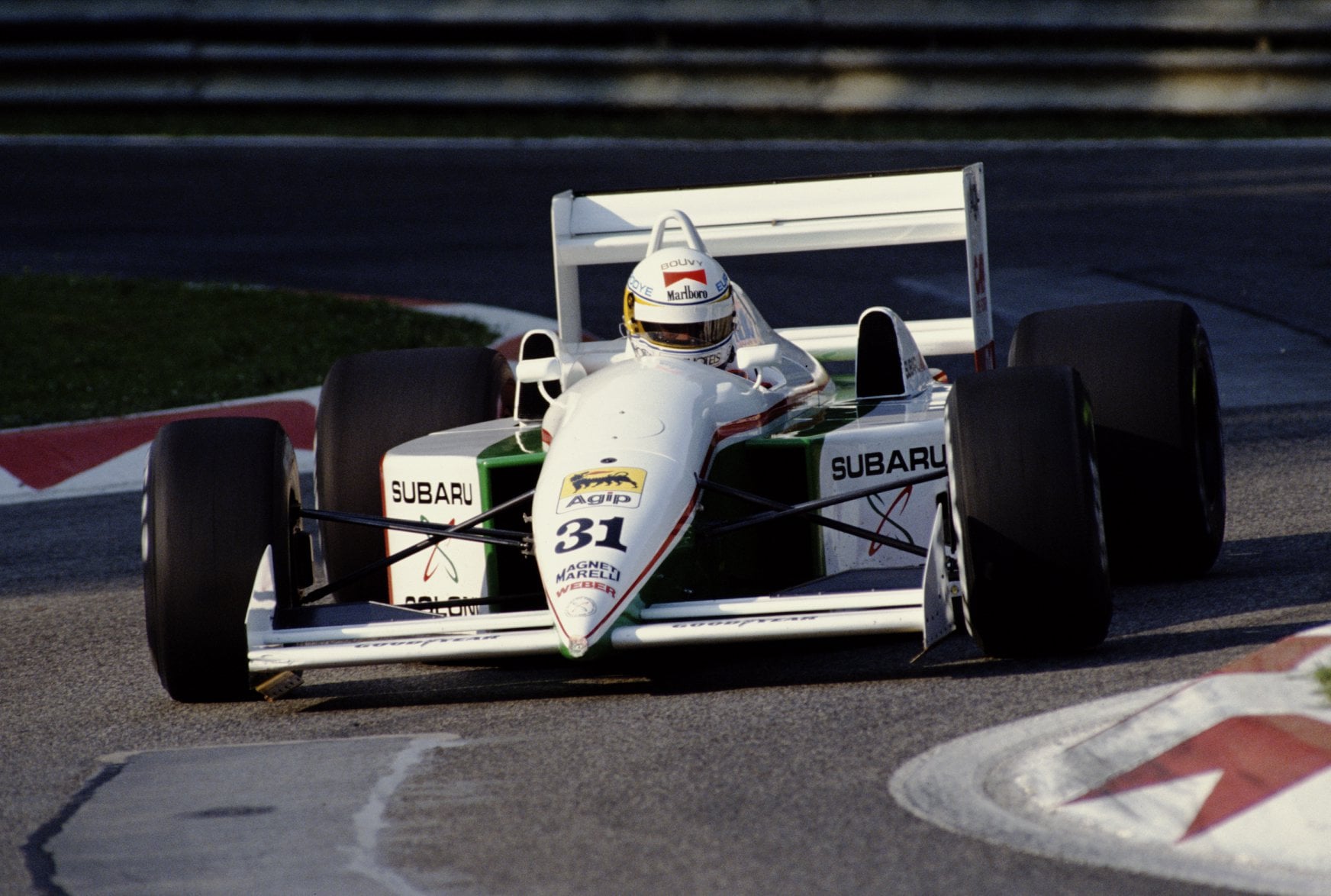
Few remember this, but Subaru has already made an F1 engine. As usual, the Japanese manufacturer made a horizontal block. But here it was a V12 with a 180° angle.
The difference in this configuration is that each piston is on a pin, while in the boxer each pin has two pistons. In both there is the advantage of the center of gravity being lower.
The Subaru Formula 1 engine was interesting on paper, but in practice it didn’t work. The power of 567 hp was one of the smallest on the grid and the 12-cylinder weighed more than the V8 Cosworth of similar power.
Subaru bought 51% of the Italian Colani team instead of becoming an engine supplier. The car was a derivation of the model used the previous year and only finished being assembled on the weekend of the first race, held in Phoenix in the USA.
It was assembled in the Paddock and spun for the first time in a test held in the parking lot of a supermarket. There was only one driver in the team, Belgian Bertrand Gachot.
Colani raced for only eight races in the 1990 season. The driver was unable to qualify the car for any of them. In addition to poor performance, the engine was unreliable. Subaru gave up the venture, in the middle of the championship the team started using a V8 Cosworth engine. And he continued without qualifying to start the races.

Toyota’s history with motorsport has been marked by victories at Le Mans, in rallying and in touring car championships. The arrival in F1 was late when compared to rival Honda, debuting in 2002 with its own team.
Unlike the other brands we list here, Toyota managed to make a reliable engine and even had good results. In the 2005 season it managed a fourth position in the constructors’ championship, with its drivers securing three podiums.
Toyota’s problem in Formula One was the industrial espionage process suffered in 2004. Ferrari charged that the Japanese team’s TF104 was identical to its F2003-GA.
Toyota did not want to disclose the car’s data, as Ferrari’s information was mixed with its own data. The team had Italian engineers, who came from Ferrari. They were arrested for industrial espionage.



